
AI Hallucination Legal Risk: What Lawyers Must Know
TL;DR:
- AI hallucination legal risk arises when lawyers rely on fabricated or inaccurate AI-generated content without proper verification, leading to sanctions, ethics violations, and reputational damage. Regulatory bodies in the EU, New York, and Italy are enforcing disclosure and warning requirements, emphasizing the need for point-of-use alerts and verification protocols. Effective risk management involves thorough citation verification, disclosure practices, internal governance, and prompt correction of errors to ensure compliance and professional integrity.
AI hallucination legal risk is the professional and regulatory liability that arises when lawyers rely on AI-generated content containing fabricated or inaccurate information without adequate verification. This is not a theoretical concern. In Mata v. Avianca, attorneys were sanctioned $5,000 after submitting a brief with six fabricated case citations produced by ChatGPT. Regulators are now moving fast: the EU AI Act Article 50 takes effect August 2026, New York passed a GenAI warning bill in March 2026, and Italy’s AGCM has already pursued enforcement actions against AI providers over hallucination disclosures. For legal professionals, understanding this risk is no longer optional.
What is AI hallucination legal risk in practice?
An AI hallucination is a confident, fluent output from a generative AI model that is factually false or entirely fabricated. In the legal context, this means case citations that do not exist, holdings that misrepresent actual decisions, procedural rules that are invented, and statutory language that was never enacted. The term “hallucination” comes from AI research, but the legal profession increasingly uses the phrase “AI-generated misinformation” to describe the same phenomenon in court filings and compliance documents.

Hallucinations appear plausible because large language models like GPT-4 are trained to produce grammatically coherent, contextually appropriate text. They do not retrieve facts from a verified database. They predict the next most likely token. A fabricated citation such as Johnson v. United States, 847 F.3d 112 (2d Cir. 2017) looks exactly like a real citation. That is precisely what makes it dangerous.
Common hallucination types in legal documents include:
- Fabricated case names and citations that follow correct formatting conventions but reference nonexistent decisions
- Distorted holdings where a real case exists but the AI misrepresents what the court actually held
- Invented procedural rules such as false filing deadlines or jurisdiction-specific requirements
- Misquoted statutes where the AI paraphrases or invents statutory language rather than reproducing it accurately
- False regulatory citations referencing agency guidance documents that do not exist
Pro Tip: Never use an AI-generated citation in a filing without first verifying it in Westlaw, LexisNexis, or a comparable authoritative database. Check both that the case exists and that it actually supports the proposition you are citing it for.
What are the legal risks and professional responsibilities?
The core legal risk from AI hallucinations in practice is sanctions under Federal Rule of Civil Procedure 11. FRCP 11(b) requires every attorney who signs a pleading or motion to certify, after reasonable inquiry, that the legal contentions are warranted by existing law. The rule does not care whether a human or an AI generated the false content. The certification obligation rests with the signing attorney.
Mata v. Avianca is the landmark case every legal professional must study. The attorneys argued they were unaware ChatGPT could fabricate citations. The court rejected that defense entirely. The duty of reasonable inquiry requires lawyers to verify what they submit, regardless of the source. Delegating research to an AI tool does not transfer or reduce that duty.
The professional responsibility exposure extends beyond sanctions. Bar associations in multiple states have issued guidance warning that submitting unverified AI-generated content may constitute a violation of competence rules under Model Rule 1.1 and candor obligations under Model Rule 3.3. Reputational damage compounds the formal penalties.
| Risk Category | Description | Potential Consequence |
|---|---|---|
| FRCP 11 Sanctions | Filing briefs with fabricated AI-generated citations | Monetary sanctions, adverse rulings |
| Ethics Violations | Breach of competence or candor duties | Bar discipline, suspension |
| Malpractice Liability | Client harm from reliance on false legal authority | Civil damages claims |
| Reputational Damage | Public court orders identifying AI misuse | Loss of client trust and referrals |
Pro Tip: When you discover a hallucinated citation after filing, disclose it to the court immediately. Prompt correction reduces sanction risk and preserves your professional integrity. Delays make outcomes significantly worse.
How are regulators responding to AI hallucination risks?
Regulatory responses to AI hallucination risks in legal contexts are accelerating across three major jurisdictions. Each takes a different approach, but all converge on one principle: users must be warned, at the point of interaction, that AI outputs can be inaccurate.
-
EU AI Act Article 50. Transparency obligations for generative AI systems take effect August 2, 2026. Article 50 requires providers to disclose AI interactions and mark AI-generated content in machine-readable formats. The focus is on preventing deception, not just providing vague disclaimers buried in terms of service. Legal AI tool providers operating in the EU must build these disclosures into their user interfaces.
-
New York GenAI Warning Bill (March 2026). New York passed legislation requiring conspicuous notice that AI outputs may be inaccurate, with fines of $1,000 per violation. The bill targets generative AI user interfaces directly. Law firms and legal technology vendors serving New York clients face compliance obligations that go beyond internal policy.
-
Italian AGCM Enforcement. Italy’s competition authority closed AI hallucination probes after AI providers committed to improving user warnings. Without those commitments, potential fines could have exceeded $11 million. The AGCM treated inadequate hallucination disclosures as an enforceable consumer protection violation, not merely a technical limitation.
-
Point-of-use warning trend. Across all three jurisdictions, regulators are moving away from accepting general disclaimers. The emerging standard requires warnings at the moment a user receives AI output, not in a footnote on a terms page. For legal professionals, this means the tools you use must meet these standards, and your own disclosures to clients and courts must reflect the same principle.
What strategies help legal professionals manage AI hallucination risk?
Effective AI risk management in legal practice depends more on governance and verification protocols than on the accuracy of any particular AI model. No model is hallucination-free. Your firm’s workflows determine whether a hallucination reaches a court filing or gets caught before it causes harm.
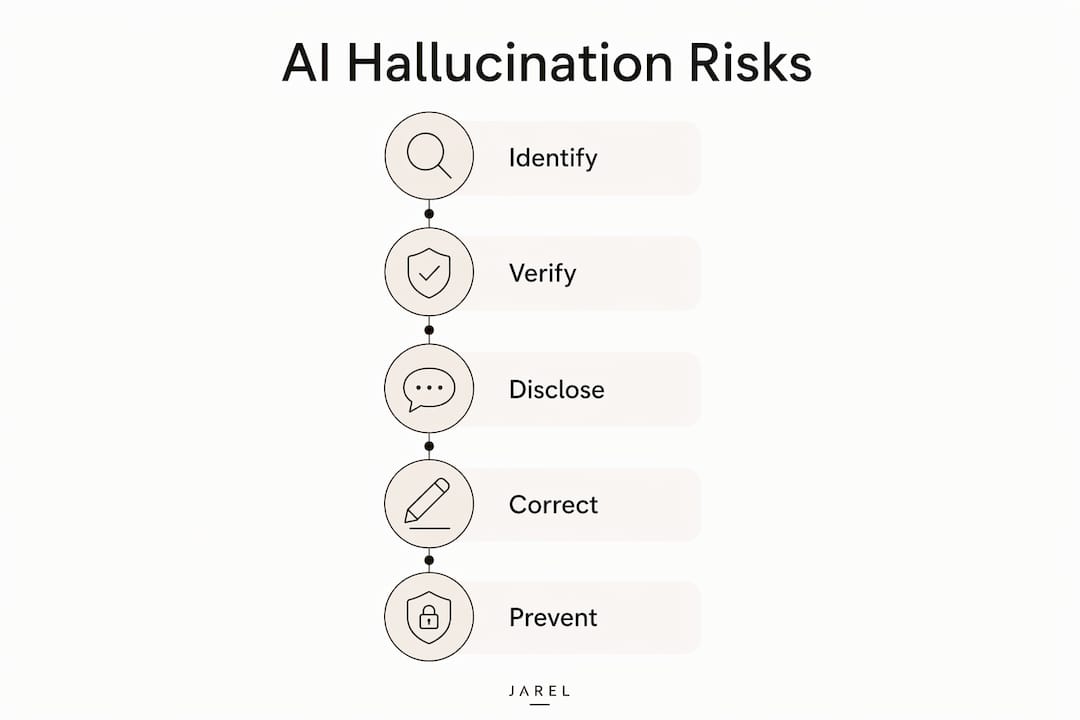
The following practices form a defensible risk management framework:
- Multi-tiered citation verification. Check every AI-generated legal citation in Westlaw or LexisNexis. Confirm the case exists, then read the actual holding to confirm it supports your proposition. Verifying both existence and relevance is the lesson Mata v. Avianca made unavoidable.
- Client and court disclosure. Disclose AI use in legal work product when required by court rules or when the client has a reasonable interest in knowing. Several federal courts now require AI disclosure in filings. Check local rules before submitting any AI-assisted brief.
- Internal governance policies. Establish written policies governing which AI tools are approved for use, what verification steps are mandatory, and who bears sign-off responsibility. Governance failures in policies and incident response increase legal risk more than the AI model itself.
- Training and audit trails. Train all attorneys and paralegals on hallucination risks and verification requirements. Maintain audit logs showing that AI outputs were reviewed and verified before use. These records are your defense if a hallucination claim arises.
- Correction protocols. Define in advance what happens when a hallucination is discovered post-filing. Immediate disclosure and correction reduce legal exposure. The protocol should assign responsibility, set a response timeline, and include court notification procedures.
You can find detailed guidance on building these workflows in Jarel’s guide to responsible AI legal use and its 2026 resource on professional responsibility in AI research.
Pro Tip: Treat AI-generated legal research the way you treat a first-year associate’s memo. Read it critically, verify every citation independently, and never submit it without your own substantive review.
Key takeaways
Managing AI hallucination legal risk requires verification discipline, governance infrastructure, and proactive disclosure at every stage of the legal workflow.
| Point | Details |
|---|---|
| FRCP 11 liability is absolute | Signing attorneys bear full verification responsibility regardless of whether AI generated the content. |
| Mata v. Avianca set the standard | Courts reject ignorance of AI limitations as a defense; verify both case existence and holding accuracy. |
| Regulations are tightening fast | EU AI Act Article 50, New York’s GenAI bill, and Italian AGCM enforcement all demand point-of-use warnings by 2026. |
| Governance beats model accuracy | Written policies, audit trails, and training reduce hallucination risk more than relying on any AI tool’s claimed accuracy. |
| Immediate correction limits damage | Disclosing and correcting a hallucinated citation promptly reduces sanction severity and preserves professional standing. |
The uncomfortable truth about AI hallucination risk in legal practice
I have spent years watching legal professionals treat AI hallucination risk as a technology problem. It is not. It is a professional responsibility problem that technology makes worse.
The attorneys in Mata v. Avianca were not reckless people. They were busy practitioners who trusted a tool that presented false information with complete confidence. That is the real danger. AI systems do not signal uncertainty the way a junior associate does when they are unsure. They produce polished, authoritative-sounding output whether they are right or catastrophically wrong.
What concerns me most in 2026 is the gap between how fast firms are adopting AI tools and how slowly they are building the governance structures to match. I see firms with AI in their workflows and no written policy, no mandatory verification step, and no incident response plan. That is not a technology gap. That is a management failure waiting to become a sanctions order.
The regulatory direction is clear. The EU AI Act, New York’s legislation, and Italy’s enforcement actions all point toward a world where inadequate AI disclosure is treated as a legal violation, not just a best practice gap. Firms that build transparent AI workflows now will be ahead of mandatory compliance deadlines. Firms that wait will be scrambling.
My honest recommendation: treat every AI output as unverified until you have personally confirmed it. Build that habit before a regulator or a court forces you to.
— Albin
How Jarel reduces AI hallucination risk in legal workflows
Jarel is built specifically for the verification and transparency demands that AI hallucination risk creates in legal practice. Every AI output in Jarel is linked directly to its source material, whether that is a contract clause, a statute, or a case citation. You see exactly where each claim originates before it reaches a filing or a client deliverable.

Jarel’s Outlook Add-In brings source-linked legal research and drafting directly into your inbox, so citation verification happens inside your existing workflow rather than as a separate step. For contract review, Jarel’s AI contract review tools give in-house teams audit trails and review logs that document every AI-assisted decision. When a regulator or court asks how you verified your AI output, Jarel gives you the answer.
FAQ
What is an AI hallucination in legal practice?
An AI hallucination in legal practice is a fabricated or inaccurate output from a generative AI model, such as a nonexistent case citation or a misrepresented legal holding, that appears credible but has no basis in actual law.
Can lawyers be sanctioned for using ai-generated content?
Yes. Under FRCP 11, attorneys who submit filings containing fabricated legal authority face sanctions regardless of whether AI generated the content. Mata v. Avianca confirmed that AI origin is not a defense.
What regulations govern AI hallucination disclosures in 2026?
The EU AI Act Article 50 takes effect August 2, 2026, requiring machine-readable disclosure of AI-generated content. New York’s GenAI warning bill mandates conspicuous inaccuracy notices with $1,000 per-violation fines. Italy’s AGCM has already enforced hallucination disclosure commitments against AI providers.
How should a lawyer respond when a hallucinated citation is discovered after filing?
Disclose the error to the court immediately and file a corrected submission. Prompt candor reduces sanction risk and demonstrates professional responsibility. Delays in correction consistently worsen outcomes in disciplinary and sanctions proceedings.
Does using a legal-specific AI tool eliminate hallucination risk?
No AI tool eliminates hallucination risk entirely. Legal-specific platforms reduce risk by linking outputs to verified source materials and maintaining audit trails, but attorney verification of every citation and legal claim remains a professional obligation under current rules.