
AI Legal Workflow Transparency: What Lawyers Need to Know
TL;DR:
- AI transparency in legal workflows requires organizations to understand and document how AI tools generate outputs and how human oversight is integrated. Building detailed audit trails, mapping AI tool usage, and ensuring supervision compliance are essential to meet ethical, legal, and regulatory standards. Effective operational transparency fosters trust with clients, courts, and regulators by making every AI action traceable and accountable.
Disclosing that you used AI is not the same as being transparent about it. That distinction is at the heart of what is AI legal workflow transparency, and it matters more than most firms currently acknowledge. Transparency in legal AI processes goes far beyond a footnote in a filing or a checkbox in a client engagement letter. It involves knowing which model generated what output, why, based on which source, and who reviewed it before it reached a judge or a client. This article breaks down what that actually means in practice, technically, ethically, and operationally.
Table of Contents
- Key takeaways
- What AI legal workflow transparency actually means
- The technical foundations: audit trails and traceability
- Ethical and professional obligations in AI-augmented work
- Court and regulatory disclosure requirements
- Operationalizing transparency through workflow visibility
- My perspective on where legal teams get this wrong
- How Jarel supports transparent, accountable AI workflows
- FAQ
Key takeaways
| Point | Details |
|---|---|
| Disclosure is not enough | True AI transparency requires internal comprehension, not just external acknowledgment of AI use. |
| Audit trails are non-negotiable | Logs must capture inputs, model versions, intermediate steps, and human review to support accountability. |
| Attorney responsibility remains fixed | Under ABA Model Rules, attorneys must supervise AI outputs the same way they supervise nonlawyer work. |
| Court rules vary by jurisdiction | Disclosure requirements range from simple certification to outright prohibition, and sanctions apply for errors. |
| Workflow visibility drives trust | End-to-end reporting on AI actions and human review gates is what makes AI use defensible in practice. |
What AI legal workflow transparency actually means
The phrase “AI transparency” has been used so broadly that it risks losing meaning. Legal AI transparency is shifting from a disclosure exercise to a comprehension requirement. That means organizations need to understand what their AI tools are doing internally before they can explain it externally with any credibility.
Think about what that requires. A firm that uses an AI tool to review contracts should be able to answer: Which model reviewed this clause? What data did it draw from? Was the output reviewed by an attorney, and is that documented? If the answer to any of those questions is “we’re not sure,” the firm has a transparency gap, regardless of any disclaimer in its engagement letter.
Practical transparency means building an AI inventory at the organizational level. That includes mapping which tools are used in which workflows, what data flows into them, and what governance controls are applied.
- Know which AI tools are active across your practice groups
- Document the data sources each tool accesses, including whether client-privileged material is involved
- Require clear, plain-language explanations of what the tool does, not marketing copy from the vendor
- Align internal understanding with what you would actually be comfortable telling a client or a court
Pro Tip: Start with a single workflow, such as contract review, and document every AI touchpoint before trying to build organization-wide governance. Specificity at small scale is far more useful than vague policy at large scale.
The gap between disclosure and comprehension is where most firms get into trouble. Vague statements like “AI-assisted drafting was used” tell no one anything useful. Meaningful transparency explains what the AI did, what it did not do, and where human judgment took over.
The technical foundations: audit trails and traceability
Understanding legal transparency with AI requires getting specific about what “auditability” means technically. A functional audit trail in an AI legal workflow is not just a log file. It is a structured record that captures the full lifecycle of an AI decision.
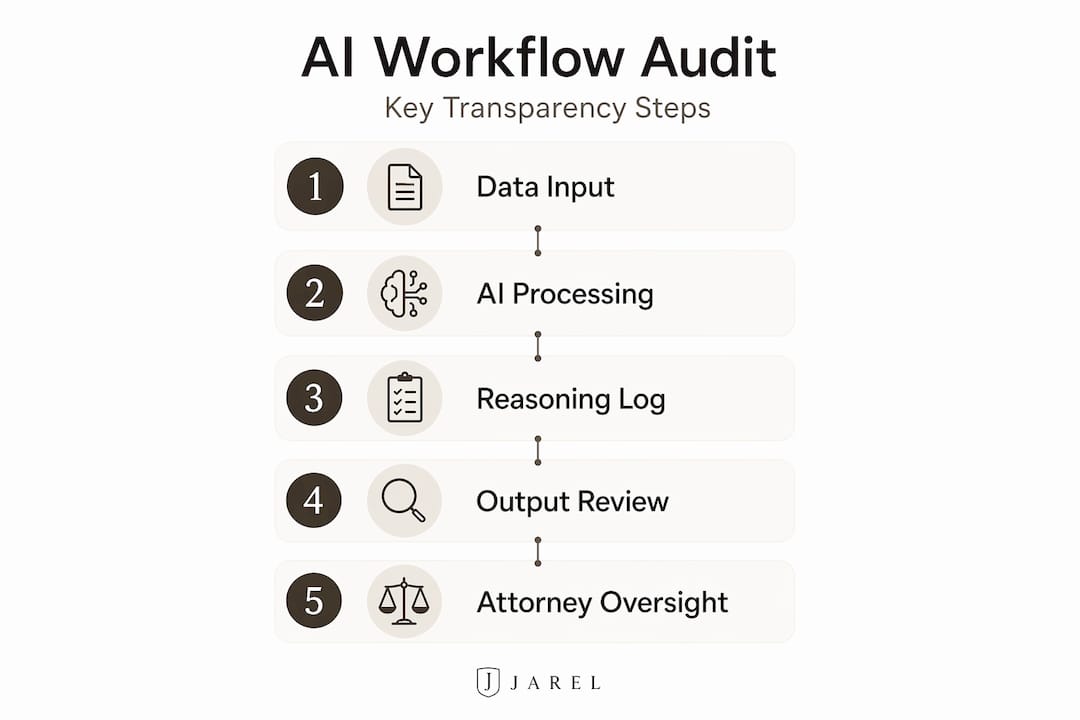
| Audit trail element | Why it matters |
|---|---|
| Input data and query | Establishes what the AI was asked to analyze |
| Model version and configuration | Allows the output to be reproduced or explained later |
| Intermediate reasoning steps | Enables reconstruction of how the AI reached its output |
| Human review record | Documents attorney oversight and sign-off |
| Output with source citations | Links the AI’s conclusion to the underlying material |
Most organizations fail to capture intermediate reasoning steps, logging only the final output. That creates a serious accountability gap. If an AI-generated brief contains an error and you can only show what the final output was, not how the model arrived at it, you cannot reconstruct what went wrong or demonstrate that reasonable oversight was in place.

The distinction between interpretability and observability matters here. Interpretability means understanding why a model made a specific decision at the model level, which is technically complex and often impossible for large language models. Observability means being able to see what went in, what came out, and what happened in between. Observability is what regulators actually require, and it is achievable today.
For multi-agent AI systems, the logging challenge compounds. When one AI agent hands off to another, each transition must be recorded. EU AI Act Articles 12 through 17 set specific requirements for immutable audit logs, pipeline configuration records, and evidence retention that apply to high-risk AI systems. Even if your firm is not directly subject to the EU AI Act, its structure is increasingly the baseline expectation for defensible AI governance globally.
Pro Tip: Treat your audit logs as potential exhibits. If you would not be comfortable showing a log to a judge or opposing counsel, it is not detailed enough.
Ethical and professional obligations in AI-augmented work
AI in legal processes does not change who is responsible. Under the ABA Model Rules, AI tools are treated as nonlawyers for supervision purposes. That means Rules 5.1 and 5.3 require that attorneys take reasonable steps to supervise AI outputs, just as they would supervise work from a paralegal or contract attorney.
The practical implications for accountable AI workflow in legal teams are significant:
- Verification duty. An attorney cannot simply accept AI-generated research, contract analysis, or drafted language without independent review. Reliance without verification is a malpractice risk.
- Supervision documentation. The fact of attorney review should be documented in a supervision record, not just mentally acknowledged. This is what creates a defensible paper trail.
- Written AI use policies. Firms need written policies governing which tools are approved, how they may be used, and what review steps are mandatory. Ad hoc usage without a policy framework is increasingly seen as a governance failure.
- Client consent and disclosure. Informed client consent is required before using AI on sensitive or confidential client information. The consent process itself should be documented.
The malpractice exposure here is real. If an AI tool generates a flawed legal analysis and an attorney files it without adequate review, the attorney bears professional responsibility. The existence of an AI tool in the chain does not distribute or reduce that liability. This is not a theoretical concern. Courts are already issuing sanctions for AI-generated citations that do not exist, and bar authorities are beginning to issue formal guidance. The ethical AI use framework for legal teams starts with accepting that supervision is non-negotiable, not optional.
Court and regulatory disclosure requirements
How AI improves legal workflows means nothing if the disclosure practices around AI use create procedural or ethical violations. Court requirements are not uniform across jurisdictions, and that inconsistency is itself a risk management challenge.
Current court orders on AI use tend to fall into a few categories. Some courts require disclosure that AI was used in drafting a document. Others require certification that an attorney reviewed and verified AI-generated content. A smaller number prohibit AI-generated filings outright without leave of court. And some courts require disclosure of the specific AI tool used, which raises its own confidentiality considerations.
The risk of getting this wrong is not theoretical. Attorneys have received sanctions for failing to disclose AI use or for submitting AI-generated content with fabricated citations. Jurisdiction-specific tailoring of disclosure language is not a nicety. It is a compliance requirement.
Pro Tip: Build a jurisdiction-specific disclosure checklist into your workflow at the filing stage, not as an afterthought. Assign one person on each matter to own the AI disclosure review before anything is filed.
Safe disclosure language typically identifies that AI tools were used, identifies the attorney who reviewed the output, and certifies that the attorney takes responsibility for the content. Vague language that obscures rather than explains the role of AI in a filing is increasingly viewed by courts as an evasion rather than a disclosure. When in doubt, more specificity is safer.
Operationalizing transparency through workflow visibility
Knowing what AI legal workflow transparency is in theory does not help unless you can build it into day-to-day legal workflows. End-to-end workflow visibility means that every AI action taken in a matter is recorded, every human review point is documented, and reporting on that data is available to supervisors and compliance functions.
Here is what operationalizing this looks like in practice:
- Intake automation with AI logging. When a matter enters the system, the AI tools engaged at intake, such as document classification or conflict checking, are logged automatically, not manually entered later.
- Human review gates. Before any AI-generated output advances to the next stage, a designated attorney review step must be completed. This gate is documented in the matter record, including who reviewed, when, and what changes were made.
- Cycle time reporting. Supervisors and legal operations teams can track how long AI review steps take versus human review steps, and where bottlenecks occur. This is not just efficiency data. It is governance data.
- Escalation paths. When an AI tool flags uncertainty or a low-confidence output, the workflow routes it to a senior attorney review rather than proceeding automatically. The escalation event is logged.
- Integration with practice management systems. Transparency data should live in the matter management system, not in a separate AI governance silo. Integration makes compliance reporting practical rather than burdensome.
The benefits of AI in law are most defensible when the AI use is visible, documented, and tied to human accountability at each step. Clients trust firms that can show their work. Regulators trust organizations that can produce records. Internally, a well-documented AI workflow is also an error-detection mechanism. When something goes wrong, you can trace it, fix it, and prevent recurrence.
My perspective on where legal teams get this wrong
I’ve seen a consistent pattern across firms and legal departments adopting AI: they invest heavily in the tool itself and almost nothing in the governance layer around it. The logging capability is there. The review gate functionality exists. But no one sets it up properly because the pressure to show productivity gains comes before the pressure to demonstrate accountability.
The technical logging and the user-facing explanation are not the same thing, and conflating them is where teams get burned. A detailed log that only your IT department can interpret does not constitute transparency for a court, a client, or a bar examiner. In my experience, the organizations that handle this best treat their AI governance documentation the same way they treat their work product. It gets drafted, reviewed, and revised, not just auto-generated and filed away.
The other underestimated risk is the gap between what attorneys think they’re supervising and what they’re actually reviewing. AI outputs can look authoritative and polished, which makes cursory review dangerously easy. Supervision means engaging with the output critically, not just signing off on it. That requires time and deliberate process design, and it cannot be optimized away.
My honest take: the firms that will be ahead of this in three years are the ones treating AI transparency as a practice management discipline today, not a compliance checkbox.
— Albin
How Jarel supports transparent, accountable AI workflows

If the operational demands described in this article feel like a significant lift, the right platform reduces that friction considerably. Jarel is built specifically for legal teams that need their AI workflows to be transparent, traceable, and tied to source materials at every step. Every AI-generated output in Jarel is linked to its source document, statute, or case law, so the basis for any analysis is never ambiguous.
Jarel’s architecture includes audit logs, access controls, and review trails that document attorney oversight as a native part of the workflow, not a retroactive add-on. For teams working within email, the Jarel Outlook Add-In brings source-linked AI directly into your inbox, with the same traceability standards applied to research, drafting, and review tasks. Jarel supports legal professionals from law students building good AI habits early through to established teams managing complex, high-stakes matters. See Jarel’s full product suite to find the right fit for your practice.
FAQ
What is AI legal workflow transparency?
AI legal workflow transparency means having clear, documented visibility into how AI tools are used at every stage of a legal matter, including what inputs were provided, which model was used, what outputs were generated, and who reviewed them. It goes beyond simple disclosure to require internal comprehension and accountable documentation.
Do attorneys have to disclose AI use to courts?
Court requirements vary by jurisdiction, with some courts requiring disclosure or certification of AI use and others prohibiting AI-generated filings. Attorneys should check standing orders in each jurisdiction and build disclosure review into their pre-filing workflow.
What happens if AI audit trails only capture final outputs?
Logging only final outputs without capturing intermediate steps creates accountability gaps that make it impossible to reconstruct how an AI reached a given conclusion, undermining both defensibility and error correction.
Are attorneys responsible for AI-generated errors in legal filings?
Yes. Under ABA Model Rules, attorneys retain full responsibility for any AI-generated content they submit, and must supervise and verify AI outputs with the same diligence applied to work from nonlawyer staff.
How does the EU AI Act affect legal AI transparency?
The EU AI Act requires immutable audit logs and pipeline documentation for high-risk AI systems, including records of model versions, human oversight, and evidence retention. Its structure is increasingly the global baseline expectation for defensible AI governance in legal contexts.