
Cross-Referencing Contract Definitions: A Drafter's Guide
TL;DR:
- Centralize all defined terms in a single article and reference them by name to prevent broken links.
- Consistent capitalization, descriptive definitions without obligations, and term-based references enhance contract clarity and stability.
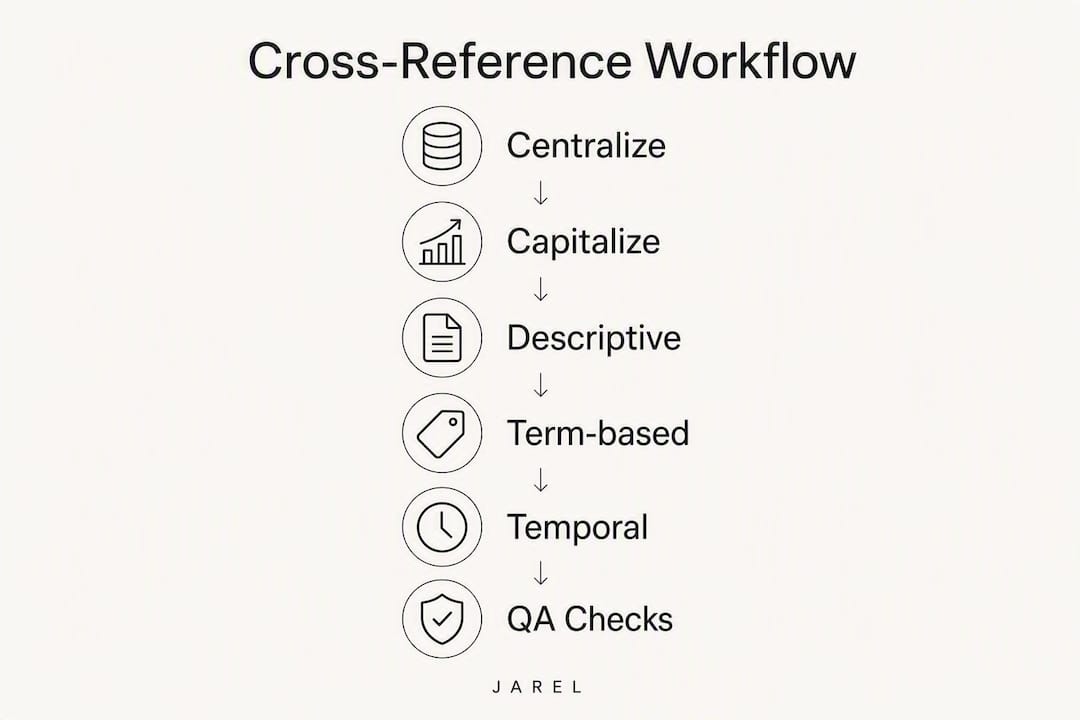
The safest approach to cross-referencing definitions is this: collect every defined term in one central definitions article, capitalize each term consistently throughout the document, and point to the term by name rather than by clause number. That single discipline prevents most of the broken references, ambiguous antecedents, and maintenance headaches that plague contract revisions.
Here are the core rules you can apply today:
- One definitions article. Centralize all defined terms in Article 1 (or an equivalent definitions section). Avoid scattering in-line definitions across operative clauses unless the term is used only once in a narrow context.
- Capitalize consistently. Every defined term gets an initial capital (or full caps for acronyms) on every appearance. No exceptions.
- No obligations in definitions. A definition describes; it does not command. Drop "shall" and any duty language from definitions entirely.
- Avoid circular definitions. If "Affiliate" is defined using "Control" and "Control" is defined using "Affiliate," you have a loop. Break it by defining the foundational concept first.
- Prefer term-based references over clause numbers. Write "the Effective Date" not "the date defined in Section 2.1(a)." Clause numbers change; defined terms do not.
- Use "(as defined in [Document Name])" for external sources. When a term originates in another agreement, write the capitalized term followed immediately by that parenthetical. Do not cite an article number in the external document.
- Add temporal language where meaning shifts. For terms like "Affiliate" or "Control," include "as of the time of determination" to prevent disputes about whether the definition applies at signing or at a later triggering event.
TL;DR for reviewers: Run a search for capitalized terms not listed in Article 1 (orphan references). Replace any clause-number cross-references with defined-term references where feasible. Check for "shall" inside definitions and relocate that language to the operative clauses. Tools like Microsoft Word's cross-reference field updater, Contract Companion, and Jarel's source-linked review workspace can automate much of this sweep. LexisNexis practice notes on contract drafting provide additional rule-sets for jurisdiction-specific nuances.
Table of Contents
- What are cross-references and where do they belong in a contract?
- Core drafting principles every definitions article needs
- What do resilient cross-referencing patterns actually look like?
- Common drafting mistakes that break cross-references
- Pre-signature QA checklist
- Which tools and workflows actually hold up in practice?
- Ready-to-adapt clause snippets
- How do you keep cross-references accurate after amendments?
- Key Takeaways
- The discipline gap between knowing the rules and actually running them
- Jarel brings source-linked review to your cross-reference QA
- Useful sources
- FAQ
What are cross-references and where do they belong in a contract?
A cross-reference is a textual pointer that directs the reader from one location in a document to another part of the same document or to a separate document entirely. The purpose is to avoid repeating the same language twice and to connect related obligations without duplication.
Internal vs. external cross-references
Internal cross-references stay within the four corners of the same contract. External cross-references point to a separate agreement, statute, schedule, or exhibit.
Common locations for each type:
- Definitions article — defines terms used throughout; internal refs connect sub-definitions to parent terms
- Recitals — introduce defined terms with an "(as defined in Article 1)" tag on first use
- Operative clauses — reference defined terms and, where necessary, other clauses
- Schedules and exhibits — often incorporate definitions by reference to the main agreement
Three internal cross-reference examples:
- "'Net Revenues' has the meaning set forth in the Revenue Sharing Schedule attached hereto as Exhibit A."
- "The Indemnified Parties (as defined in Section 8.1) shall be notified within five (5) Business Days." (Note: this clause-number form is acceptable in a stable, non-modular document but less resilient than a term-based reference.)
- "'Business Day' means any day other than a Saturday, Sunday, or day on which commercial banks in New York, New York are required or authorized to close."
Three external cross-reference examples:
- "'Intellectual Property Rights' has the meaning ascribed to it in the Master Services Agreement dated January 15, 2024."
- "'Confidential Information' (as defined in the Non-Disclosure Agreement between the parties dated March 3, 2023) shall be subject to the obligations in Section 6."
- "'GAAP' means generally accepted accounting principles in the United States as in effect from time to time."
Pro Tip: Government guidance on consumer-facing contracts specifically warns against cluttering agreements with too many cross-references, noting that readability is part of transparency. Even in commercial drafting, fewer and cleaner references reduce interpretation risk.
Core drafting principles every definitions article needs
Single source of truth
Centralize definitions in one article unless a term is genuinely local to a single clause and will never appear elsewhere. In-line definitions scattered across operative provisions force readers to hunt and create version-control problems during redlines. When a term appears more than twice, it belongs in Article 1.
Capitalization and consistent use
Capitalize every defined term on every appearance, without exception. Multi-word terms follow the same rule: "Effective Date," "Change of Control," "Permitted Transferee." The capital letter is the signal to the reader that a specific, bounded meaning applies. Dropping the capital mid-document, even once, invites an argument that the uncapitalized use carries a different, ordinary meaning.

Keep definitions descriptive, not operative
Definitions must not contain obligations. The moment "shall," "must," or "will" appears inside a definition, you have buried a duty where a court may not look for it. Move that language to the relevant operative clause. A definition answers "what does this term mean?" not "what must a party do?"
Prefer term-based references; use "(as defined in [Document])" externally
Clause numbers are fragile. Every amendment, reordering, or modular reuse can break a clause-number reference without anyone noticing until a dispute surfaces. Referring to "the Effective Date" rather than "the date in Section 2.1(a)" survives restructuring. For external documents, practitioners consistently recommend using the capitalized term followed by "(as defined in [Document Name])" rather than citing an article number in the external agreement, because article numbers in third-party documents are even more likely to change.
Temporal qualification for time-sensitive terms
Include "as of the time of determination" in any definition whose meaning can shift after signing. "Affiliate" is the classic example: if a party's ownership structure changes between signing and a triggering event (a change-of-control clause, a consent requirement), the contract needs to specify which moment governs.
Pro Tip: When drafting for a contract series (master agreement plus statements of work), place the master definitions article in the governing document and incorporate it by reference in each SOW using a single sentence: "Capitalized terms used but not defined herein have the meanings given in the Master Services Agreement."
What do resilient cross-referencing patterns actually look like?
Internal defined-term reference patterns
First mention in recitals (where the term is defined in Article 1): Subsequent mentions in operative clauses require no parenthetical — the capital letter carries the signal.
When a recital introduces a concept before Article 1 appears, tag it:
External-document reference pattern
The stable form names the document, not an article number: Avoid: "'Confidential Information' has the meaning set forth in Section 3.2 of the NDA." Section 3.2 of the NDA may be renumbered in the next amendment.
Operative clause references vs. defined-term references
Use a defined-term reference when the concept has a definition: "Subject to Section 9 (Termination), the License shall continue until the Expiration Date." The defined term "Expiration Date" carries the meaning; the Section 9 reference is a navigational aid to the operative clause, which is an acceptable use of a clause-number cross-reference because it is pointing to a procedure, not a definition.
Sample templates with temporal language
Affiliate (with temporal qualification):
Effective Date: Schedule reference:
Common drafting mistakes that break cross-references
Dead and ambiguous references
Dead references point to a clause or term that no longer exists — usually because an amendment deleted or renumbered it. Ambiguous references point to two or more possible targets. Both arise most often during redlines when a drafter deletes a section without updating the references to it.
Quick fixes:
- After any amendment, run Word's "Update Fields" command and look for "Error! Reference source not found" flags.
- Use Contract Companion's Cross Reference Checker, which labels each issue as "Not found," "Ambiguous," or "Out of date" and lists them in a review pane for targeted repair.
Obligations buried in definitions
The "shall deliver" and "no later than" language creates an obligation inside a definition. A court interpreting a breach claim may focus on the operative delivery clause and miss this buried duty entirely.
The obligation moves to the operative clause where it belongs. For more on common drafting errors of this type, the pattern repeats across indemnity, payment, and notice clauses.
Nested and circular definitions
Nested: "Affiliate" defined using "Subsidiary," "Subsidiary" defined using "Controlled Entity," "Controlled Entity" defined using "Affiliate." Un-nest by defining "Control" as the foundational concept and building the others from it.
Circular: "'Approval' means the written consent of the Approving Party" and "'Approving Party' means the party with authority to grant Approval." Rename one term to break the loop.
Overuse of clause-number references in modular documents
In a contract designed to be reused across transactions (a master agreement, a framework agreement, a template), clause-number references are a liability. Every customization risks renumbering. Prefer defined-term references throughout, and reserve clause-number references for procedural cross-references (notice periods, dispute resolution steps) where the clause is unlikely to move.
Pre-signature QA checklist
Run this before circulating any final draft:
- Search for undefined capitalized terms. Every capitalized word that is not a proper noun must appear in the definitions article. Flag any that do not.
- Search for defined but unused terms. Remove or consolidate unused definitions before circulation. An unused defined term can inadvertently expand scope if a later amendment references it.
- Run Word's "Update Fields" / cross-reference field update. Look for "Error! Reference source not found" in the document.
- Run an automated cross-reference checker. Contract Companion flags "Not found," "Ambiguous," and "Out of date" references in a single pass.
- Verify temporal language. Confirm that time-sensitive terms ("Affiliate," "Net Revenues," "Material Adverse Effect") include "as of the time of determination" or equivalent.
- Check external-document references. Each one should name the document, not an article number, and use the "(as defined in [Document Name])" form.
- Confirm no obligations in definitions. Search for "shall," "must," and "will" inside the definitions article and relocate any you find.
Pro Tip: Assign checklist steps 1–3 to the drafting associate and steps 4–7 to the reviewing partner or in-house counsel. Splitting the QA reduces the chance that the same person who introduced an error also signs off on it.
Which tools and workflows actually hold up in practice?
Tool overview
| Tool | Key capability | Best for |
|---|---|---|
| Microsoft Word (native) | Cross-reference fields, "Update Fields," field error flags | Clause-level refs in stable, single-document drafts |
| Contract Companion | "Not found / Ambiguous / Out of date" flags, review pane navigation | Automated pre-signature sweep across complex documents |
| Jarel | Source-linked review, audit trails, playbooks, review checkpoints | Traceability, maintenance, multi-document series QA |
Step-by-step workflow
- Author with a central definitions article. Draft Article 1 first. Every operative clause references terms from it.
- Use Word cross-reference fields for clause-level refs. Insert fields via Insert → Cross-reference rather than typing clause numbers manually. Word can update these automatically.
- Run an automated cross-reference scan before circulation. Contract Companion's checker surfaces every broken or ambiguous reference in one pass, ordered by location.
- Fix "Not found" and "Ambiguous" issues. Navigate to each flagged reference using the review pane and correct the target.
- Perform a source-linked review with sign-off checkpoint. A source-linked review workflow connects every annotation and finding back to the specific clause text, creating an audit trail that survives the signature event and supports future maintenance.
- Archive the reviewed version with its audit trail. After signature, the annotated version with source citations becomes the maintenance baseline for amendments.
Jarel's review playbooks let teams codify cross-reference QA rules so that every reviewer runs the same checks in the same order, which is particularly useful for in-house teams managing high-volume contract pipelines.
Ready-to-adapt clause snippets
Definitions article entry style
'"Affiliate" means, with respect to any Person, any other Person that, as of the time of determination, directly or indirectly controls, is controlled by, or is under common control with such Person. For purposes of this definition, "Control" means the possession, directly or indirectly, of the power to direct or cause the direction of the management and policies of a Person, whether through ownership of voting securities, by contract, or otherwise.'
In-line definition in recitals
"WHEREAS, the Company (as defined in Article 1) and Contractor desire to enter into this Agreement for the provision of the Services (as defined in Article 1) on the terms set forth herein;"
External-document reference template
"'Licensed IP' has the meaning ascribed to it in the Intellectual Property License Agreement between the parties dated [Date] (the 'IP License'), as such agreement may be amended from time to time."
Indemnity clause with robust cross-referencing
Problematic vs. corrected — assignment clause:
Problematic: "This Agreement may not be assigned without the prior written consent of the other party, as set forth in Section 14.3(b)(ii)."
Corrected: "This Agreement may not be assigned without the prior written consent of the other party (a 'Permitted Assignment,' as defined in Article 1). The consent requirements for a Permitted Assignment are set forth in Section 14 (Assignment)."
The corrected version uses a defined term for the concept and reserves the clause-number reference for navigational purposes only.
How do you keep cross-references accurate after amendments?
Amendments are where cross-reference discipline breaks down most often. A drafter deletes a clause, renumbers a section, or adds a new defined term without updating the references that depend on it. The result is a contract that reads correctly in isolation but contains silent errors that surface only in a dispute.
Run this maintenance checklist after every redline or amendment:
- Update all Word fields. Select all (Ctrl+A), then press F9 to update fields. Review every "Error! Reference source not found" flag before saving.
- Rerun the automated cross-reference checker. Treat cross-reference maintenance as a separate lifecycle phase after each amendment, not as part of the initial draft review.
- Update external-document citations. If the referenced document was itself amended, confirm the document name and date in each "(as defined in [Document Name])" reference still accurately identifies the current version.
- Check the definitions article for new orphans. Any term added by the amendment must appear in Article 1. Any term deleted by the amendment must be removed from Article 1 and from every operative clause that referenced it.
- Confirm temporal language still fits. If the amendment changes a triggering event or a party's ownership structure, revisit "as of the time of determination" qualifications.
Version-stability tactics for modular drafting: In a contract series (master agreement plus statements of work, or a framework with call-off orders), avoid clause-number-only references in the child documents. Instead, use the defined term plus the document identity: "as defined in the Master Services Agreement" rather than "as defined in Section 3.1 of the MSA." This survives amendments to the master without requiring updates to every child document.
Pro Tip: In a multi-document series, maintain a single "definitions register" — a tracked spreadsheet or a Jarel vault entry — that lists every defined term, its source document, and its current definition. When a term changes in one document, the register flags every other document that imports it. This is the fastest way to catch orphan references across an assignment or restructuring.

Responsibility for the final QA step should be assigned explicitly. In a law firm context, the drafting partner owns sign-off. In an in-house setting, designate a named reviewer (senior counsel or a designated contract manager) who runs the maintenance checklist and signs off before the amendment is circulated for signature.
Key Takeaways
Disciplined cross-referencing requires a central definitions article, term-based references, no obligations in definitions, temporal qualification for shifting terms, and an automated QA sweep before every signature.
| Point | Details |
|---|---|
| Centralize definitions | Keep all defined terms in one Article 1; avoid scattering in-line definitions across operative clauses. |
| No obligations in definitions | Move "shall," "must," and duty language out of definitions and into the relevant operative clause. |
| Use term-based references | Refer to "the Effective Date," not "the date in Section 2.1(a)"; clause numbers break during amendments. |
| Add temporal language | Include "as of the time of determination" in any definition whose meaning can shift after signing. |
| Jarel for source-linked QA | Jarel's review playbooks and audit trails codify cross-reference checks and preserve a traceable maintenance baseline after signature. |
The discipline gap between knowing the rules and actually running them
Most drafting failures in cross-referencing are not ignorance failures. The rules are well-known: Ken Adams has documented them in A Manual of Style for Contract Drafting with the kind of granular precision that makes most other style guides look approximate. The failure is procedural. A drafter knows not to embed obligations in definitions and does it anyway under time pressure. A reviewer knows to run a cross-reference check and skips it because the deal is closing in two hours.
What actually works is treating QA as a non-negotiable step in the workflow, not an optional polish pass. The teams that consistently produce clean drafts assign the checklist to a specific person, run it at a fixed point in the process (before circulation, not after), and use automated tools to catch what human review misses. Word's field update catches broken clause-number references. Contract Companion catches ambiguous and out-of-date references. A source-linked review step catches the interpretive gaps that neither tool surfaces: the definition that technically works but conflicts with how the term is used three clauses later.
Junior drafters benefit most from a written internal policy that specifies exactly which steps to run and in what order. Something as simple as a one-page checklist posted in the team's document management system reduces variance more than any amount of training. The checklist is not a substitute for judgment; it is the floor that ensures judgment gets applied to the hard questions rather than wasted on the mechanical ones.
The investment in this discipline pays off most visibly when a contract goes into dispute. A clean definitions article with consistent capitalization, no buried obligations, and a maintained cross-reference log is a document a litigator can work with. A contract full of clause-number references pointing to deleted sections, circular definitions, and temporal ambiguity is a document that generates fees for the wrong reasons.
Jarel brings source-linked review to your cross-reference QA
Cross-reference QA is only as good as the trail it leaves. Jarel's source-linked review workspace connects every annotation, flag, and finding directly to the clause text it came from, so the reasoning behind a drafting decision is preserved alongside the document itself.

For teams managing high-volume contract pipelines or multi-document series, Jarel's review playbooks let you codify the exact cross-reference checks from this guide into a repeatable, assignable workflow. Access controls and audit logs mean every QA step is attributable. The Outlook Add-In surfaces review cues directly in a reviewer's inbox, so the maintenance checklist reaches the right person at the right moment in the signing cycle. Start a review on your next draft and see what a traceable QA baseline looks like in practice.
Useful sources
The sources below support the rules and workflows in this guide. Each is worth consulting for deeper reading on the specific topic noted.
| Source | What it covers |
|---|---|
| WeAgree: 22 best practice rules for definitions | Capitalization, external-document reference form, unused-term sweeps |
| Mondaq: Five tips on drafting definitions | No obligations in definitions; temporal qualification for shifting terms |
| Cobrief: Cross-reference overview and example | Definition of cross-references and their role in contract navigation |
| Litera: Contract Companion Cross Reference Checker | Tool documentation for automated "Not found / Ambiguous / Out of date" checks |
| GOV.UK: Writing a fair contract for customers | Readability and cross-reference density guidance for consumer-facing contracts |
| Jarel playbooks | Codifying QA rules into repeatable review workflows with audit trails |
Additional practitioner resources worth consulting:
- Ken Adams, A Manual of Style for Contract Drafting (American Bar Association) — the most detailed U.S.-jurisdiction style guide for definitions and cross-references in commercial contracts.
- LexisNexis Practice Notes on Contract Drafting — jurisdiction-specific guidance on definitions articles, boilerplate, and cross-reference conventions for U.S. commercial agreements.
- Microsoft Support documentation for Word cross-reference fields — covers inserting, updating, and troubleshooting field-based cross-references in long documents.
FAQ
What is a cross-reference in a contract?
A cross-reference is a textual pointer that directs the reader from one part of a contract to another location in the same document or to a separate agreement, statute, or schedule. Its purpose is to avoid duplicating language while keeping related provisions connected.
Why should definitions not contain obligations?
Embedding "shall" or duty language inside a definition buries an obligation where a court may not look for it during a breach analysis. Obligation language belongs in the operative clauses, where it is visible and enforceable on its own terms.
How do you handle definitions from another contract?
Use the capitalized defined term followed immediately by "(as defined in [Document Name])," naming the document rather than citing an article or section number. Article numbers in external documents change with amendments; the document name is stable.
What does temporal language in a definition do?
Phrases like "as of the time of determination" specify which moment governs when a defined term's meaning can shift after signing. For terms like "Affiliate" or "Control," this prevents disputes about whether the definition applies at execution or at a later triggering event.
How do you catch broken cross-references before signature?
Run Microsoft Word's "Update Fields" command to surface field errors, then use an automated checker such as Contract Companion to flag "Not found," "Ambiguous," and "Out of date" references in a single pass. A source-linked review step in Jarel adds an audit trail connecting each finding to its clause for post-signature maintenance.