
Best Harvey.ai Alternatives for Legal Teams in 2026
TL;DR:
- Legal teams are opting for AI platforms like GC AI, Jarel, and Ironclad that prioritize source-linked outputs and governance. Selecting the right tool depends on the team's specific workflow needs, governance maturity, and existing technology infrastructure. Proper AI adoption requires disciplined oversight, clear goals, and seamless integration to ensure accuracy and compliance.
What are the best Harvey.ai alternatives for legal teams?
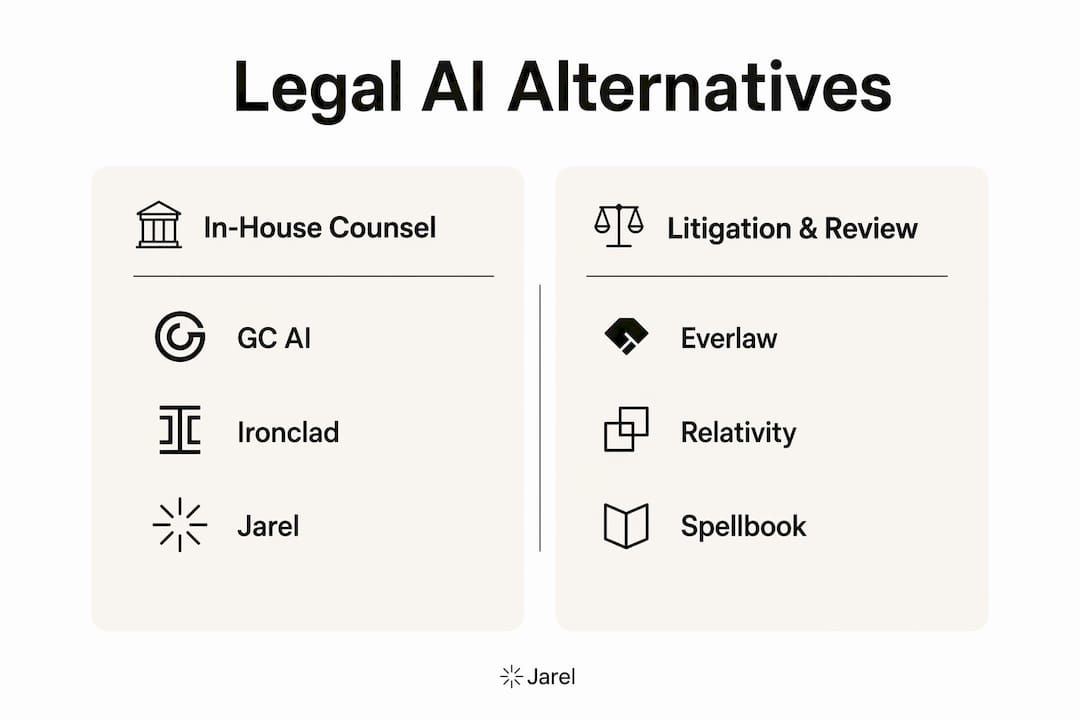
The strongest Harvey.ai alternatives in 2026 are GC AI, Thomson Reuters CoCounsel, Lexis+ AI, Spellbook, Everlaw, Relativity, Rev, iManage Work, Ironclad, Assembly Neos, Filevine, Aline, Luminance, and Jarel. Each targets a distinct slice of the legal AI market, from litigation support to contract lifecycle management to in-house workflow automation.
Here is a quick orientation before the deep dive:
- GC AI — Built for in-house counsel; focuses on contract review, policy drafting, and regulatory research with a clean, non-technical interface.
- Thomson Reuters CoCounsel — Deep legal research and document review powered by GPT-4, tightly integrated with Westlaw; strong fit for law firms already in the Thomson Reuters ecosystem.
- Lexis+ AI — LexisNexis's AI layer for case law research, brief drafting, and deposition prep; best for firms relying on Lexis databases.
- Spellbook — A Word add-in for contract drafting and redlining; designed for transactional lawyers who live in Microsoft Office.
- Everlaw — Cloud-based e-discovery and litigation platform with AI-assisted document review; targets litigation teams and large law firms.
- Relativity — Enterprise e-discovery and review platform with AI analytics; dominant in large-scale litigation and regulatory response.
- Rev — AI transcription and deposition support; narrow but precise use case for litigation teams needing accurate transcripts fast.
- iManage Work — Document and email management with AI-powered search and matter organization; core infrastructure for law firms managing large document volumes.
- Ironclad — Contract lifecycle management (CLM) platform for in-house legal teams; strong on workflow automation and approvals.
- Assembly Neos — Practice management software with AI features for law firms; covers billing, case management, and client communication.
- Filevine — Case and project management for plaintiff law firms and legal departments; AI tools for document generation and deadline tracking.
- Aline — AI-powered contract negotiation and redlining; targets in-house teams handling high-volume commercial agreements.
- Luminance — AI contract review and due diligence platform trained on legal documents; used by both law firms and in-house teams globally.
- Jarel — Source-linked legal AI workspace covering research, contract review, due diligence, and compliance workflows with full audit trails and access controls.
| Platform | Best For | Core AI Capability | Pricing Model |
|---|---|---|---|
| GC AI | In-house counsel | Research, drafting, policy review | Subscription (not publicly listed) |
| Thomson Reuters CoCounsel | Law firms + in-house | Research, document review | Subscription via TR |
| Lexis+ AI | Law firms | Research, brief drafting | Subscription via LexisNexis |
| Spellbook | Transactional lawyers | Contract drafting, redlining | Subscription (Word add-in) |
| Everlaw | Litigation teams | E-discovery, document review | Per-GB / subscription |
| Relativity | Large law firms, enterprises | E-discovery, AI analytics | Per-GB / enterprise license |
| Rev | Litigation support | Transcription, deposition | Per-minute / subscription |
| iManage Work | Law firms | Document management, AI search | Enterprise license |
| Ironclad | In-house legal | CLM, workflow automation | Subscription (not publicly listed) |
| Assembly Neos | Law firms (SMB) | Practice management, billing | Subscription |
| Filevine | Plaintiff firms, legal depts | Case management, doc generation | Subscription |
| Aline | In-house counsel | Contract negotiation, redlining | Subscription (not publicly listed) |
| Luminance | Law firms + in-house | Contract review, due diligence | Enterprise license |
| Jarel | Law firms + in-house | Research, review, drafting, compliance | Subscription |
Table of Contents
- How do these legal AI platforms actually compare?
- How to choose the right alternative to Harvey.ai for your legal team
- Why are legal teams looking beyond Harvey.ai?
- What does successful legal AI adoption actually require?
- Jarel brings source-linked AI to legal teams that need accountability
- FAQ
- Key Takeaways
How do these legal AI platforms actually compare?
GC AI and Thomson Reuters CoCounsel
GC AI is purpose-built for general counsel who need answers fast without learning a new research paradigm. Its interface surfaces policy gaps and contract risks in plain language, which matters when your team is two lawyers covering a 500-person company. Thomson Reuters CoCounsel takes a different approach: it sits on top of Westlaw's case law database, so the research it produces is grounded in the same authoritative source attorneys have trusted for decades. For firms already paying for Westlaw, CoCounsel adds genuine leverage rather than a parallel subscription.
Pros/Cons:
- GC AI: Intuitive for non-technical users; limited public documentation on security certifications; pricing not publicly listed.
- CoCounsel: Deep Westlaw integration; requires existing TR subscription; less suited for teams outside the TR ecosystem.
Lexis+ AI and Spellbook
Lexis+ AI is the natural choice if your firm runs on LexisNexis. It handles brief drafting, deposition prep, and case law synthesis with citations tied directly to Lexis sources, which reduces the hallucination risk that plagues generic large language models. Spellbook is narrower but genuinely useful: it lives inside Microsoft Word and redlines contracts against your playbook in seconds. Transactional associates report it cuts first-pass review time significantly, though it is not a research tool and should not be treated as one.
Pros/Cons:
- Lexis+ AI: Strong citation grounding; ecosystem lock-in; pricing tied to LexisNexis plans.
- Spellbook: Fast, low-friction adoption; Word-native; limited to contract drafting and review.
Everlaw and Relativity
Both platforms dominate e-discovery, but they serve different scales. Everlaw is cloud-native, faster to deploy, and popular with mid-size litigation boutiques that need collaborative review without a six-month implementation. Relativity is the enterprise standard for large firms and corporations managing regulatory investigations or mass tort litigation. Its AI analytics layer, RelativityOne, handles predictive coding and concept clustering at a scale Everlaw does not match. The tradeoff is cost and complexity: Relativity implementations typically require dedicated administrators.
Pros/Cons:
- Everlaw: Faster onboarding, strong collaboration tools; per-GB pricing can escalate on large matters.
- Relativity: Unmatched scale and analytics; significant IT overhead; enterprise pricing.
Rev, iManage Work, and Ironclad
Rev is a specialist, not a platform. Its AI transcription accuracy for legal proceedings is high, and it integrates with common deposition workflows. If your litigation team is still manually transcribing depositions, Rev pays for itself quickly. iManage Work is infrastructure rather than an AI product per se: it organizes documents and emails by matter, then layers AI-powered search and classification on top. Most large law firms already use it. Ironclad is the leading CLM for in-house teams that need contract requests, approvals, and renewals managed in one place. Its workflow builder is genuinely flexible, though the implementation timeline for complex approval chains can stretch several months.
Pros/Cons:
- Rev: Precise transcription; narrow use case; not a full legal AI platform.
- iManage Work: Strong document governance; requires enterprise license; AI features vary by tier.
- Ironclad: Powerful CLM workflows; implementation complexity; pricing not publicly listed.
Assembly Neos, Filevine, Aline, and Luminance
Assembly Neos targets small and mid-size law firms that need practice management, billing, and client communication in one place, with AI features layered in. Filevine is the go-to for plaintiff firms: its case management and document generation tools are built around the contingency fee model. Aline focuses tightly on contract negotiation, using AI to flag deviations from standard positions and suggest redlines during live negotiations. Luminance stands apart by training its models specifically on legal documents rather than general text, which gives its contract review and due diligence outputs a precision that general-purpose models often miss.
Pros/Cons:
- Assembly Neos: All-in-one for smaller firms; AI features less advanced than specialist tools.
- Filevine: Strong for plaintiff work; less suited to transactional or in-house environments.
- Aline: Precise negotiation support; limited scope beyond contract workflows.
- Luminance: Legal-specific training data; enterprise pricing; strong due diligence use case.
Jarel
Jarel provides a source-linked workspace where every AI output connects back to the underlying contract, statute, or case law that generated it. That traceability is not a marketing claim; it is the architecture. Review trails, audit logs, and access controls are built in from the start, which matters when you are handling privileged communications or sensitive due diligence. Jarel covers research, contract review, regulatory mapping, and document classification in one environment, making it a strong fit for legal teams that want AI embedded in accountable workflows rather than a standalone tool they have to govern separately.
Pros/Cons:
- Jarel: Full audit trail and source citations; covers multiple workflow types; designed for governance-conscious teams.
- Pricing is subscription-based; check Jarel's pricing page for current plans.
How to choose the right alternative to Harvey.ai for your legal team
The single most useful question to ask before evaluating any platform: what specific legal task is consuming the most time, and who is doing it? The answer narrows the field faster than any feature comparison.
Key evaluation criteria:
- Target user type: In-house teams and law firms have different workflows, billing structures, and risk tolerances. A CLM built for in-house approval chains (Ironclad, Aline) will frustrate a litigation associate who needs fast document review.
- Core AI capabilities: Map the platform's strengths to your actual bottlenecks. Research-heavy teams need Westlaw or Lexis integration. Transactional teams need drafting and redlining. Litigation teams need e-discovery and transcript support.
- Integration support: Fragmented AI tools and manual workarounds account for 41% of system issues in law departments. Prioritize platforms that connect to your existing document management, email, and matter management systems.
- Pricing and total cost of ownership: Per-GB e-discovery pricing escalates unpredictably on large matters. Subscription CLMs often carry implementation fees that dwarf the annual license. Get a full cost picture before signing.
- Security and compliance: US legal teams handling privileged material need SOC 2 Type II certification at minimum. Confirm data residency, encryption standards, and whether the vendor trains models on your data.
- Ease of adoption: A tool your team does not use is not an asset. Prioritize platforms with documented onboarding programs and responsive support, especially for teams with limited legal tech experience.
One structural choice worth thinking through carefully: monolithic CLM platforms promise end-to-end contract management but require months of configuration and change management. Modular, surgical AI tools embedded in existing workflows, like a Word add-in or an Outlook integration, often deliver faster ROI because adoption friction is lower. The right answer depends on your team's governance maturity and appetite for a multi-month implementation.
Pro Tip: Before issuing an RFP, assign one internal owner to the AI program. Axiom's research shows that clear ownership and defined goals are the primary drivers of AI ROI, not the software itself. Without an owner, even the best platform stalls.
For in-house teams, also consider who actually controls the procurement decision. Most legal AI purchases are made by IT or Operations, not the GC's office. If you are not at the table, you are inheriting someone else's risk tolerance. Push for legal-outcome goals to be written into the vendor evaluation criteria before IT finalizes the shortlist. You can also review in-house workflow efficiency guidance to frame those goals concretely.
Why are legal teams looking beyond Harvey.ai?
Technology selection has overtaken workload as the primary challenge for legal professionals in 2026, with 54% naming it their biggest pain point. That shift reflects something real: the market has moved from "should we use AI?" to "which AI, for what, and how do we govern it?" Harvey.ai was an early mover, but early movers rarely hold every use case as the market matures.
Several specific dynamics are pushing teams to evaluate alternatives. Pricing is one. Harvey.ai's enterprise model works for large law firms with dedicated legal tech budgets, but in-house teams at mid-size companies often find the cost-to-use-case ratio hard to justify when they only need contract review or regulatory research, not a full platform. Integration gaps are another. Teams already invested in iManage, Salesforce, or Microsoft 365 want AI that connects to those systems rather than requiring a parallel workflow.
Trust and accuracy concerns are significant. Many legal teams report concerns about hallucinated or incorrect AI outputs, and accuracy and trust remain blockers to broader adoption. When an AI tool cannot show its work, attorneys cannot fulfill their professional responsibility obligations under ABA guidance on AI ethics. Source-linked outputs and audit trails are no longer nice features; they are a compliance requirement for many teams.
The broader trend is a move away from platform replacement toward embedding AI into existing workflows. Legal teams that tried to rip out their document management system in favor of an all-in-one AI platform mostly learned an expensive lesson. The teams seeing real productivity gains are adding targeted AI capabilities to the tools their attorneys already use every day. Understanding AI risk in legal practice is now a prerequisite for making that transition safely.
What does successful legal AI adoption actually require?
Technology is the easy part. The harder part is everything around it.
A small minority of legal teams have a documented, actively followed AI governance framework, while a notable portion have none at all. That gap is where AI programs fail, not in the software.
Only 7% of legal teams have a documented, actively followed AI governance framework — yet 14% have none at all. (Consilio, 2026)
The talent-technology gap is the other pressure point. Law.com's analysis of 2026 deployments found that firms investing in AI tools without matching investment in training and change management consistently underperformed those that treated workforce readiness as equal in priority to the technology itself. Buying a better platform does not fix a team that does not know how to use it, review its outputs, or catch its errors.
Best practices for legal AI governance and adoption:
- Assign a named AI program owner with authority to set standards and enforce them.
- Define measurable goals before deployment: time saved per contract review, reduction in research turnaround, error rate benchmarks.
- Run a structured pilot with a defined review cycle before scaling to the full team.
- Document an AI use policy covering acceptable tasks, required human review steps, and escalation procedures.
- Invest in training at every level, from partners setting strategy to associates doing daily review.
- Build in regular audits of AI outputs to catch drift in accuracy or scope creep.
- Align your AI governance policy with ABA ethics guidance and your state bar's current positions on AI use.
Jarel's architecture directly addresses the governance gap. Its audit logs, source citations, and review trails give legal teams the documentation they need to demonstrate oversight, which is exactly what human review of AI-drafted documents requires in practice. For teams building their first formal AI program, that built-in accountability structure reduces the governance burden considerably.

Jarel brings source-linked AI to legal teams that need accountability
Every platform in this comparison can generate a contract summary or surface a relevant case. The question is whether you can stand behind the output. Jarel is built for legal teams where that question is non-negotiable.


Jarel's source-linked workspace connects every AI output to the contract clause, statute, or case law that produced it. When a partner asks how the AI reached a conclusion, the answer is one click away, not a black box. That traceability extends across contract review, due diligence, regulatory mapping, and compliance workflows, all within a single environment with access controls and audit logs that satisfy privilege and confidentiality requirements.
For in-house teams managing high-volume contract review, Jarel's configurable playbooks enforce your standard positions automatically, so junior reviewers are not reinventing the wheel on every NDA. For law firms, the Outlook add-in puts AI review and drafting directly inside the inbox your attorneys already live in, cutting the friction that kills adoption on other platforms.
See what Jarel looks like for your team's specific workflows at jarel.se.
FAQ
What is the best Harvey.ai alternative for in-house counsel?
GC AI, Ironclad, Aline, and Jarel are the strongest options for in-house teams. Jarel stands out for teams that need source-linked outputs and built-in audit trails to satisfy governance and privilege requirements.
How do Harvey.ai alternatives handle AI accuracy and hallucination risks?
Platforms like Lexis+ AI and Thomson Reuters CoCounsel ground outputs in their proprietary legal databases, which reduces hallucination risk. Jarel addresses the same problem through source citations that tie every AI output directly to the underlying document or statute.
What should legal teams prioritize when evaluating AI platforms?
Assign a named program owner, define measurable goals, and confirm the platform's security certifications before evaluating features. Axiom's research shows that disciplined adoption, not software quality, is the primary driver of AI ROI in legal teams.
Are Harvey.ai alternatives suitable for small law firms?
Yes. Assembly Neos and Filevine are built for smaller firms, and Spellbook's Word add-in model keeps costs low for transactional practices. Jarel's subscription model scales from small teams to full legal departments.
How important is AI governance for legal teams adopting these platforms?
Critical. Only 7% of legal teams have an active AI governance framework, and teams without one face accuracy, compliance, and professional responsibility risks regardless of which platform they choose.
Key Takeaways
The right Harvey.ai alternative depends on your team's specific workflows, governance maturity, and existing tech stack, not on feature lists alone.
| Point | Details |
|---|---|
| Governance is the real gap | Only 7% of legal teams have an active AI governance framework, making oversight the primary adoption risk. |
| Disciplined adoption drives ROI | Clear ownership, defined goals, and iterative review matter more than software quality for AI program success. |
| Integration gaps cost productivity | Fragmented tools account for 41% of system issues in law departments; prioritize platforms that connect to existing workflows. |
| Match the tool to the task | In-house CLM needs (Ironclad, Aline) differ sharply from litigation support (Everlaw, Relativity) and research (Lexis+ AI, CoCounsel). |
| Jarel for accountable AI workflows | Jarel's source-linked outputs, audit logs, and access controls give legal teams the traceability governance requires. |