
How AI-Assisted Contract Analysis Works in 2026
TL;DR:
- AI contract analysis uses natural language processing, machine learning, and OCR to assess agreements quickly and accurately. It identifies clauses, flags deviations, scores risks, and generates summaries, requiring human review for final judgments. This approach significantly improves efficiency, consistency, and risk management for legal and business teams.
AI-assisted contract analysis uses natural language processing, machine learning, and optical character recognition to automatically extract, classify, and evaluate contract clauses, far faster and more consistently than manual review. A 2018 LawGeex study put the gap in stark terms: AI reached 94% accuracy in 26 seconds, while experienced corporate lawyers averaged 85% accuracy in 92 minutes. That gap has only widened as the underlying models have matured.
What AI actually does in contract review:
- Reads and digitizes scanned or paper contracts via OCR
- Identifies parties, obligations, and key dates through entity recognition
- Classifies clause types and flags deviations from standard positions
- Scores risk based on benchmarks drawn from thousands of similar agreements
- Generates summaries and suggested redlines with justification comments
- Answers natural language questions about specific contract terms
How AI technologies power contract analysis today
Three core technologies work together to make automated contract analysis possible, and understanding each one clarifies why AI outperforms keyword search by such a wide margin.
Natural Language Processing (NLP) does the heavy lifting on meaning. Rather than scanning for the word “indemnify,” NLP analyzes sentence structure, identifies the parties involved, and determines whether a clause protects you or exposes you. Two clauses can contain identical words but carry opposite legal consequences. NLP catches that distinction; keyword search cannot.
Machine Learning (ML) models are trained on large labeled legal datasets, including the Contract Understanding Atticus Dataset (CUAD), which contains over 500 contracts annotated across 41 clause types. When a clause deviates from patterns the model has seen thousands of times, it flags the deviation statistically, not just lexically.
Optical Character Recognition (OCR) converts scanned PDFs and paper documents into machine-readable text before any analysis begins. Without accurate OCR, the downstream NLP and ML steps have nothing to work with.
Beyond these three, modern systems also apply:
- Entity recognition to identify parties, dates, and defined terms
- Intent classification to categorize what a clause is trying to accomplish
- Deviation detection to compare language against established benchmarks
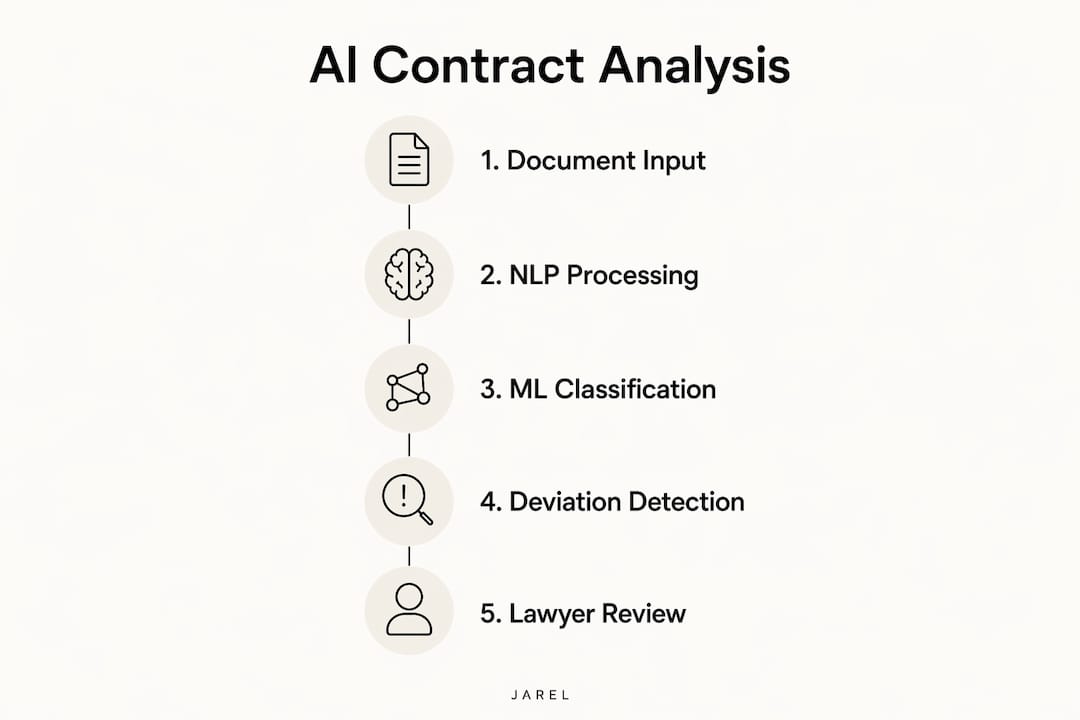
Step-by-step: what happens when AI reviews a contract
The workflow follows a clear sequence, though the speed at which each stage runs is what surprises most legal teams the first time they see it.
- Document ingestion. The contract is uploaded, and OCR converts any non-text content into analyzable text.
- Clause extraction and classification. NLP segments the document into individual clauses and labels each one by type: indemnification, limitation of liability, termination, governing law, and so on.
- Playbook comparison. The AI checks each clause against your defined positions or a pre-built template, flagging anything that deviates from standard language.
- Risk scoring. Flagged clauses receive a risk score based on how far they stray from market norms across comparable agreements.
- Redline generation. The system generates redlines with explanatory comments, not just strikethroughs, so the reviewing lawyer understands the reasoning behind each suggested change.
- Summary output. A plain-language summary of key terms is produced for business stakeholders who need the essentials without reading the full agreement.
- Human review. A qualified legal professional reviews flagged items, applies judgment to the AI’s suggestions, and makes the final call on every negotiation decision.
The AI handles the first pass. The lawyer handles everything that requires judgment, context, and strategic thinking.
Pro Tip: Build your playbook before running the first analysis. The AI’s deviation detection is only as useful as the standard positions it has to compare against.

Key benefits AI-assisted contract analysis offers legal and business teams
The clearest benefit is time. Customer implementations of AI-driven annotation have substantially reduced manual contract review time, cutting review cycles that once took days down to hours. For large-scale portfolio work, enterprise teams report up to 75% efficiency gains on due diligence, compliance reviews, and contract migration projects.
Consistency is the second major gain. A human reviewer working through a 200-contract due diligence portfolio will inevitably apply slightly different standards at hour one versus hour eight. AI applies the same analytical criteria to every document, every time.
Risk management improves because AI surfaces deviations that manual review often misses under time pressure. Systems can benchmark contract language against industry norms, scoring risk and fairness across thousands of comparable agreements. That gives legal teams specific, defensible talking points in negotiations rather than general impressions.
At the portfolio level, AI enables a kind of visibility that was previously cost-prohibitive. Teams can identify renewal leakage, track obligation exposure, and spot systemic risk patterns across hundreds of agreements simultaneously.
Real-world accuracy and efficiency results
The 2018 LawGeex study remains the most cited benchmark in AI contract review, and the numbers hold up. Twenty experienced US corporate lawyers from firms including Alston & Bird and Goldman Sachs reviewed five NDAs against an AI system. The AI scored 94% accuracy in 26 seconds. The lawyers averaged 85%, with individual scores ranging from 67% to 94%, and completion times running from 51 minutes to over two and a half hours.
“AI finally makes it affordable to know what is in your contracts. Now, choosing not to know becomes the riskiest decision.” — Bloomberg Law
The practical implications extend well beyond NDAs. A global software company used AI to analyze 17,000 contracts in days rather than months during a major service crisis, giving its legal team a full view of contractual exposure at a fraction of the cost of traditional review. A global gaming company extracted key rights data from historical agreements at roughly one minute per contract. These are not edge cases. They reflect what happens when AI in legal document review is applied at scale.
Which contract types benefit most from AI analysis
High-volume, standardized agreements deliver the clearest return because playbooks can be built once and refined over time. NDAs, vendor contracts, SaaS agreements, procurement contracts, and employment agreements all fall into this category.
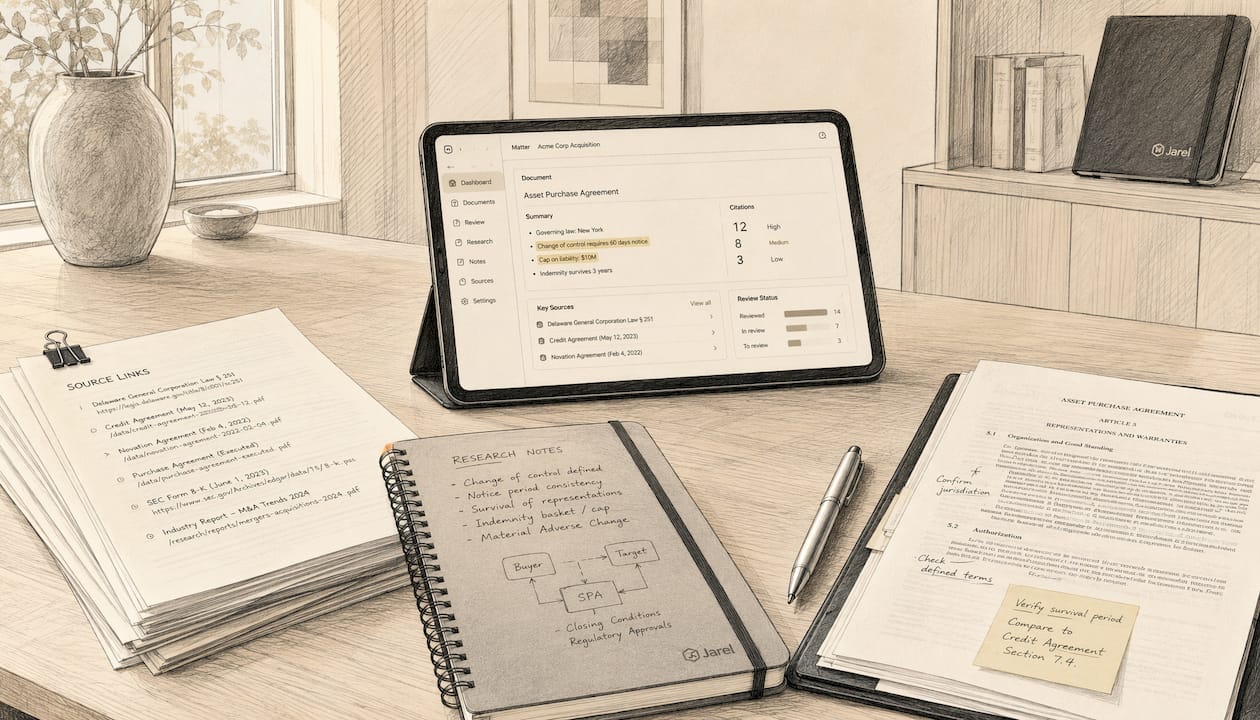
For large-scale analysis projects, AI is particularly effective on M&A due diligence portfolios, lease collections, compliance reviews, and contract migration work where the goal is consistent data extraction across hundreds or thousands of documents. The in-house legal teams that see the fastest ROI are typically those running recurring review cycles on standardized contract types.
Complex, bespoke agreements, such as joint venture contracts or heavily negotiated financing documents, still benefit from AI on the first pass, but require proportionally more attorney time on the flagged items.
Common challenges and limitations of AI in contract analysis
AI performs well on clause identification and deviation detection. It performs less well on judgment calls that depend on commercial context, client relationship history, or jurisdiction-specific nuance that falls outside its training data.
Highly unusual contract structures can confuse classification models, particularly when parties use non-standard defined terms or unconventional clause ordering. OCR quality also matters: a poorly scanned document produces errors that propagate through every downstream step.
Training data bias is a real constraint. A model trained primarily on US commercial contracts will be less reliable when applied to contracts governed by civil law jurisdictions or written in non-standard English. Legal teams should validate AI outputs against a sample of manually reviewed agreements before relying on the system at scale.
Data privacy and security considerations
Contracts contain some of the most sensitive commercial information an organization holds. Before deploying any AI analysis tool, legal teams need clear answers on three questions: where contract data is stored, who can access it, and whether documents are used to train the underlying model.
Reputable platforms process documents against pre-trained models rather than using client documents to retrain the base system. The American Bar Association’s ethical obligations for client data protection apply directly to AI tools, and attorneys remain responsible for ensuring any platform they use meets those standards.
ISO 27001 certification is a baseline indicator of information security management. Audit logs, access controls, and data residency options are non-negotiable for privileged legal work. Jarel’s architecture addresses these requirements directly, with review trails and source citations built into every output.
AI algorithms used for specific contract analysis tasks
Different tasks within contract analysis call for different algorithmic approaches.
Named Entity Recognition (NER) identifies parties, dates, monetary values, and defined terms. It is typically built on transformer-based models fine-tuned on legal corpora.
Sequence classification assigns a label to each clause, such as “indemnification” or “limitation of liability,” drawing on training data like CUAD’s 41 annotated clause categories.
Retrieval-Augmented Generation (RAG) grounds AI responses in the actual contract text rather than relying on model memory alone. PwC’s AIDA system uses RAG on AWS to produce context-specific answers with citations linking back to the source document, which is critical for auditability.
Semantic similarity models compare incoming clause language against a library of standard positions to calculate deviation scores.
Training and customizing AI models for your organization
Out-of-the-box models cover common clause types well. The real performance gains come from customization. Most enterprise platforms let legal teams build playbooks that define their standard positions, fallback language, and escalation thresholds. The AI then applies those positions consistently across every document it reviews.
Fine-tuning on your own contract history, where the platform supports it, teaches the model what “normal” looks like for your specific deal types, counterparty mix, and risk tolerance. This is particularly valuable for organizations with unusual standard terms or industry-specific language that general models may not handle well.
Jarel’s playbooks feature lets legal teams encode their review rules directly into the AI workflow, so every contract is checked against the same standards without manual configuration on each new document.
Key Takeaways
AI-assisted contract analysis delivers its greatest value when NLP, ML, and OCR work together within a structured workflow that keeps human judgment at the final decision point.
| Point | Details |
|---|---|
| Speed and accuracy gap | AI reached 94% accuracy in 26 seconds vs. lawyers averaging 85% in 92 minutes in the 2018 LawGeex study. |
| Time savings at scale | AI-driven annotation has substantially reduced manual contract review time in customer implementations. |
| Portfolio efficiency | Enterprise teams report up to 75% efficiency gains on due diligence and compliance review projects. |
| Human oversight stays essential | AI handles the first pass; attorneys make every final judgment call on negotiation and risk. |
| Customization drives accuracy | Playbooks and fine-tuning on organization-specific contracts improve deviation detection significantly. |
FAQ
How accurate is AI at reviewing contracts?
In a 2018 LawGeex study, AI achieved 94% accuracy on NDA review in 26 seconds, outperforming 20 experienced corporate lawyers who averaged 85% accuracy in 92 minutes.
What types of contracts work best with AI analysis?
High-volume, standardized agreements such as NDAs, vendor contracts, SaaS agreements, and employment contracts deliver the clearest efficiency gains, as do large due diligence portfolios and lease collections.
Does AI replace lawyers in contract review?
No. AI handles the first pass, flagging deviations and generating redlines, while qualified attorneys apply judgment, context, and strategic thinking to every final decision.
How does AI contract analysis handle data privacy?
Reputable platforms process documents against pre-trained models without using client contracts to retrain the base system, and should provide audit logs, access controls, and ISO 27001-aligned security practices.
How long does AI take to analyze a contract?
A standard contract can be processed in roughly one minute, with consistent analytical rigor applied every time, regardless of document volume.