
Legal Intake: Workflow, Compliance and AI Insights
TL;DR: - Legal intake is a structured process that ensures proper qualification, ethical compliance and efficient routing of client matters before legal work begins. It encompasses multiple stages, including information gathering, scope and conflict screening, and onboarding, with compliance checks embedded at every point to reduce risk. Automated tools and AI enhance process discipline, speed and accuracy, ultimately reducing legal liability and improving client service.
Most legal teams think of intake as the first phone call or a simple web form. It is not. Legal intake is a structured, compliance-driven sequence that determines whether a matter is properly qualified, ethically approved and efficiently routed before any legal work begins. If you do it wrong, you do not just lose efficiency. You create real exposure: missed conflicts, incomplete engagement terms and data handled without proper protocols. This article breaks down each stage of the process, explains the compliance obligations built into it, and shows where AI fits into a modern, responsible intake workflow.
Table of Contents
- What is legal intake?
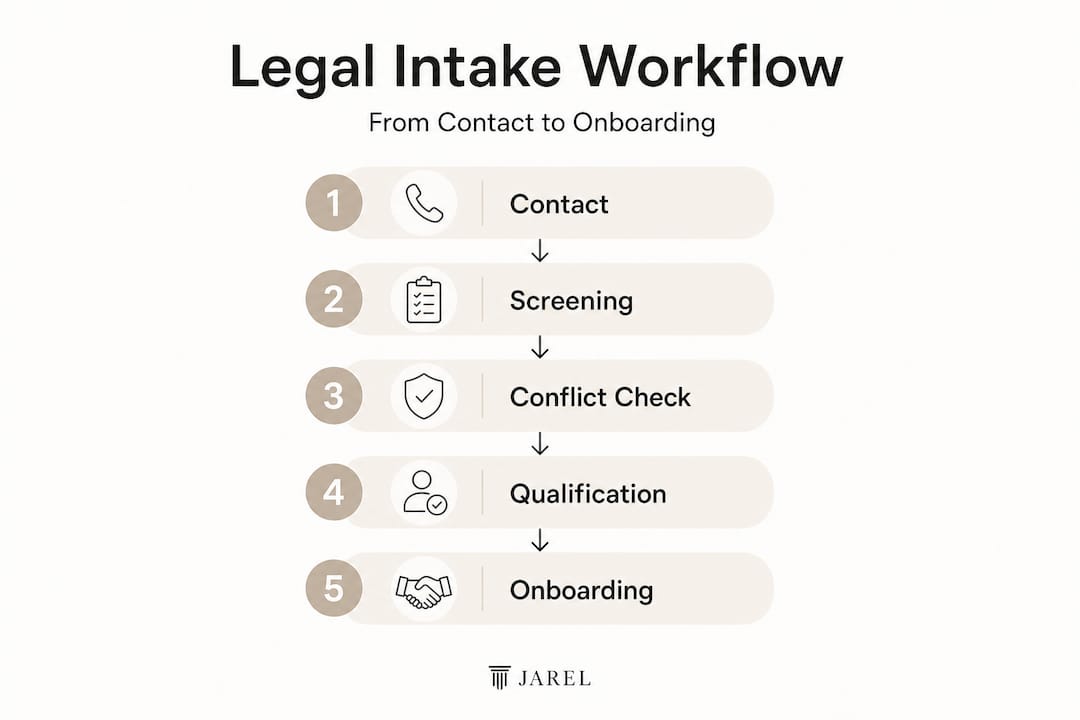
- Key stages in legal intake: From contact to onboarding
- Compliance and conflict check in the intake workflow
- Optimizing intake: KPIs, AI and continuous improvement
- What most guides overlook about legal intake: Lessons from practice
- How Jarel streamlines your legal intake process
- Frequently asked questions
Key takeaways
| Point | Details | | --- | --- | | Structured workflow | Effective legal intake requires a defined sequence of steps from first contact to onboarding. | | Built-in compliance | Conflict checks and ethical compliance must occur during intake, not afterwards. | | Law firm vs. in-house | Law firms and in-house teams follow different intake routines tailored to their client types. | | AI integration | Modern intake leverages AI for efficiency, real-time screening and compliance checks. | | Goals and improvement | KPIs help measure intake performance and identify areas for continuous improvement. |
What is legal intake?
At its core, legal intake is the structured set of steps used to capture, screen and qualify incoming client matters or requests, and to route or onboard the matter into the legal workflow. This definition sounds simple, but execution is anything but.
The process covers everything from the moment someone first contacts your firm or submits an internal request, to the point where a matter is formally opened, assigned and ready for substantive legal work. Every step in between has obligations: ethical, operational and increasingly regulatory.
It is also worth noting that intake looks different depending on your environment. Law firm intake is primarily about external clients. It involves identifying who the prospective client is, what they need, whether you can help them, and whether taking on the matter creates any conflicts with existing clients. In-house legal intake, on the other hand, is a standardized process where internal stakeholders submit legal requests and legal teams triage, route and track them to the right attorney or workflow. The business unit submitting a contract review request is not your client in the traditional sense, but intake discipline is equally important.
Here are the core functions that every intake process, regardless of setting, must perform:
- Capture incoming requests through consistent, structured channels
- Screen for completeness, relevance and scope
- Qualify the matter against your practice area, jurisdiction and capacity
- Conflict check to identify ethical barriers before any advice is given
- Route the matter to the right person, team or workflow
- Onboard the matter formally with documentation, engagement terms and access setup
"Intake is not the beginning of the legal process. It is the gate that determines whether the legal process should begin at all, and under what terms."
Understanding AI in legal workflows starts here, because intake is where structured data collection and automated screening deliver the most immediate value. Poor intake creates cascading problems downstream. Strong intake creates clarity from the start.
Key stages in legal intake: From contact to onboarding
The intake process unfolds in a logical sequence, and each stage builds on the previous. Skipping or rushing through any stage creates gaps that tend to surface at the worst possible time, typically mid-matter or at the point of disagreement.
Here is how a well-structured intake workflow proceeds:
- First contact — The prospective client or internal stakeholder reaches out via phone, email, web form or referral. This is the entry point. Law firm intake begins here and continues through onboarding and matter opening, while in-house intake functions as the front door for internal departments submitting legal requests.
- Initial information gathering — Structured data is collected: identity, matter type, relevant dates, opposing parties and jurisdictional details. This is where client intake forms in practice play a critical role in standardizing what is captured and how.
- Screening and qualification — The matter is assessed against the firm’s or department’s scope, capacity and practice area. Does this fall within what you handle? Is the timeline realistic? Is there enough information to proceed?
- Conflict check — Before any legal advice is given or any engagement is signed, a conflict check is run. This is non-negotiable and time-sensitive.
- Triaging and routing — The matter is assigned a priority level and directed to the right attorney, practice group or workflow. In-house teams often use layered routing based on matter complexity and risk level.
- Engagement and onboarding — The formal relationship is established. For law firms this means a signed engagement and fee agreement. For in-house teams it means matter opening, system entry and assignment confirmation.
Edge cases are where intake systems get tested. Incomplete information at first contact is one of the most common failure points, requiring structured follow-up protocols instead of ad hoc chasing. Jurisdictional differences, where a matter falls outside your licensed practice area, need clear escalation paths. And the timing of the engagement is legally important: data collected from a prospective client before an engagement is signed must be handled under different protocols than data from an active client.
| Stage | Law firm intake | In-house intake | |---|---|---| | Entry point | Phone, web form, referral, walk-in | Internal portal, email, ticketing system | | Qualification focus | Practice area, conflict, capacity | Business unit, matter type, risk level | | Conflict check | Against existing client database | Against organization’s conflict policy | | Routing | Attorney or practice group | Legal team member or outside counsel | | Onboarding | Engagement, fee agreement | Matter opening, system entry | | Tracking | Matter management system | Legal operations platform |
Pro tip: Build a feedback loop into your intake form so that when required fields are missing or answers are ambiguous, the system automatically requests clarification before the matter proceeds. This prevents bottlenecks from forming later in the workflow and keeps your data clean from the start.
With the overall process clear, the next priority is to understand the compliance obligations that must be built into every stage, not added as an afterthought.
Compliance and conflict check in the intake workflow
Compliance in legal intake is not a box to check. It is a structural requirement that must be woven into the workflow itself. The most important compliance function is the conflict check, and timing is enormously important.

Conflict checks must occur before legal advice is given and before an engagement is signed with a prospective client. This is an ethical obligation, not just a best practice. Running a conflict check after you have already given preliminary advice or made representations about the matter creates serious professional liability exposure.
The broader compliance picture includes handling of prospective client data, confidentiality obligations that attach even before engagement, and, increasingly, AI-specific compliance requirements when automated tools are part of the intake workflow. Ethical duties around conflicts and handling of prospective clients require workflow integration, not after-the-fact review. The system itself must be designed to stop or route appropriately when issues are detected, not rely on a human catching problems at the end of the process.
Here is a comparison of real-time versus manual compliance checks in intake:
| Compliance check | Real-time (automated) | Manual review | |---|---|---| | Conflict check | Instant flag on submission | Delayed, often after advice | | Jurisdiction screening | Automated against rules database | Attorney judgment, inconsistent | | Data handling | Protocol triggered at intake | Dependent on staff awareness | | Audit trail | Automatic, time-stamped | Incomplete, reconstructed | | Escalation | System-driven, immediate | Ad hoc, often delayed |
Key compliance risks in intake, and how you mitigate them:
- Premature advice — Giving legal guidance before a conflict check is completed. Mitigation: configure intake systems to prevent matter assignment until the conflict check is cleared.
- Prospective client data exposure — Treating data before engagement the same as active client data. Mitigation: use separate data handling protocols triggered at intake, not at engagement.
- Jurisdictional overreach — Accepting matters outside your licensed scope. Mitigation: build jurisdiction screening into the qualification stage with hard stops for out-of-scope matters.
- Missing audit trail — No record of who handled intake data, when and under what authorization. Mitigation: use platforms with automatic audit logging from first contact.
The role of AI compliance in intake is growing, but it requires careful implementation. AI can run conflict checks against large databases in seconds, flag jurisdictional differences automatically and surface compliance risks that a manual reviewer might miss under time pressure. The key is that AI must be configured to escalate, not decide. Human oversight must remain the final authority on compliance determinations.
Statistic callout: Legal malpractice claims related to conflicts of interest and engagement failures are among the most common and most preventable categories of professional liability. The intake stage is where most of these failures occur, and where most of them could be stopped.
Optimizing intake: KPIs, AI and continuous improvement
Measuring intake performance is how you move from a process that works to a process that improves. The right key performance indicators (KPIs) tell you where the workflow is strong and where it creates friction or risk.
The most meaningful intake KPIs for legal teams include:
- Response time — How quickly does the team acknowledge and begin processing an incoming request? Delays at this stage signal bottlenecks and can affect client perception before the matter is even opened.
- Qualification rate — What percentage of incoming requests proceed after initial screening? A very low rate may indicate a mismatch between your intake channels and your target matters. A very high rate may indicate insufficient screening.
- Conflict check turnaround time — How long does it take to complete and clear a conflict check? This directly affects how quickly you can move to engagement.
- Conversion rate — For law firms, how many qualified prospects become retained clients? For in-house teams, how many submitted requests are successfully routed and resolved?
- Data completeness at intake — What percentage of intake submissions arrive with all required fields completed? Low completeness rates indicate a form or process design problem.
Empirical benchmarks are often presented as KPIs related to intake speed and conversion, but many publicly available benchmark claims come from vendor-reported or secondary aggregations. They should be validated against your jurisdiction and firm’s own baseline metrics before treating them as targets. What works for a large commercial firm in a major market may be irrelevant for a regional practice or a lean in-house team.
AI-driven intake solutions can help teams meet and exceed their own benchmarks by automating the most time-consuming steps: data collection, initial screening, conflict database queries and routing logic. The result is faster turnaround, fewer manual errors and a more consistent experience for everyone submitting a request.
For teams tracking intake performance benchmarks, the most useful approach is to establish your own baseline first, then measure improvement over time rather than chasing industry averages that may not apply to your context.
Pro tip: Run a quarterly audit of your intake data, not just the results. Look at where requests stall, where information is most often incomplete, and where conflict checks take longest. These patterns reveal the specific friction points that, when addressed, deliver the greatest gains in overall intake efficiency.
AI-driven intake solutions work best when they are configured around your actual workflow, not a generic template. The more precisely the system reflects your routing logic, compliance requirements and matter types, the more value it delivers.
What most guides overlook about legal intake: Lessons from practice
Most articles on legal intake treat it as an onboarding problem. Get the form right, set up a calendar link, send the engagement. Done. This framing is dangerously incomplete.
Legal intake is ongoing risk management. The decisions made during intake—what information was captured, what was overlooked, when the conflict check ran, how prospective client data was handled—shape the risk profile of every matter that follows. A poorly designed intake process does not just lose efficiency. It creates liability that may not surface for months or years.
One of the most underestimated complexities is the prospective client problem. The moment someone shares confidential information with your firm in the context of seeking legal advice, ethical obligations attach. Even if you never take the matter. Even if you decline. Most intake checklists do not account for this with any precision, meaning teams routinely handle prospective client data without the protocols the situation legally requires.
Follow-up bottlenecks are another hidden risk. When intake submissions arrive with incomplete information, the typical response is an email to the prospective client requesting more details. That email sits in someone’s inbox. The prospective client replies three days later. The information is forwarded. No one logs it. When the matter opens, there is no clean record of what was known, when and by whom. This is not just an efficiency problem. It is a documentation problem that can become an ethics problem.
AI legal intake lessons from teams that have implemented automation point to a consistent pattern: AI delivers the most value when it enforces process discipline, not when it replaces judgment. Automated conflict checks, structured data collection and system-driven routing remove the variability that creates gaps. But the system still needs human review at key decision points, particularly around conflict clearance and engagement terms.
The practical advice from experienced practitioners is consistent: design your intake process for the hard cases, not the easy ones. Any intake workflow can handle a simple new client with a clear matter type and no conflicts. The real test is what happens when information is incomplete, jurisdiction is ambiguous, the conflict check uncovers a potential issue, or the prospective client has already received informal advice from someone at your firm. Build for these scenarios, and the routine matters take care of themselves.
How Jarel streamlines your legal intake process
The compliance and workflow requirements described throughout this article are exactly what Jarel is built to handle. Legal intake requires precision, traceability and real-time compliance integration, and these are the foundation of Jarel’s platform.

Jarel’s legal intake platform supports every stage of the intake process, from structured request collection and AI-driven conflict screening to compliance flag integration and audit-ready documentation. The platform is designed for both law firms and in-house legal teams, with access controls, review trails and source-linked output that keep every intake decision transparent and verifiable. Whether you are managing high-volume client intake or routing internal legal requests across a complex organization, Jarel gives your team the tools to move faster without compromising on compliance or accountability. Explore how Jarel can transform your intake workflow today.
Frequently asked questions
What is the main goal of the legal intake process?
The main goal is to capture, screen and qualify legal matters efficiently, ensuring they are routed and onboarded into the correct workflow with necessary compliance checks. As defined by the American Bar Association, it is the structured set of steps used to capture, screen and qualify incoming matters and route them into the legal workflow.
How does law firm intake differ from in-house intake?
Law firm intake handles external clients and conflict checks against an existing client database, while in-house intake standardizes how internal stakeholders submit legal requests and routes them to the right attorney or workflow within the organization.
Why must conflict checks happen before legal advice is given?
Conflict checks protect both the client and the firm by identifying ethical barriers before any advice or engagement begins, preventing professional liability exposure that cannot be undone after the fact. The obligation is clear: conflict checking must occur before legal advice is given and before an engagement is signed.
How can AI help legal intake?
AI can automate request collection, accelerate conflict checks and integrate real-time compliance flags, increasing turnaround time and accuracy. Critically, ethical duties in AI-assisted intake require that the system stop or route appropriately when issues are detected, rather than relying on after-the-fact human review.