
Legal Doctrine Study Methods for Law Students
TL;DR:
- Effective doctrinal study begins with precise legal questions using frameworks like 5-W and TARP, focusing research before database searches. Systematic layered analysis, verification, and critical questioning transform understanding from mere summaries into evaluated legal arguments rooted in primary sources. Thorough source tracking and saturation checks ensure research completeness, while recognizing doctrines’ evolving nature and using AI tools responsibly supports rigorous legal research.
Mastering legal doctrine is one of the hardest intellectual challenges in legal education and practice. The volume alone is staggering, but the real difficulty is understanding how doctrines interact, evolve, and apply across shifting factual contexts. Most students memorize rules and miss the analysis underneath. Most professionals revisit doctrine under deadline pressure without a system. Good legal doctrine study methods fix both problems. This guide walks you through preparation, execution, and verification — a structured workflow that transforms how you engage with statutes, case law, and legal principles at every stage of your career.
Table of Contents
- Key Takeaways
- Legal doctrine study methods: starting with solid preparation
- Step-by-step analysis techniques for studying doctrine
- Common pitfalls in doctrinal research
- Verification and refinement in doctrinal study
- My take on what actually makes doctrinal study work
- How Jarel supports your legal research workflow
- FAQ
Key Takeaways
| Point | Details |
|---|---|
| Start with precise questions | Use the 5-W or TARP framework to define your legal issue before opening a database. |
| Layer your sources | Begin with secondary sources for context, then move to primary authorities for binding rules. |
| Analyze, don’t describe | Identify tensions and ambiguities in doctrine rather than simply summarizing legal rules. |
| Verify before concluding | Use citators and cross-checks to confirm sources are current and your conclusions are complete. |
| Iterate systematically | Reach research saturation by repeating searches until results consistently overlap. |
Legal doctrine study methods: starting with solid preparation
Most researchers dive into databases before they know what they are actually looking for. That habit costs hours. Effective legal doctrine study methods begin with a preparation phase that sharpens your focus before you read a single case.
The first step is formulating a precise legal question. Vague questions produce vague research. Two frameworks work well here. The 5-W and TARP methods help you clarify the parties involved, the conduct at issue, the relief sought, and the jurisdiction before you start searching. That specificity changes everything. A question like “what are the damages rules?” becomes “what are the consequential damages limitations under New York contract law for commercial sellers?” The second version tells you exactly where to look.
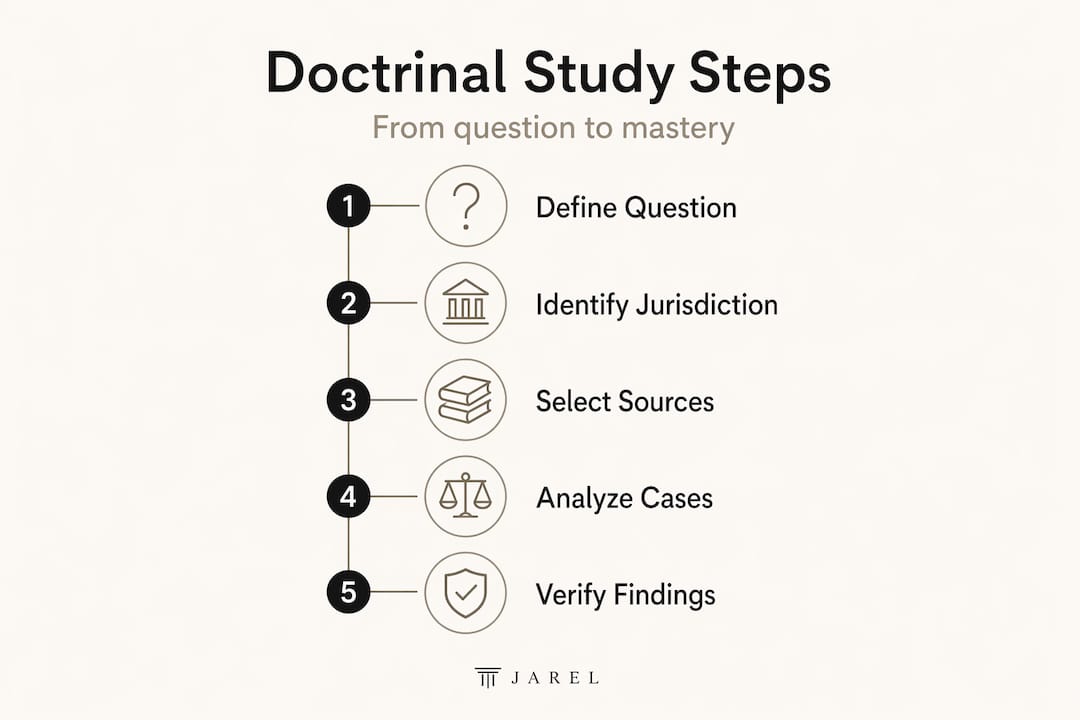
Jurisdiction matters more than most students realize. A doctrine settled in one federal circuit may be actively contested in another. State courts often apply different standards entirely. Before you begin any research session, identify whether you need federal law, state law, or both, and whether you are working with binding precedent or persuasive authority only.
The table below outlines the core preparation tools and their functions:
| Tool / Framework | Purpose | Best Used For |
|---|---|---|
| 5-W Method | Clarifies parties, jurisdiction, facts, and relief | Initial issue spotting |
| TARP Framework | Structures legal inquiry by thing, action, relief, and parties | Narrowing research scope |
| Secondary sources | Provide doctrinal background and scholarly context | Orientation before primary research |
| Research checklist | Tracks completed steps and sources consulted | Preventing gaps in coverage |
Secondary sources deserve special attention during preparation. Treatises, legal encyclopedias, and law review articles explain doctrinal development and flag scholarly debates that you would never find by reading cases alone. They are persuasive rather than binding, but they are the fastest way to understand the shape of a doctrine before you start reading primary law.
Key preparation habits to build before every research session:
- Write your legal question in one sentence before opening any database
- Identify the controlling jurisdiction and court hierarchy
- Note the key terms of art that appear in your question — these become your search terms
- Select two or three secondary sources to orient yourself before moving to statutes and cases
Pro Tip: Keep a running research log from the first minute of any doctrinal project. Record every source you consult, every search string you use, and every dead end you hit. That log prevents duplicate effort and becomes a built-in audit trail for your work.
Step-by-step analysis techniques for studying doctrine
Once your preparation is solid, the execution phase is where real doctrinal understanding gets built. Effective legal research follows a structured sequence that moves from broad orientation to precise primary authority. Here is a workflow that works whether you are a first-year student or a practicing attorney revisiting unfamiliar doctrine.
- Read secondary sources first. Spend thirty minutes with a treatise chapter or a well-regarded law review article before reading a single case. You want to understand the doctrinal landscape before you get lost in the details of individual decisions.
- Identify the governing statute or regulation. In most areas of law, the primary rule starts with codified law. Read the text slowly. Note definitions, exceptions, and any ambiguous terms. Statutory text controls when it is clear; knowing where it is unclear tells you where courts have had to fill gaps.
- Locate the leading cases. The four-step legal research process moves from issue analysis through secondary sources, codified law, and then case law review. When you get to cases, start with the most recent appellate decisions and work backward. A 2023 circuit court opinion often synthesizes twenty years of doctrine in a few paragraphs.
- Read cases in layers. First pass: facts, holding, and judgment. Second pass: the court’s reasoning, the doctrine it applied, and any limiting language. Third pass: dissents and concurrences, which often reveal the tensions the majority glossed over.
- Map doctrinal tensions. Every mature legal doctrine has fault lines. Look for cases that reach different results on similar facts. Note where courts disagree about the scope of a rule. Doctrinal analysis demands that you construct arguments to resolve or highlight these ambiguities, not just catalog them.
- Use Boolean and proximity searches. Tools like Westlaw and Lexis offer advanced search capabilities that let you find cases discussing specific doctrinal combinations. A proximity search linking two legal terms finds sources where those concepts interact, which is exactly what doctrinal research requires.
- Incorporate historical and policy context. Including historical and policy context takes your analysis beyond technical accuracy toward practical relevance. Ask why a doctrine developed when it did. Understanding the policy problem a rule was designed to solve tells you how courts will likely apply it at the margins.
Pro Tip: Build a one-page doctrinal outline for every major legal rule you study. List the elements, the key cases for each element, the main exceptions, and any open circuit splits. That outline becomes a retrieval system you can use under exam pressure or client deadline.
Common pitfalls in doctrinal research
Even diligent researchers make the same mistakes. Knowing them in advance saves you from weeks of misdirected effort.
The most damaging error is descriptive rather than analytical work. Many law students write research memos that summarize what courts said without evaluating whether those decisions are internally consistent, well-reasoned, or adequate to address the problem they were meant to solve. High-quality doctrinal research requires probing the coherence and adequacy of legal rules, not just compiling them. If you find yourself writing “the court held that…” paragraph after paragraph, you are describing, not analyzing.
The second major pitfall is ignoring jurisdictional hierarchy. Citing a persuasive authority from another state as if it were binding precedent is a mistake that undermines the credibility of your entire analysis. Always identify whether a source is binding or merely persuasive, and be explicit about that distinction in your work.
Other common errors to watch for:
- Overreliance on outdated sources. A doctrine can shift dramatically after a single Supreme Court or circuit court decision. A treatise from 2015 may misstate current law on a contested question.
- Skipping secondary sources. Jumping straight to cases without reading scholarly commentary means you miss the doctrinal debates that explain why courts rule the way they do.
- Failing to track sources. Losing track of which authorities you have already consulted leads to redundant searching and missed gaps. A systematic process is what separates reliable research from guesswork.
- Ignoring dissents. A dissenting opinion today is often the majority position in ten years. Dissents signal where doctrine is under pressure.
“Critical analysis involves identifying inconsistencies, tensions, and assessing adequacy rather than simple summarizing.” — LawTeacher.net
If you are working with AI tools to assist your legal research efficiency, keep that caution front of mind. AI platforms can assist brainstorming but every finding must be validated against primary legal authorities. No AI output replaces a citator check.
Verification and refinement in doctrinal study
Finishing your research is not the same as knowing your research is complete. Verification is a separate phase, and skipping it is where otherwise solid work falls apart.

The clearest signal that your research is complete is saturation. Research saturation means repeating your searches returns the same key materials consistently. When you run three different search strings across two databases and keep finding the same ten cases, you have covered the doctrine. If each new search keeps surfacing unfamiliar authorities, you are not done yet.
The table below compares the most effective verification methods:
| Verification Method | What It Checks | Tools to Use |
|---|---|---|
| Citator check | Whether cases are still good law | Westlaw KeyCite, Lexis Shepard’s |
| Cross-referencing | Whether secondary and primary sources align | Manual comparison |
| Search saturation | Whether research is sufficiently complete | Database search repetition |
| Peer review of outline | Whether analysis is coherent and gap-free | Colleague or supervisor review |
After verifying sources, move to refinement. Draft your doctrinal argument and read it against your source materials. Every assertion should trace back to a specific authority. Any claim that floats free of citation is either unsupported or reflects your own reasoning that needs to be labeled clearly as such.
Pro Tip: Run your completed research through a citator even when you feel confident in your sources. Courts occasionally overrule or limit precedent quietly, without the kind of fanfare that makes news. A five-minute Shepard’s check has saved more than one attorney from citing dead law in a brief.
Source management matters throughout this process. Keep a master source list that records the full citation, the database where you found it, the date you accessed it, and a brief note on its relevance. That document becomes your verification record and your drafting reference at the same time. For a deeper look at managing AI-generated legal summaries, check how accuracy and verification challenges play out in practice.
My take on what actually makes doctrinal study work
I’ve watched a lot of smart people struggle with legal doctrine, and the pattern is almost always the same. They treat doctrine like a set of facts to memorize rather than a set of arguments to evaluate. The students and practitioners who get genuinely good at this work understand that every legal rule is an answer to a question someone once thought was hard. When you study doctrine, you are studying the reasoning, not just the conclusion.
In my experience, the biggest skill gap is not research technique. It is critical questioning. Most people can find cases. Far fewer can look at a line of cases and ask whether the doctrine they establish is actually consistent, whether it produces fair outcomes, and where it would break down under different facts. That questioning habit is what separates a good research memo from a genuinely useful one.
I’ve also learned that dead ends are data. When you spend an hour searching and find nothing definitive, that absence often means the doctrine is unsettled, contested, or still developing. Treating that uncertainty as a finding rather than a failure is a mark of research maturity.
The iterative approach matters more than any single technique. Start broad, narrow systematically, verify before concluding, and revise your argument as your understanding deepens. There is no shortcut that replaces that cycle. Any “quick fix” study tactic that skips the iteration phase produces analysis that cannot withstand scrutiny.
— Albin
How Jarel supports your legal research workflow

If you are spending hours manually tracking sources, cross-referencing authorities, and verifying citations, there is a better way to work. Jarel is a source-linked AI platform built specifically for law students and legal professionals who need research they can trust and trace. Every AI-generated output in Jarel connects directly to the underlying source material, so you always know where your analysis is grounded.
Jarel’s Legal Research tool supports structured doctrinal workflows with source validation built in, making it easier to move from secondary source orientation through primary authority analysis without losing track of your citation trail. For law students building their research practice, Jarel’s dedicated law student solutions offer an accessible starting point. You can also explore Jarel’s pricing to find the right plan for your academic or professional needs. Good doctrinal research deserves tools that keep up with the work.
FAQ
What are the most effective legal doctrine study methods?
The most effective methods combine structured preparation, layered reading, critical analysis, and systematic verification. Using frameworks like TARP to define your research question, then moving through secondary sources, statutes, and case law in sequence, produces the most complete doctrinal understanding.
How do you analyze case law for doctrinal research?
Read cases in multiple passes: first for the holding, then for the court’s reasoning and limiting language, then for dissents that reveal doctrinal tensions. The goal is to identify how each case contributes to, complicates, or refines the broader doctrine you are studying.
How do you know when doctrinal research is complete?
Research saturation is the clearest indicator. When repeated searches across multiple databases consistently return the same authorities, you have reached sufficient coverage. A citator check on your key cases confirms they remain good law.
What is the difference between primary and secondary sources in doctrinal research?
Primary sources are the binding law: statutes, regulations, and court decisions. Secondary sources like treatises and law review articles explain and analyze that law but are persuasive rather than binding. Always cross-verify secondary sources against primary authorities before relying on them in a legal argument.
Can AI tools be used for legal doctrine study?
AI tools can assist with orientation and brainstorming, but every output must be validated against authoritative primary sources. Platforms like Jarel are designed with source linkage and verification built in, which addresses the accuracy risks associated with general-purpose AI tools in legal research contexts.