
Legal document management: smarter compliance with AI
TL;DR:
- Effective legal document management is essential for compliance, risk reduction, and operational efficiency in modern law firms. AI enhances workflows by automating routine tasks, ensuring verifiability, and strengthening audit trails, but human judgment remains critical. A culture of disciplined usage, continuous review, and shared responsibility bridges technology with law practice, ensuring sustainable success.
Legal document management is not just filing and storage. For modern legal teams, it is the infrastructure that determines whether your firm survives a regulatory audit, wins a dispute, or loses a client’s trust overnight. As AI reshapes how legal work gets done, the gap between teams with verifiable, transparent document workflows and those still relying on shared drives and email chains is growing fast. This guide breaks down the fundamentals, exposes the real risks, and shows you exactly how AI-powered systems create compliance-ready workflows that hold up under pressure.
Table of Contents
- What is legal document management—and why does it matter?
- Key components of legal document management systems
- How AI enhances legal document workflows
- Building verifiable and compliant document workflows
- The real-world challenge: what most legal teams miss about document management
- Ready to transform your document management workflow?
- Frequently asked questions
Key Takeaways
| Point | Details |
|---|---|
| AI plus human | Hybrid systems amplify efficiency but need human judgment for true compliance. |
| Workflow transparency | Immutable audit trails guarantee verifiable, auditable compliance across complex matters. |
| Modern DMS essentials | Edge-case handling, AI tools, and granular permissions are now baseline. |
| Active diligence | Ongoing review and organizational culture are as vital as technology. |
What is legal document management—and why does it matter?
Legal document management (LDM) is the organized process of capturing, storing, retrieving, securing, and disposing of legal documents throughout their lifecycle. Traditionally, this meant filing systems, physical archives, and basic digital folders. But that definition no longer covers what modern legal teams actually need.
The stakes have changed. A missed retention deadline can trigger a spoliation sanction. An improperly shared contract can expose privileged communications. A document stored without an access log becomes a liability in discovery. These are not edge cases. They are the everyday risks that legal teams face when their document management infrastructure is weak.
“Poor legal document management exposes firms to data breaches, non-compliance penalties, and litigation vulnerability. The shift now is from AI handling competence tasks to humans focusing on judgment.” Legal Document Management Best Practices
This human-AI shift is significant. AI handles the repetitive, high-volume tasks: searching, classifying, flagging, and routing documents. Humans focus on the judgment calls: privilege determinations, ethical considerations, and strategic decisions. When both work together within a structured system, the result is a workflow that is both faster and more defensible.
Robust LDM delivers four critical outcomes for legal teams:
- Workflow transparency: Every document action is logged and traceable, so nothing disappears into a black hole.
- Verifiable compliance: Retention schedules, access controls, and audit trails prove that your team followed the rules.
- Reduced litigation risk: Proper document handling limits exposure during discovery and regulatory investigations.
- Operational efficiency: AI for legal workflows automates the low-value, high-volume tasks so attorneys can focus on what actually requires their expertise.
The AI in legal asset protection conversation has moved well past theory. Firms that treat document management as a back-office function are leaving themselves exposed in ways that are entirely preventable.
Key components of legal document management systems
Having clarified the risks and value of legal document management, let’s look at what a robust system should actually include. A legal document management system (DMS) is only as strong as its weakest component. Most failures happen not because a system lacks features, but because critical features are misconfigured, underused, or absent entirely.
Here are the core components every effective legal DMS must have:
- Document capture and ingestion: The system must handle all formats, including scanned image PDFs, which require optical character recognition (OCR) to make them searchable. Without OCR, a scanned contract is invisible to your search engine.
- Granular search and retrieval: Full-text search, metadata filtering, and semantic search capabilities let attorneys find the right document in seconds, not hours.
- Retention scheduling: Automated retention rules ensure documents are kept for the required period and disposed of properly, reducing storage costs and legal risk.
- Access control and ethical walls: Role-based permissions and ethical walls (barriers that prevent conflicts of interest by restricting access between teams) are non-negotiable for multi-matter firms.
- Audit trails: Every view, edit, share, and deletion must be logged with a timestamp and user identity. This is your compliance backbone.
- AI-powered features: Classification, risk flagging, contract analysis, and predictive routing accelerate work without replacing human judgment.
Modern systems also handle edge cases that traditional tools simply cannot manage. Building Document Management Systems for International Legal Workflows requires tracking jurisdictional dependencies, managing legal holds that suspend retention schedules during active investigations, maintaining privilege logs for disputes, processing scanned image PDFs with OCR, and enforcing ethical walls across practice groups. These are not optional extras. They are operational requirements for any firm handling cross-border matters.
Here is how traditional rules-based systems compare to modern hybrid AI solutions:
| Feature | Traditional DMS | Hybrid AI-powered DMS |
|---|---|---|
| Document search | Keyword only | Semantic and keyword |
| Classification | Manual tagging | Automated AI classification |
| Compliance checks | Scheduled manual review | Continuous automated monitoring |
| Risk flagging | None or basic rules | AI-driven anomaly detection |
| Audit trails | Basic logs | Immutable, timestamped records |
| Cross-jurisdiction support | Limited | Built-in jurisdictional mapping |
| Human oversight | Full manual control | AI-assisted with human review |
The source-linked AI approach is particularly valuable here. When every AI output is tied directly to the source document or statute it references, attorneys can verify the output instantly rather than trusting a black-box result.
Pro Tip: When evaluating any DMS, test its OCR accuracy on your most complex scanned documents and verify that granular permissions can be set at the document level, not just the folder level. These two features alone will determine whether the system holds up on high-risk matters.
You can also explore using AI for asset protection as part of a broader legal technology strategy that integrates document management with substantive legal work.
How AI enhances legal document workflows
Now that the DMS essentials are clear, it’s time to explore how AI reshapes and sharpens legal document workflows with greater speed and certainty. The most important thing to understand about AI in legal document management is that it is not a replacement for legal judgment. It is a force multiplier for the tasks that do not require it.
Here is a practical breakdown of where AI excels versus where human oversight is essential:
| Task | Best handled by | Reason |
|---|---|---|
| Document classification | AI | High volume, pattern-based |
| Contract clause extraction | AI | Consistent, rule-driven |
| Privilege review | Human | Requires legal judgment |
| Redlining complex agreements | Human | Nuance and strategy matter |
| Deadline and retention tracking | AI | Automated, reduces human error |
| Ethical wall enforcement | AI + Human | System enforces, human confirms |
| Risk flagging | AI | Speed and consistency |
| Settlement strategy | Human | Judgment, ethics, client context |
AI Can Improve Great Lawyers, But It Can’t Replace Them makes the case clearly: traditional rules-based systems are still preferred for certainty in high-risk tasks like redlining, while AI excels in augmentation. Hybrid approaches that combine both are the recommended path forward.
To evaluate whether AI is appropriate for a specific workflow, use the 4 Cs framework from the American Bar Association:
- Criticality: How high-stakes is this task? Higher stakes demand more human oversight.
- Confidentiality: Does the document contain privileged or sensitive information? Ensure the AI system meets your data security requirements.
- Complexity: Is the task pattern-based or does it require nuanced judgment? AI handles patterns; humans handle nuance.
- Comfort: Is your team trained and confident in the AI tool’s outputs? Untrained users create risk, not efficiency.
The AI risks and opportunities in law are real on both sides. Firms that ignore AI fall behind on speed and cost. Firms that over-rely on AI without proper oversight expose themselves to hallucinations, errors, and ethical violations.
Pro Tip: Any generative AI-assisted workflow, whether it involves drafting, summarizing, or analyzing documents, should produce outputs that are AI enhancements for legal teams with direct source links. If you cannot trace an AI output back to the specific document or clause it references, you cannot verify it, and you should not rely on it.
The practical benefits are significant. AI-powered classification reduces the time attorneys spend sorting and routing documents by a substantial margin. Automated deadline tracking eliminates the manual calendar management that leads to missed filings. Risk flagging surfaces potential issues in contracts before they become disputes. These are not incremental improvements. They are structural changes to how legal work flows through a firm.
Building verifiable and compliant document workflows
Enhancing workflows with AI is only half the story. Verifiable, audit-ready compliance completes the picture for high-stakes legal teams. The difference between a compliant firm and a non-compliant one often comes down to whether their document workflows are designed to prove compliance, not just achieve it.
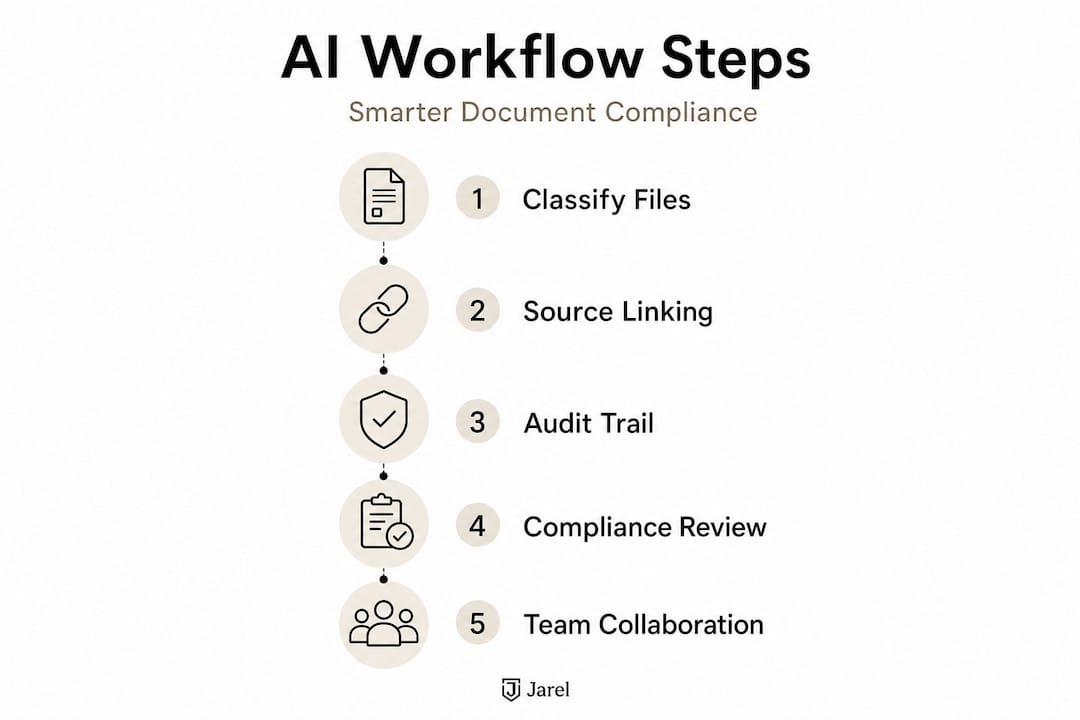
Immutable audit trails are the foundation of this proof. An immutable audit trail is a tamper-proof record of every action taken on a document: who viewed it, who edited it, who shared it, and when. Blockchain-based systems take this further by creating records that cannot be altered retroactively, even by system administrators. This matters enormously in litigation, where opposing counsel or regulators may challenge the integrity of your document records.

Workflow transparency via immutable blockchain audit trails and AI-driven predictive next-steps enhances verifiable compliance for legal teams in ways that traditional systems simply cannot match. Predictive AI can flag when a document is approaching its retention deadline, suggest the next workflow step based on document type, or alert a supervisor when an unusual access pattern occurs.
Here are the everyday practices that build a genuinely verifiable document workflow:
- Access logging: Every document access is recorded with user identity, timestamp, and action type. No exceptions.
- Version control: Every edit creates a new version with a clear record of what changed, who changed it, and why.
- Role separation: The person who creates a document should not be the same person who approves or disposes of it. Separation of duties reduces both error and fraud risk.
- Source linking: Every AI-generated summary, analysis, or recommendation is linked directly to the source document or clause it references. This makes verification instant.
- Legal hold management: When litigation is anticipated, automated holds suspend retention schedules for relevant documents immediately, preventing accidental deletion.
- Periodic compliance reviews: Scheduled audits, combining both automated AI checks and human review, catch gaps before they become violations.
The AI benefits for legal tech conversation increasingly centers on this combination of automation and accountability. The firms seeing the best outcomes are those that use AI to enforce consistency and humans to review exceptions.
Pro Tip: Schedule quarterly compliance reviews that include both an automated system audit and a human review of access logs and retention schedules. This two-layer approach catches the gaps that each method misses on its own.
The real-world challenge: what most legal teams miss about document management
Here is the uncomfortable truth that most implementations get wrong: document management is not a technology problem. It is a culture problem with a technology solution.
Legal teams invest in sophisticated systems, configure the workflows, and then treat it as done. Six months later, attorneys are emailing documents outside the system because it is “faster,” paralegals are creating workaround folders, and the audit trail has gaps that would not survive a discovery request. The system is there. The discipline is not.
Legal Document Management Best Practices are clear on this: the shift from AI handling competence tasks to humans focusing on judgment requires ongoing training, not a one-time rollout. The risks, including data breaches, non-compliance, and litigation exposure, do not disappear because you deployed a new system. They disappear because your team uses the system correctly, every time.
The real-world lesson is that document management success depends on three things that no vendor can sell you: culture, periodic reviews, and readiness for edge cases. Culture means that every person who touches a document understands why the workflow matters, not just how to follow it. Periodic reviews mean that compliance is treated as an ongoing practice, not a checkbox. Readiness for edge cases means that your team has thought through the unusual scenarios, the cross-border matter, the emergency legal hold, the privileged document accidentally shared, before they happen.
The AI-judgment hybrid approach bridges the intention-action gap by making the right behavior the easy behavior. When AI automatically logs access, enforces retention schedules, and flags anomalies, the burden on individual attorneys to “remember” compliance steps is reduced. But it does not eliminate the need for human judgment on the hard calls.
Collaborative responsibility is the final piece. IT, compliance, and legal must own document management together. When IT owns it alone, the system is technically sound but legally naive. When legal owns it alone, the system is legally rigorous but technically fragile. When compliance owns it alone, it becomes a checkbox exercise that nobody trusts. The teams that get this right treat document management as a shared infrastructure, like the firm’s network or its billing system, that everyone depends on and everyone is responsible for maintaining.
Ready to transform your document management workflow?
Legal teams that want compliance and efficiency need more than good intentions. They need a platform built for the specific demands of verifiable, transparent legal work.

Jarel’s source-linked AI platform is designed precisely for this. Every AI-generated output in Jarel is linked directly to its source material, whether that is a contract clause, a statute, or a case citation, so your team can verify results instantly without second-guessing the AI. The platform includes immutable audit logs, granular access controls, and review trails that make compliance demonstrable, not just achievable. Whether your team handles contract review, due diligence, regulatory mapping, or document classification, Jarel provides the structured, accountable workspace that modern legal work demands. Explore how Jarel can bring transparency and traceability to your document workflows today.
Frequently asked questions
What is the difference between a traditional DMS and an AI-powered system?
Traditional DMS focuses on storage and search, while AI-powered systems automate classification, risk flagging, and compliance checks. Hybrid approaches are recommended because AI excels in augmentation but still requires human oversight for judgment, ethics, and complex nuance.
How does AI ensure compliance in legal document management?
AI aids compliance by automating audit trails, predictive workflows, and document access logs, but regulatory review by humans remains essential. Immutable blockchain audit trails and AI-driven predictive next-steps together create a verifiable compliance record that holds up under scrutiny.
What are the biggest risks of poor legal document management?
Major risks include data breaches, non-compliance penalties, and increased litigation vulnerability. Poor document management also creates gaps in audit trails that can undermine a firm’s position in discovery or regulatory investigations.
What is an immutable audit trail and why does it matter?
An immutable audit trail is a tamper-proof record of every document action, including who accessed, edited, or shared a document and when. Blockchain-based audit trails are particularly valuable because they cannot be altered retroactively, making them highly defensible in litigation and regulatory proceedings.