
Responsible AI legal use: governance and best practices
AI is reshaping how legal teams research, draft, and review work at a pace that outstrips most compliance programs. Unlike other industries where a failed algorithm causes inconvenience, a flawed AI output in a legal context can harm clients, breach professional obligations, and trigger regulatory action. The stakes are categorically different. This guide walks legal professionals and compliance officers through the standards, frameworks, and practical workflows that make responsible AI legal use more than a policy document. It is a living discipline your team must own.
Table of Contents
Key Takeaways
| Point | Details |
|---|---|
| Responsible AI is proactive | Legal compliance with AI requires ongoing governance, not just one-time checks. |
| Traceability and documentation | Every AI output used in legal settings must be traceable and easily explained. |
| Use recognized frameworks | Applying frameworks like NIST AI RMF or OECD Due Diligence makes legal compliance realistic and auditable. |
| Account for edge cases | Be vigilant for emergent and third-party risks that standard procedures might overlook. |
| Empowered teams drive success | Real progress in responsible AI comes from cultures of accountability and ownership, not just checklists. |
Why responsible AI matters in the legal profession
Legal professionals operate under obligations that most technology users never face. Attorney-client privilege, duties of competence, confidentiality rules, and regulatory reporting requirements all create a uniquely demanding environment for AI adoption. When an AI system produces a biased contract analysis or generates a case summary with hallucinated citations, the consequences are not just embarrassing. They can be professionally catastrophic.
The risk areas are specific and serious:
-
Bias in outputs: AI models trained on historical legal data can reproduce systemic biases, affecting outcomes in areas like employment law, criminal defense, and lending compliance.
-
Lack of transparency: When a model cannot explain why it flagged a clause or ranked a case as relevant, legal teams cannot defend that output to a client or regulator.
-
Auditability failures: Decisions that cannot be traced back to a source or a reasoning chain are indefensible in regulatory proceedings.
-
Sector-specific compliance gaps: Financial services, healthcare, and government legal teams face additional AI-specific regulations that generic governance frameworks do not cover.
The OECD Due Diligence Guidance establishes that responsible AI legal use is “typically implemented as a due-diligence risk management process across the AI lifecycle.” That framing matters. It signals that governance is not a one-time checkbox but a continuous process woven into how your team operates every day.
“Responsible AI legal use for compliance officers emphasizes traceability, documentation, and governance so outputs can be reviewed and defended, especially in legal and regulatory contexts.”
This is the operating standard. Every AI output your team relies on must be traceable and documented before it influences a legal decision, a client deliverable, or a regulatory filing. Anything less is a liability waiting to surface.
Responsible use is not optional for modern legal organizations. It is a standard operating procedure. The question is not whether your firm will adopt responsible AI practices, but whether you will do it proactively or reactively after something goes wrong.
What does responsible AI legal use involve?
Responsible AI legal use is not a single policy. It is a structured approach applied across the full lifecycle of any AI system your team touches, from the moment you evaluate a vendor through ongoing monitoring of deployed tools.
A widely used methodology for operationalizing this is the NIST AI RMF, which organizes governance controls into four core functions:
| NIST AI RMF function | What it means for legal teams | Practical example |
|---|---|---|
| Govern | Establish policies, roles, and accountability structures | Assign an AI governance lead; create an acceptable use policy |
| Map | Identify risks associated with specific AI applications | Catalog all AI tools in use; assess each for bias and transparency |
| Measure | Test and evaluate AI performance against defined standards | Run accuracy checks on contract review outputs quarterly |
| Manage | Mitigate identified risks and improve systems over time | Retire or retrain models that underperform; log all interventions |
This framework is not theoretical. Legal teams that apply it systematically find they can answer the hard questions: What did the AI do? Why did it do it? Who approved the output? What would we do differently?
Here is how to implement responsible AI legal use step by step:
-
Define your AI inventory. List every tool, model, or AI-assisted feature your team uses, including those embedded in document management or e-discovery platforms.
-
Classify each tool by risk level. A tool that auto-suggests email replies carries different risk than one that flags contract clauses for client review.
-
Establish documentation standards. Every AI-assisted output should include a record of the model used, the data inputs, and the human reviewer who approved it.
-
Build review protocols. No AI output should reach a client or regulator without a qualified human reviewing and signing off on it.
-
Conduct interpretability checks. If your team cannot explain why the AI reached a conclusion, the output is not ready for use.
The AI Risk Management Roadmap from NIST offers detailed guidance on sequencing these steps, particularly for organizations just beginning to formalize their approach. Documentation, review protocols, and interpretability are not bureaucratic overhead. They are the foundation of legal accountability in an AI-enabled practice.
Building compliance workflows for responsible AI
Knowing the framework is one thing. Building it into daily legal workflows is where most organizations struggle. The gap between policy and practice is where legal risk actually lives.
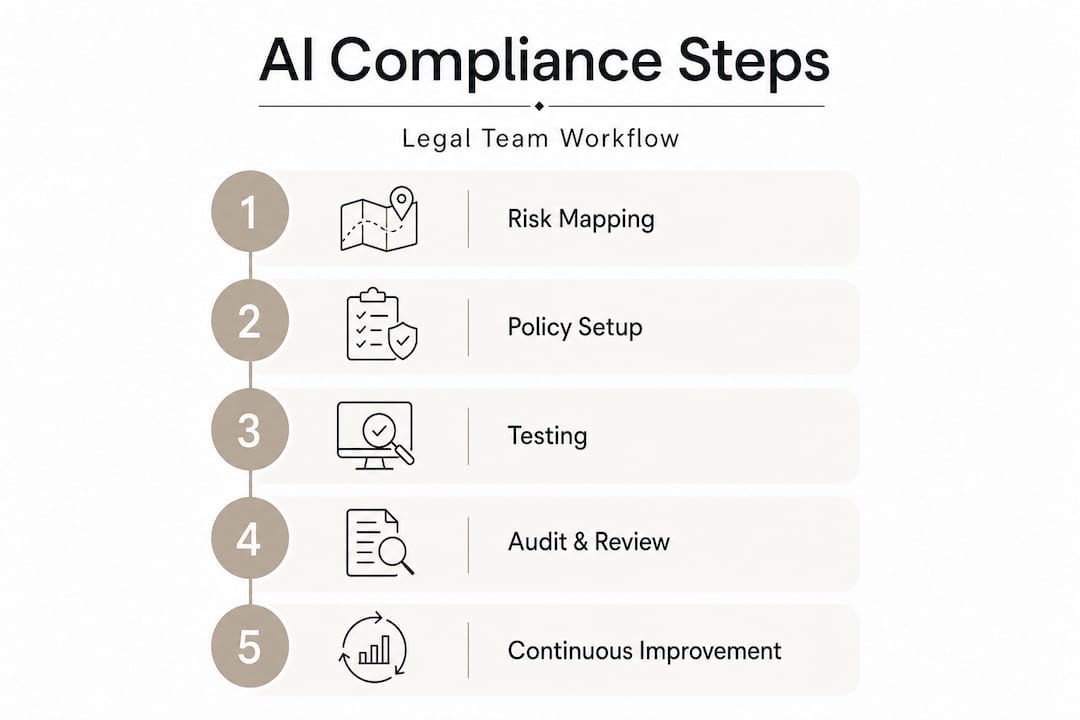
A practical compliance workflow for AI-assisted legal work follows a lifecycle approach. According to NIST’s AI RMF Roadmap, effective workflows require “TEVV-style testing and documented metrics for risk and trustworthiness,” along with auditability so legal teams can defend decisions and explain model-generated outputs. TEVV stands for test, evaluation, verification, and validation. It is a structured quality assurance process borrowed from engineering and adapted for AI governance.
Here is what a practical compliance workflow looks like for a legal team:
| Workflow stage | Key activity | Responsible party |
|---|---|---|
| Risk mapping | Identify AI use cases and classify by risk | Compliance officer |
| Documentation | Record model details, inputs, and intended use | Legal operations lead |
| Governed review | Human attorney reviews and approves AI output | Supervising attorney |
| TEVV testing | Run accuracy, bias, and reliability checks | Legal tech or IT team |
| Audit cycle | Quarterly review of AI outputs and decisions | Compliance officer |
| Incident response | Log and investigate any AI output failures | General counsel or designee |
Pro Tip: Always include a human-in-the-loop at the review stage, not just as a formality but as a genuine check. The attorney reviewing an AI-generated contract summary should be asking: does this match the source document? Can I explain this to the client? Would I stake my professional reputation on this output? If the answer to any of those is uncertain, the output needs more work.
Following the due diligence steps outlined by the OECD reinforces that this is a risk management discipline, not just a technology question. The numbered workflow below gives your team a repeatable process:
-
Map risks before deploying any AI tool in a legal workflow.
-
Document processes so every AI-assisted decision has a paper trail.
-
Review outputs with a qualified human before any external use.
-
Audit regularly to catch drift, errors, and emerging risks.
Maintaining AI documentation standards throughout this process is not just good practice. It is the difference between being able to defend a decision in a regulatory inquiry and scrambling to reconstruct what happened after the fact.
Risk management and edge cases: What most frameworks miss

Standard compliance frameworks give legal teams a solid foundation. But they were largely written for predictable, static systems. AI tools, especially those powered by large language models, are neither predictable nor static. They evolve, sometimes without your knowledge.
Edge cases legal teams should plan for include emergent risks after deployment, third-party data or model changes that shift the risk posture, and the limits of what governance controls can ensure when organizations lack transparency or accountability mechanisms. That last point deserves emphasis. If your vendor cannot tell you what changed in their model update, your governance controls are operating on incomplete information.
Here are the risks that most frameworks underweight:
-
Model drift: AI systems can degrade over time as the legal landscape changes. A contract review model trained on pre-2020 data may miss clauses that are now standard in data processing agreements.
-
Third-party model shifts: A vendor updates their underlying model, changes training data, or modifies how the system handles ambiguous inputs. Your team may not be notified until something goes wrong.
-
Lack of transparency from providers: Some AI vendors treat their models as black boxes. If you cannot get documentation on how a model was trained or tested, you cannot responsibly deploy it in legal work.
-
Accountability gaps: When a workflow spans multiple vendors and tools, it can be unclear who is responsible when an AI output causes harm. Your governance framework must assign that accountability explicitly.
Pro Tip: Build a vendor review cycle into your AI governance calendar. At least twice a year, contact your AI vendors and request updated documentation on model versions, training data changes, and any known failure modes. If a vendor cannot provide this, treat it as a red flag for continued use in sensitive legal workflows.
The risks above are not hypothetical. Legal teams that have adopted AI tools without ongoing governance have found themselves unable to explain outputs during regulatory audits, unable to identify which version of a model produced a specific result, and unable to demonstrate that a human reviewed an AI-generated filing before it was submitted. These are not technology failures. They are governance failures.
Why real accountability, not just checklists, defines responsible AI legal use
Here is an uncomfortable truth that most governance guides avoid: a team that has completed every checklist item can still be operating irresponsibly. Frameworks are maps, not destinations. The NIST AI RMF and OECD guidance are genuinely useful, but they describe what to do, not how to build the organizational culture that makes it stick.
Real accountability in AI-assisted legal work requires three things that no framework can mandate. First, empowered staff who feel safe raising concerns about AI outputs without fear of slowing down a deal or annoying a partner. Second, ongoing education, because the AI landscape changes faster than annual training cycles can track. Third, mechanisms for transparency that go beyond logging. Your team needs to be able to question, challenge, and override AI outputs without bureaucratic friction.
We have seen legal teams treat AI defenses for regulatory audits as a documentation exercise. They produce records that look complete but cannot actually explain the reasoning behind a decision. That is a fragile position. Regulators and opposing counsel are getting better at asking the right questions, and “the AI flagged it” is not an answer that will satisfy anyone.
Defensibility is only as strong as your team’s ability to explain, challenge, and improve AI decisions over time. That means investing in people, not just platforms. It means creating feedback loops where attorneys report AI errors and those reports actually change how tools are used. It means owning the responsibility for fair and lawful AI use rather than outsourcing it to a vendor’s terms of service.
The organizations that get this right are not necessarily the ones with the most sophisticated AI tools. They are the ones where someone senior is genuinely accountable for AI governance, where junior staff feel confident raising concerns, and where the question “can we defend this?” is asked before every AI-assisted output goes out the door.
Solutions that empower responsible AI in legal practice
Putting responsible AI principles into practice requires more than policy documents and good intentions. Legal teams need tools that are built for traceability, auditability, and source-linked transparency from the ground up.

Jarel’s AI platform for legal compliance is designed specifically for this challenge. Every AI-generated output in Jarel is linked directly to its source material, whether that is a contract clause, a statutory provision, or a case citation. Review trails, access controls, and audit logs are built into the workflow, not bolted on afterward. For legal teams that need to demonstrate responsible AI use to clients, regulators, or senior leadership, that architecture makes the difference between a defensible process and an exposed one. If your team is ready to move from framework to practice, Jarel provides the environment where responsible AI legal work actually happens.
Frequently asked questions
What are the main legal risks of using AI in law?
The main risks involve lack of transparency, biased or unverified outputs, and failures to document or explain decisions for clients or regulators. Responsible AI legal use addresses these risks through traceability, documentation, and governed review processes.
How can law firms start building responsible AI workflows?
Begin by mapping where AI is used across your practice, then create controls for documentation, review, testing, auditing, and assign responsible parties for oversight at each stage. NIST AI RMF core functions provide a proven structure for sequencing these steps.
Why are traceability and auditability so important for legal AI outputs?
Without traceability or audit logs, legal teams cannot defend, explain, or correct AI-generated results in regulatory or client disputes. Traceable outputs allow teams to reconstruct exactly what the AI produced, who reviewed it, and what action followed.
What frameworks should legal teams use for responsible AI governance?
Widely accepted options include the NIST AI Risk Management Framework and the OECD Due Diligence Guidance for Responsible AI, both of which provide structured, lifecycle-based approaches to AI governance that translate well into legal practice.