
The Role of AI in Regulatory Analysis for Legal Teams
TLDR:
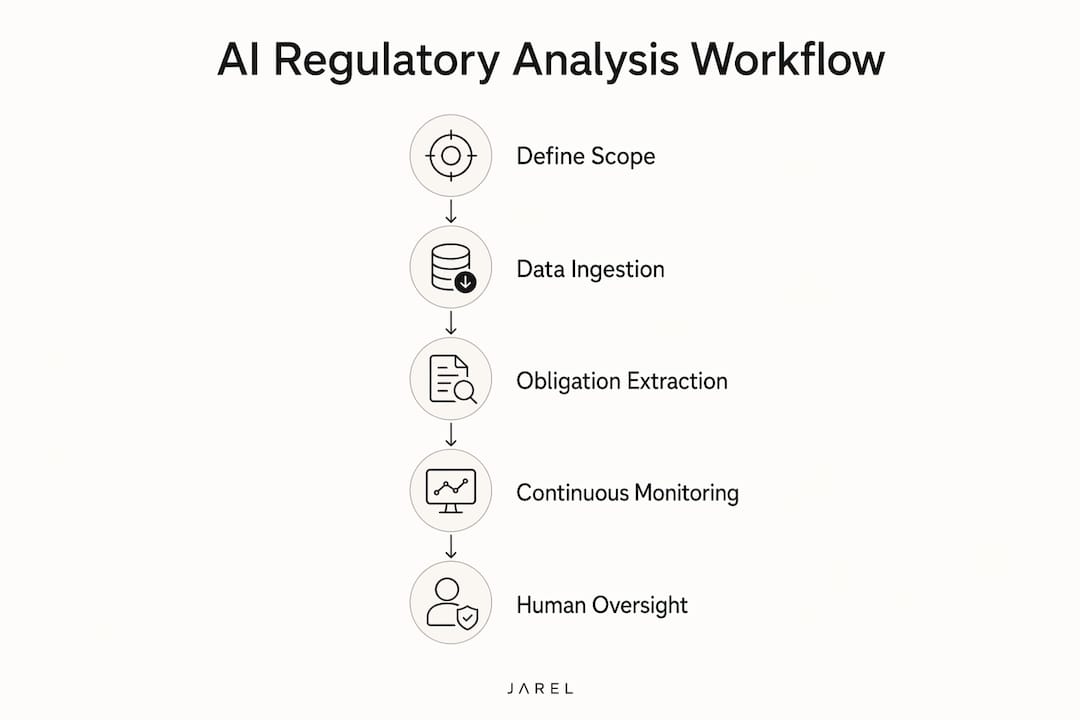
- AI is transforming regulatory analysis by automating the extraction of obligation segments, enabling real-time monitoring, and streamlining document classification. Human oversight remains essential, particularly for results classified as high-severity, while a layered architecture balances speed and semantic accuracy. Responsible AI governance, clear procedures, and continuous validation are critical to successful integration into compliance workflows.
AI in regulatory analysis is defined as decision-support technology that automates the extraction of obligation segments, continuous monitoring, and document classification to help legal professionals meet compliance requirements faster and with greater accuracy. ComplianceNLP demonstrated a 3.1-fold increase in analyst efficiency with 94.2% accuracy in extracting obligation segments—figures that redefine AI not as a convenience but as a structural change in how compliance work is performed. Platforms such as Jarel and agentic AI systems built for federal rulemaking now cover the entire regulatory lifecycle, from initial research to final publication. For legal professionals and compliance officers, understanding this shift is no longer optional.
How AI Transforms the Role of Regulatory Analysis in Compliance Workflows
AI replaces the traditional model of periodic, manual compliance audits with continuous, real-time monitoring. Regulatory communication systems now integrate directly with global agencies such as the FDA, EMA, and WHO, automatically flagging relevant regulatory changes when they are published instead of waiting for a scheduled review cycle. This shift from static snapshots to dynamic intelligence means your team detects a new guidance document on its publication date, not three weeks later when someone finally performs the quarterly review.

Document management is where the efficiency gains become most visible. AI handles classification, metadata extraction, version control, and policy mapping across large document sets that would take a paralegal team days to process manually. AI compliance agents such as those deployed by Sentie maintain audit-ready documentation with detailed context attached to every record, so when an auditor requests evidence of a specific regulation, your team retrieves it in minutes instead of rebuilding the paper trail from scratch. Audit-preparation time drops from weeks to hours when documentation is maintained continuously rather than assembled reactively.
The practical benefits of compliance monitoring fall into four categories:
- Real-time detection of regulatory changes across multiple jurisdictions and regulatory bodies simultaneously
- Automated document classification that tags and routes incoming regulatory changes by business unit, product line, or risk level
- Version control and audit trails that preserve the history of every compliance decision with timestamps and source references
- Policy gap analysis that compares current internal policies with updated external requirements and automatically flags discrepancies
Tips: Configure your AI monitoring policy to filter regulatory changes by jurisdiction and business-specific activities before they reach your team. Unfiltered feeds create distractions that erode analyst confidence in the system within weeks.
What Agentic AI Does to the Federal Rulemaking Lifecycle
Agentic AI systems represent a qualitatively different capability compared with conventional machine-learning regulatory review tools. When conventional AI flags a document for human review, an agentic system coordinates the actions of multiple specialized agents working in parallel through a complex, multi-step process. In federal rulemaking, these systems handle continuous public-comment monitoring, theme clustering across thousands of submissions, and the identification of coordinated campaigns that might otherwise distort the apparent weight of public opinion.
The rulemaking lifecycle contains at least five stages where agentic AI adds measurable value:
- Pre-rule research: Agents scan academic literature, prior regulations, and agency guidance to build a fact-based record before drafting begins.
- Draft creation: AI produces an initial regulatory text with citations to the Administrative Procedure Act and relevant executive orders, giving human drafters a structured starting point.
- Public-comment analysis: Agents classify, deduplicate, and summarize thousands of comments, revealing substantive objections the agency must address.
- Interagency coordination: Intelligent document routing sends draft rules to the appropriate internal and external stakeholders based on subject-matter classification.
- Compliance verification: Before publication, agents check the final rule against the procedural requirements of the Administrative Procedure Act and applicable executive orders.
"Agentic AI requires intentional governance frameworks that include human oversight to preserve the democratic values of regulatory decision-making." — Harvard Journal of Law
Human oversight is not optional in this architecture. It is a design requirement that makes the entire system legally defensible. Every output from an agentic regulatory system carries accountability implications, and the governance framework must define who reviews what, at which stage, and with what authority to override the AI’s recommendation.
Ethical Considerations and Risks in AI-Driven Regulatory Analysis
The governance trilemma in AI regulation involves balancing accessibility, rights, and institutional power. Systems without transparency can marginalize vulnerable groups and create accountability gaps that no single actor is positioned to close. For legal and compliance teams, this is not an abstract concern. It is a matter of professional responsibility.
Specific risks to monitor in any AI regulatory deployment include:
- Epistemological traps: AI systems trained on historical regulatory data encode assumptions about past enforcement priorities. If your jurisdiction shifted its enforcement focus during the past two years, a model trained on older data will systematically underweight the new priorities.
- Algorithmic bias: Obligation-extraction models perform differently across document types, languages, and regulatory sectors. A model calibrated for SEC filings will not achieve the same level of accuracy on FDA guidance documents.
- Accountability gaps: When an AI system flags a compliance issue that turns out to be a false positive, and a business decision is made based on that flag, the chain of accountability becomes unclear without documented human review at every decision point.
- Epistemological blind spots in audits: Independent auditing of AI models presents real challenges because third-party assurance for AI regulatory tools remains underdeveloped, leaving institutions dependent on vendor self-reporting.
Institutional differences in AI adoption also shape how these risks appear. Governments and organizations with different resources and regulatory philosophies build AI systems around fundamentally different priorities, meaning that a multinational compliance program cannot assume that an AI tool calibrated for one jurisdiction will transfer cleanly to another.
The answer to most of these risks is not to avoid AI. It is to build responsible AI governance into the deployment framework from the outset, with documented review protocols, bias-testing schedules, and clear escalation paths for results classified as high-severity.
Practical Strategies for Integrating AI into Legal and Compliance Teams
Selecting the right AI tool begins with mapping your regulatory scope before evaluating any vendor. A mid-sized asset manager’s securities-law team has different monitoring requirements from an in-house environmental-law team at a manufacturing company. AI for securities lawyers requires tools calibrated for the SEC, FINRA, and exchange rules, while an environmental in-house counsel must cover EPA regulations, state environmental agencies, and international frameworks. Buying a general-purpose tool and hoping it covers your specific area is the most common and costly mistake in this space.
Technical architecture matters more than most buyers realize. Successful AI regulatory tools combine a fast rule-based layer for binary pass/block decisions with a slower interpretive layer using large language models for semantic understanding of complex obligation segments. The rule-based layer handles volume; the LLM layer handles nuance. Teams that use only one layer get either speed without accuracy or accuracy without scale.
| Aspect | Rule-based AI layer | LLM interpretive layer |
|---|---|---|
| Speed | Fast, near real-time | Slower, adds latency |
| Best use case | Binary compliance checks | Nuanced obligation-segment analysis |
| Risk | Misses contextual edge cases | Higher computational cost |
| Human-review trigger | Exceptions and escalations | Always for high-severity findings |
Human-in-the-loop workflows are not a workaround for AI limitations. They are a professional standard. Results classified as high-severity always require human expert judgment regardless of the AI confidence score, and your governance policy should state this clearly. Staff training must cover not only how to use the tool but also how to recognize when an AI output warrants skepticism, which is a different and more demanding skill than simply reading a dashboard.
Tips: Run a parallel validation exercise during the first 90 days after deploying any AI compliance tool. Have your team manually review a sample of AI-flagged or AI-approved items to calibrate your confidence in the system before reducing manual oversight.
For legal document management, the most durable integrations connect AI classification and monitoring directly to the document repository, so every regulatory change automatically triggers a review of relevant internal policies without requiring your team to initiate it manually.
Key Takeaways
AI in regulatory analysis delivers the greatest value when it combines continuous monitoring, layered technical architecture, and documented human oversight within a single governed workflow.
| Point | Details |
|---|---|
| Efficiency gains are real and measurable | ComplianceNLP achieved a 3.1-fold increase in analyst efficiency with 94.2% accuracy in obligation-segment extraction. |
| Continuous monitoring replaces periodic audits | Real-time regulatory intelligence reduces audit-preparation time from weeks to hours. |
| Agentic AI covers the entire regulatory lifecycle | Multi-agent systems autonomously handle comment analysis, draft production, and interagency coordination. |
| Human oversight is a design requirement | Results classified as high-severity always require human review; governance policies must state this clearly. |
| Architecture determines performance | Combining rule-based and LLM layers balances speed and semantic accuracy across document types. |
Where I Think Most Compliance Teams Are Getting This Wrong
The teams I see struggling most with AI adoption in regulatory analysis are not the ones with the wrong tools. They are the ones with the right tools and no governance. They buy a capable AI platform, deploy it in their regulatory-monitoring workflow, and then treat every output as authoritative because the accuracy numbers looked good in the demos. That is a category error.
AI in this area is a real-time compliance dashboard, not a compliance officer. The distinction matters considerably when a regulator asks who made a particular compliance determination and why. If the answer is “the AI flagged it as clear,” you have an accountability problem that no indemnification clause in the vendor contract will solve.
Institutional barriers to AI adoption are real, but they are not primarily technical. They are cultural. Senior lawyers who built their careers on manual regulatory expertise often approach AI outputs with reflexive skepticism, while junior staff approach them with reflexive trust. Neither attitude serves the client. Teams that get this right build a shared framework for when to trust AI, when to verify it, and when to override it, and document that framework as firm policy rather than leaving it to individual discretion.
The legal AI ethics framework conversation is maturing quickly, and firms that engage with it now will be better positioned when regulators begin asking tougher questions about AI governance in legal practice. The efficiency gains are real. The risks are manageable. But only if governance is treated as a first-order concern rather than an afterthought.
— Albin
How Jarel Supports Your Regulatory Analysis Workflows
Jarel is built specifically for the accountability requirements that make deploying AI in legal and compliance work different from any other industry. Every AI output in Jarel is linked directly to its source material, whether that is a regulatory provision, contract clause, or agency guidance document, so your team can verify the basis of any finding in seconds instead of reconstructing it from memory.

The Jarel Outlook add-in brings AI-assisted contract and regulatory-document review directly into email, with source citations and an audit trail attached to every analysis. Jarel Playbooks lets you configure firm-specific compliance rules that run automatically on incoming documents, flagging exceptions before they reach signature. Both tools are built with audit logs, access controls, and human-review checkpoints that meet the governance requirements imposed by firms’ professional-responsibility obligations. If you want to see how this works against your specific regulatory landscape, Jarel offers tailored demonstrations for legal and compliance teams.
FAQ
What is the role of AI in regulatory analysis?
AI in regulatory analysis functions as a decision-support system that automates the extraction of obligation segments, continuous monitoring of regulatory changes, and document classification. It complements human legal judgment rather than replacing it, and all results classified as high-severity require review by a human expert.
How does AI improve compliance monitoring accuracy?
AI compliance systems such as ComplianceNLP achieve up to 94.2% accuracy in extracting obligation segments, replacing error-prone manual reviews with consistent, scalable analysis. Accuracy depends on the quality of the training data and whether the tool uses a layered architecture that combines rule-based and LLM components.
What is agentic AI and how does it apply to regulatory work?
Agentic AI systems coordinate the actions of multiple specialized agents that independently handle complex, multi-step regulatory processes, such as public-comment analysis, regulatory-draft creation, and interagency collaboration. Human oversight is mandatory at every decision point to preserve accountability.
What are the main risks of using AI for regulatory compliance?
The main risks include algorithmic bias from historically trained models, accountability gaps when AI outputs guide decisions without documented human review, and epistemological blind spots where independent auditing of AI models remains technically underdeveloped.
How should legal teams structure human oversight of AI compliance tools?
Legal teams can define explicit governance practices specifying which AI outputs require human review, at what confidence level escalation is triggered, and who has final decision-making authority. Parallel validation exercises during the first 90 days of implementation help calibrate the appropriate confidence level before reducing manual oversight.