
The Role of Treatise in Legal Study: 2026 Guide
TL;DR:
- A legal treatise is a scholarly publication that interprets and organizes an entire area of law, making it an authoritative secondary source. Treatises synthesize statutes, case law, and regulations into coherent frameworks, shaping legal reasoning and understanding. Despite AI advances, treatises remain essential for verified analysis, doctrinal evolution, and resolving conflicting interpretations.
A legal treatise is a detailed, scholarly publication that interprets and organizes an entire area of law, making it one of the most authoritative secondary sources available to law students and legal scholars. The role of treatise in legal study goes far beyond simple reference. Treatises synthesize statutes, case law, and regulations into coherent frameworks that no single primary source provides on its own. Collier on Bankruptcy, for example, has been cited over 30,000 times in American courts, including 126 U.S. Supreme Court decisions. That citation record rivals many primary sources in persuasive power and signals just how deeply treatises shape legal reasoning at every level.
What is the role of treatise in legal study?
A legal treatise does something no statute or court opinion does alone: it explains the law. Statutes set rules. Cases apply them. Treatises interpret both, trace their development, and show how they interact across jurisdictions. For law students and legal scholars, that interpretive layer is where real understanding begins.
Treatises range from compact single volumes to expansive sets exceeding 20 volumes. That range reflects the depth of coverage they provide. A one-volume treatise on contract law might cover formation, performance, and breach with enough depth to anchor a semester of study. A 20-plus volume set on federal taxation maps every statutory provision, Treasury regulation, and relevant circuit decision in one organized system.
The scholarly nature of treatises is what separates them from other legal study resources. Authors are typically recognized experts, often law professors or senior practitioners, who spend years building a unified analysis of their subject. That expertise produces something genuinely useful: a framework for resolving conflicting interpretations before you ever open a case reporter.
- Synthesis of primary law. Treatises pull together statutes, regulations, and case decisions that would take weeks to locate independently.
- Doctrinal clarity. They explain what the law means, not just what it says, which is the gap most law students struggle to close.
- Cross-jurisdictional mapping. Multi-volume treatises track how different circuits or states have resolved the same legal question.
- Research efficiency. Cross-references inside treatises point directly to primary sources, cutting research time on complex matters.
Pro Tip: When starting research in an unfamiliar area of law, read the relevant treatise chapter before opening any database. The doctrinal overview will make your case law search faster and more targeted.
Why do legal treatises still matter in the age of AI?
Legal AI tools have changed how scholars and students access information, but they have not replaced what treatises provide. Research from 2026 confirms that treatises offer reliable human expertise and authoritative stability that large language models currently cannot match. AI tools can retrieve and summarize, but they lack consistent verification of legal accuracy across jurisdictions and time periods.
The distinction matters in practice. An AI tool might surface a case that appears on point but misread its procedural posture. A treatise written by a bankruptcy law expert will explain not just the rule but the conditions under which courts have applied it, the exceptions that have developed, and the circuits that disagree. That level of curated analysis is what legal scholars call a “professional talisman,” a structured knowledge framework that goes beyond what any search algorithm produces.
“Treatises freeze the law at a point in time, revealing the trajectory of doctrinal changes. They embody both law as it is and as it should be.” — Legal History Blog, Wilf on the Legal Treatise
That quality of capturing law’s evolution makes treatises irreplaceable for scholars studying doctrinal change. A treatise published in 1985 and updated through 2026 shows you exactly how a legal doctrine shifted, which cases drove the change, and what the current consensus looks like. No AI tool reconstructs that trajectory with the same reliability.
- Treatises provide verified, expert-curated analysis that AI tools do not consistently replicate.
- They document doctrinal evolution across decades, giving scholars a longitudinal view of legal change.
- Their cross-references guide researchers to primary law, which AI summaries often skip or compress.
- They remain cited in judicial opinions and academic writing as authoritative secondary sources.
Common misconceptions about using treatises effectively
The most common mistake law students make is treating a treatise as binding law. It is not. Treatises carry persuasive authority only. No court is required to follow a treatise’s analysis, even when that treatise has been cited thousands of times. The correct use is to let the treatise guide you to the primary sources that do bind the court.
A second misconception is that a treatise is always current. Multi-volume works update sections at different times, and neglecting to check update cycles risks citing analysis that a recent statute or circuit decision has already overtaken. This is especially dangerous in fast-moving areas like securities regulation, immigration law, or data privacy.
Authorship bias is a third issue scholars rarely discuss. A treatise reflects its author’s perspective on what the law is and what it should be. Two treatises on the same subject can reach different conclusions about unsettled questions. Recognizing that perspective is part of using treatises critically rather than uncritically.
- Verify the update date. Check when the specific section you are citing was last revised, not just the publication year of the volume.
- Trace every primary source. Use the treatise’s citations to find the actual statutes and cases, then read them directly.
- Compare multiple treatises. On contested legal questions, two authoritative treatises may disagree. That disagreement is itself useful information.
- Note the author’s position. If the author has argued for a particular legal reform, their analysis of unsettled law may reflect that preference.
Pro Tip: For legal research accuracy, always cross-check a treatise citation against a primary source database before including it in a brief or scholarly paper. Treatises point the way; primary sources close the argument.
How do treatises shape legal education and litigation?
Treatises serve law students and legal scholars as the deepest available introduction to any legal subject. University legal research guides consistently list treatises as foundational educational resources because they provide the doctrinal depth that casebooks compress or omit. A first-year student reading a contracts casebook gets edited opinions. A student who also reads Corbin on Contracts gets the full doctrinal architecture behind those opinions.

In litigation, the impact of treatises on law is direct and measurable. Lawyers use them to build arguments in areas where primary law is sparse or conflicting. The most influential treatises help attorneys identify stronger arguments amid circuit splits, giving judges a scholarly basis for choosing one interpretation over another. Federal judges cite treatises in opinions precisely because a well-regarded treatise signals that an interpretation has survived expert scrutiny.
| Application | How treatises help |
|---|---|
| Law school coursework | Provide doctrinal depth beyond casebook excerpts |
| Moot court and law review | Supply authoritative secondary support for novel arguments |
| Litigation briefing | Identify the strongest position in split-circuit disputes |
| Judicial opinions | Offer scholarly validation for interpretive choices |
| Regulatory compliance | Map statutory text to agency guidance and case law |
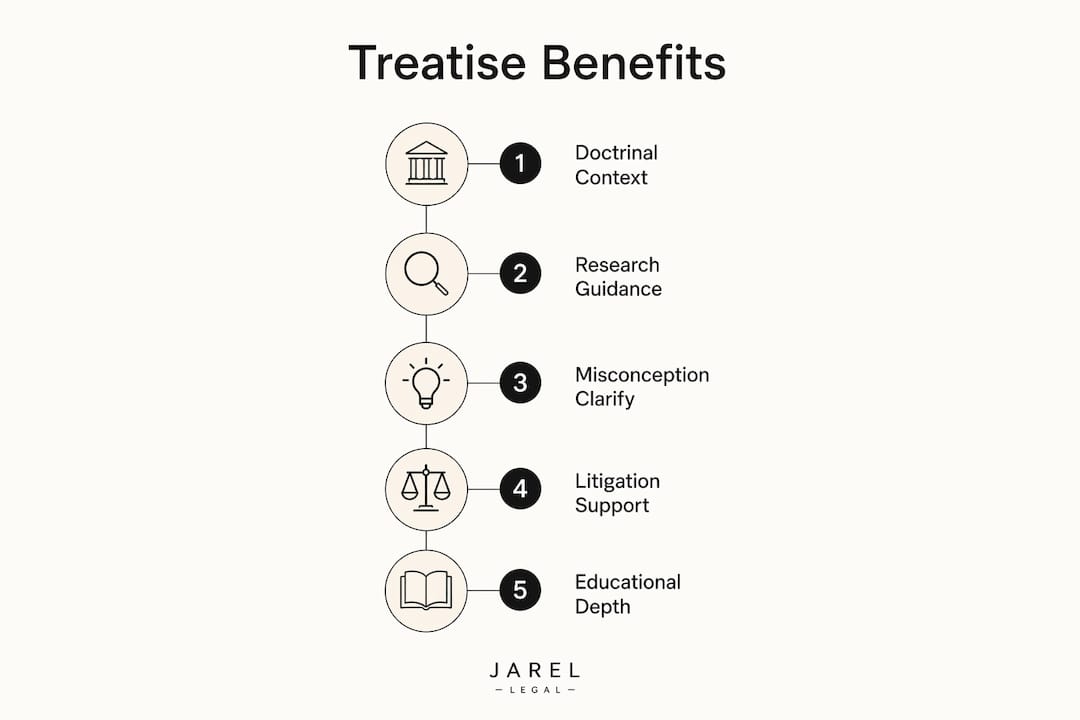
Experienced researchers use treatises’ narrative structure and cross-references to map primary law efficiently, especially in complex multi-jurisdictional matters. That research path function is particularly valuable when a legal question touches federal statute, state common law, and agency regulation simultaneously. A good treatise shows how those layers interact before you spend hours trying to reconstruct the relationship yourself.
- Treatises anchor legal scholarship by providing a stable reference point for doctrinal analysis.
- They help students move from surface-level case reading to genuine doctrinal understanding.
- In courts, they give judges a credible secondary source to cite when primary law is ambiguous.
- For effective case law use, treatises provide the doctrinal context that makes individual decisions intelligible.
Key Takeaways
Legal treatises remain the most authoritative secondary sources in legal study, providing human-verified doctrinal analysis that guides students, scholars, and courts alike.
| Point | Details |
|---|---|
| Treatises interpret, not just report | They synthesize statutes, cases, and regulations into frameworks no single primary source provides. |
| Persuasive, not binding | Courts may follow treatise analysis, but researchers must always trace arguments back to primary law. |
| Currency check is non-negotiable | Multi-volume treatises update sections at different times; always verify the revision date of the specific section cited. |
| AI does not replace treatises | Large language models lack the consistent verification and doctrinal depth that expert-authored treatises provide. |
| Educational and litigation value | Treatises deepen law school learning and help lawyers identify the strongest arguments in contested legal areas. |
Why I think scholars underestimate what treatises actually do
Most legal writing treats treatises as reference books. That framing undersells them. A treatise is a sustained argument about what the law is, written by someone who has spent years inside a single legal domain. When you read a chapter of Collier on Bankruptcy or Wigmore on Evidence, you are not just retrieving information. You are engaging with a structured legal mind that has already done the work of reconciling conflicting authorities.
I have watched law students skip treatises entirely because they assume a database search covers the same ground. It does not. A keyword search returns documents. A treatise returns judgment. The difference shows up when a student tries to explain why two circuits reached opposite conclusions on the same statutory text. The database gives you both opinions. The treatise tells you which argument is stronger and why.
The AI question is real but often framed wrong. The concern is not whether AI will replace treatises. The concern is whether researchers will stop reading treatises because AI makes retrieval feel complete. Retrieval and analysis are not the same thing. A responsible AI research workflow uses AI to locate sources and treatises to understand them.
My honest recommendation: treat every treatise as a conversation with an expert who has already read everything you are about to search. Start there. Then go to primary sources. Then use digital tools to verify currency and completeness. That sequence produces better legal analysis than any single-tool approach.
— Albin
Jarel’s approach to source-linked legal research
Legal research works best when AI output stays connected to the sources behind it. Jarel is built on exactly that principle. Every AI-generated output in Jarel links back to the source material, whether that is a contract clause, a statutory provision, or a secondary authority like a treatise. That traceability is what makes AI assistance usable in professional legal work.

Jarel supports the full research and review workflow, from initial document analysis through compliance mapping and drafting. The Outlook Add-In brings source-linked AI directly into your inbox, so legal analysis stays connected to its sources without switching platforms. For teams managing contract review at scale, Jarel’s Playbooks apply consistent review rules across documents, grounded in the same authoritative standards that treatises help define. If you want AI that respects the depth that legal scholarship demands, Jarel is built for that standard.
FAQ
What is a legal treatise?
A legal treatise is a scholarly, book-length publication that interprets and organizes an entire area of law, written by recognized experts. It functions as a secondary authority that synthesizes statutes, case law, and regulations into a coherent analytical framework.
Are legal treatises binding on courts?
Treatises carry persuasive authority only and do not bind courts. Judges may cite them to support an interpretation, but the binding authority always comes from primary sources such as statutes and precedential case law.
How do treatises aid legal research?
Treatises aid legal research by providing doctrinal context, resolving conflicting interpretations, and pointing researchers directly to relevant primary sources through cross-references. Experienced researchers use them to map complex legal questions before conducting primary source searches.
How often are legal treatises updated?
Update frequency varies by publisher and subject area. Multi-volume treatises often update individual sections at different times, so researchers must check the revision date of the specific section they are citing, not just the overall publication year.
Can AI tools replace legal treatises?
AI tools cannot replace legal treatises. Research confirms that treatises provide human-verified expertise and authoritative stability that large language models currently lack, making them irreplaceable for deep doctrinal analysis and reliable legal scholarship.