
AI-Assisted Compliance Review Explained for Legal Teams
AI-assisted compliance review means using artificial intelligence technologies, primarily machine learning and natural language processing (NLP), to automate and strengthen the process of checking documents, contracts, and organizational practices against legal and regulatory requirements. The AI does not replace legal judgment. It handles the volume work: scanning thousands of pages, flagging deviations from policy, and generating audit trails that a human reviewer then verifies and acts on.
The core components of any AI-assisted compliance review program include:
- Automated document analysis: NLP models read contracts, policies, and regulatory filings to identify relevant clauses, obligations, and risk language.
- Regulatory benchmarking: The system maps document content against applicable rules, such as HIPAA, PCI-DSS, or state AI bills, and surfaces gaps.
- Continuous monitoring: Machine learning models watch transaction data, communications, and system logs for anomalies that signal compliance risk.
- Audit trail generation: Every AI action, flag, and reviewer decision is logged automatically, creating the evidence record regulators actually examine.
- Human oversight layer: Attorneys and compliance officers review AI outputs, override incorrect flags, and make final determinations on ambiguous findings.
The NIST AI Risk Management Framework and sector-specific laws like HIPAA increasingly require that AI decision-making be auditable and traceable, which means the transparency of your AI tooling is now a compliance requirement in its own right.
Pro Tip: Before deploying any AI compliance tool, confirm it produces source-linked outputs. A flag that cannot be traced to a specific clause or regulatory provision is nearly impossible to defend in an audit.
Table of Contents
- How AI is applied in compliance workflows and contract analysis
- How government agencies and regulators are using AI in compliance enforcement
- What are the real challenges and ethical risks of AI in compliance review?
- Best practices for implementing AI-assisted compliance review
- Which U.S. regulatory frameworks shape AI compliance review in 2026?
- How Jarel supports AI-assisted compliance review for legal professionals
- Jarel gives legal teams a verifiable AI compliance workflow
- Key Takeaways
- FAQ
How AI is applied in compliance workflows and contract analysis
The practical applications of AI in compliance review span the full document lifecycle, from intake through execution and ongoing monitoring.
Document review and classification is where AI delivers the most immediate time savings. NLP models can read and categorize contracts, policies, and regulatory submissions at a pace no human team can match. They extract key terms, identify missing provisions, and flag language that deviates from a pre-approved playbook.
Contract analysis is a specific and high-value use case. AI tools compare contract language against standard clause libraries, identify non-standard indemnification or limitation-of-liability provisions, and score overall risk. Legal teams using AI for contract review report that reviewers spend far less time on routine first-pass work and more time on the genuinely ambiguous provisions that require legal judgment.

Regulatory benchmarking involves mapping document content against a defined regulatory framework. The AI reads a privacy policy, for example, and checks each section against GDPR or CCPA requirements, producing a gap report the compliance team can act on directly.
Alert monitoring is where machine learning adds a layer of continuous oversight. Systems watch for transaction patterns, access anomalies, or policy violations in real time, generating alerts that compliance teams triage. AI-augmented alert review systems help compliance teams work up to an estimated 40% faster and reduce false positives by an estimated 20–30%, according to PwC's Enterprise Control platform data.
| AI Application | Technology Used | Primary Benefit |
|---|---|---|
| Document classification | NLP, machine learning | Faster intake and routing |
| Contract clause extraction | NLP, transformer models | Identifies risk language at scale |
| Regulatory gap analysis | Rule-based AI, NLP | Maps obligations to requirements |
| Alert triage | Machine learning, anomaly detection | Reduces false positive volume |
| Audit trail generation | Automated logging | Produces defensible evidence records |
How government agencies and regulators are using AI in compliance enforcement
Regulatory agencies are not just watching organizations adopt AI. They are deploying it themselves. The SEC, FINRA, and the IRS have all invested in machine learning tools to detect anomalies in filings, flag suspicious trading patterns, and prioritize audit targets. This matters for compliance teams because the bar for what constitutes a defensible compliance record is rising as regulators gain more sophisticated detection capabilities.
Key developments in government AI adoption include:
- Automated filing analysis: Agencies use NLP to scan regulatory submissions for inconsistencies, missing disclosures, and language that deviates from required formats.
- Anomaly detection in financial data: Machine learning models identify unusual transaction patterns that warrant investigation, replacing manual sampling with continuous coverage.
- Cybersecurity compliance monitoring: Federal frameworks like NIST Cybersecurity Framework 2.0 now inform how agencies assess whether organizations have adequate controls in place, and AI tools help both sides of that assessment.
- Risk-based audit targeting: Rather than random selection, regulators increasingly use predictive models to identify which organizations or filings carry the highest risk of non-compliance.
The practical implication is straightforward: if a regulator's AI flags your organization, the examination that follows will look for the same evidence your own AI compliance program should already be generating. Regulators prioritize audit logs and documented human oversight over policies alone. A well-documented AI compliance program is not just good governance. It is your first line of defense when an agency comes asking.
What are the real challenges and ethical risks of AI in compliance review?
AI compliance tools carry genuine risks that legal professionals need to understand before deployment, not after an incident.
The "authority illusion" is the most underappreciated risk. Reviewers tend to accept AI outputs without independent verification, especially when the system presents findings with apparent confidence. Research on AI-assisted compliance published in MIS Quarterly Executive describes this as a core tension: the more fluent and authoritative an AI output appears, the more likely a reviewer is to skip the verification step that would catch an error. The authority illusion risk means teams must build independent validation into their workflows by design, not as an afterthought.
Bias in training data produces skewed outputs. If the data used to train a contract review model overrepresents one industry or jurisdiction, the model will perform poorly on contracts from other sectors or governed by different law. This is not a hypothetical. It is a documented failure mode that compliance teams inherit when they deploy AI without understanding its training provenance.
"Black box" opacity creates accountability gaps. When an AI flags a contract clause as high-risk but cannot explain why, the reviewer has no basis for accepting or rejecting the flag. Explainability is not a nice feature. It is a prerequisite for defensible compliance work.
Additional challenges include:
- Data privacy and security: AI compliance tools process sensitive, often privileged documents. Any tool that sends data to external servers without adequate controls creates its own compliance exposure under HIPAA, state privacy laws, or attorney-client privilege rules.
- False negatives: AI systems miss things. A model that flags 95% of problematic clauses still misses 5%, and those misses tend to cluster around novel or unusual language the model has not seen before.
- Regulatory uncertainty: The legal status of AI-generated compliance outputs is still unsettled in many jurisdictions. Using an AI tool does not transfer legal responsibility to the vendor.
Pro Tip: Route any AI finding that cannot be traced to a specific source document or regulatory provision directly to a subject-matter expert. Never let an unverifiable flag sit in a queue without human escalation.
Best practices for implementing AI-assisted compliance review
Effective implementation follows a governance-first sequence. The technology comes after the framework, not before.
Start with a compliance impact assessment. Before any AI tool goes live, map it against the regulations your organization is subject to. Identify which data the tool will process, where that data will be stored, and what controls the vendor has in place. Vendor attestations confirming regulatory compliance are a procurement requirement, not an optional extra.
Build a human-in-the-loop workflow. AI handles the first pass. Humans make the final call. This is not just good practice. It is what frameworks like the NIST AI RMF and ISO/IEC 42001 require for high-risk AI deployments. Design your workflow so that every AI output has a named human reviewer responsible for accepting, modifying, or rejecting it.
Retain evidence continuously, not just before audits. Most compliance failures trace back to poor evidence retention. Regulators want to see a continuous record of reviews, decisions, and policy acknowledgments, not a document dump assembled the week before an examination.
A practical implementation checklist:
- Complete a compliance impact assessment before deployment.
- Require vendor attestations covering data handling, security, and regulatory alignment.
- Define clear KPIs for AI compliance effectiveness, not just binary pass/fail metrics.
- Assign named human reviewers to every AI-generated output.
- Configure automated audit trail generation from day one.
- Schedule quarterly reviews of AI outputs against current regulatory requirements.
- Update training data and model parameters after every regulatory change or internal incident.
- Establish an escalation path for ambiguous AI findings that routes them to subject-matter experts.
- Document every override of an AI recommendation, including the rationale.
- Run periodic control effectiveness assessments to surface gaps before a regulator does.
Continuous monitoring and defined KPIs keep the program current as regulations evolve. Treating AI compliance as a one-time certification is the single most common mistake organizations make.
Which U.S. regulatory frameworks shape AI compliance review in 2026?
Several frameworks now directly govern how organizations deploy and document AI in compliance workflows. Understanding which ones apply to your organization is the prerequisite for any responsible AI compliance program.
NIST AI Risk Management Framework (NIST AI RMF): The primary voluntary framework for managing AI risk across the full AI lifecycle. It provides a structured approach to identifying, measuring, and mitigating AI risk without prescribing a specific regulatory outcome. Most enterprise AI governance programs use NIST AI RMF as their internal risk management backbone.
ISO/IEC 42001: The international standard for AI management systems. Unlike NIST AI RMF, it is certifiable, meaning organizations can demonstrate compliance to external auditors and customers through third-party certification. Many organizations use both: NIST AI RMF for internal risk management and ISO/IEC 42001 for external assurance.
HIPAA: In healthcare, any AI tool that processes protected health information must meet HIPAA's data handling, access control, and audit requirements. This applies to AI compliance tools themselves, not just the underlying clinical systems.
PCI-DSS: Payment card data processed by AI compliance tools falls under PCI-DSS scope. Organizations in financial services need to confirm that their AI vendors meet the same PCI-DSS controls they do.
State AI legislation: A growing patchwork of state bills, including laws in Colorado, Texas, and Illinois, impose transparency, impact assessment, and human oversight requirements on AI systems used in consequential decisions. The regulatory landscape is evolving fast enough that compliance teams need a process for tracking new state requirements, not just a one-time legal review.
Additional frameworks shaping AI compliance review:
- NIST Cybersecurity Framework 2.0: Governs how AI tools interact with organizational security controls and informs how agencies assess cybersecurity compliance.
- FTC guidance on AI: The Federal Trade Commission has issued guidance on deceptive AI practices and is actively enforcing against organizations that misrepresent AI capabilities or fail to disclose AI use in consumer-facing decisions.
- Sector-specific guidance: Financial services (OCC, FINRA), healthcare (HHS), and federal contractors (FAR/DFARS) each have AI-specific guidance layered on top of the general frameworks above.
How Jarel supports AI-assisted compliance review for legal professionals
Jarel is built around the principle that AI outputs in legal work must be traceable to their source. Every finding the platform generates links directly to the underlying contract clause, statute, or case law that supports it. That source-linked architecture is what makes Jarel's outputs defensible in an audit or a regulatory examination, rather than just useful internally.
For compliance workflows specifically, Jarel provides:
- Source-linked document review: Every flagged clause or compliance gap is tied to the specific document section and regulatory provision that triggered it, so reviewers can verify the finding without retracing the AI's steps.
- Audit logs and review trails: The platform records every action, every reviewer decision, and every override, generating the continuous evidence record that regulators actually examine.
- Access controls: Sensitive compliance documents stay within defined permission boundaries, supporting privilege protection and data security requirements under HIPAA and state privacy laws.
- Regulatory mapping: Jarel maps contract and policy language against applicable frameworks, helping legal teams identify gaps before they become enforcement issues.
- Contract review and due diligence workflows: The platform handles AI-assisted due diligence and contract analysis within a single environment, reducing the risk of findings falling through the gap between separate tools.
The human oversight layer is built into the workflow, not bolted on. Reviewers accept, modify, or reject every AI output, and those decisions are logged automatically. That design directly addresses the authority illusion risk: the platform makes independent verification the default, not an optional step.
Pro Tip: Use Jarel's review trail feature to document not just what the AI flagged, but what the human reviewer decided and why. That decision record is what distinguishes a defensible compliance program from one that simply ran an AI tool.

Jarel gives legal teams a verifiable AI compliance workflow
Legal and compliance professionals who have read this far know the core problem with most AI compliance tools: they generate outputs without the traceability that makes those outputs usable in a real regulatory context. Jarel was built to close that gap.

Where generic AI tools produce findings you have to manually trace back to source documents, Jarel's source-linked workspace keeps every output connected to the clause, statute, or precedent that supports it. Your team gets the speed of AI review with the audit trail that regulators and courts actually require. The platform covers contract review for in-house counsel, regulatory mapping, due diligence, and document classification, all within one environment that logs every decision automatically.
If your compliance program needs to demonstrate continuous, documented human oversight rather than just a policy document, Jarel's review playbooks give you the rule-based framework to standardize that process across your team. You can start a trial or request a walkthrough at jarel.se.
Key Takeaways
AI-assisted compliance review requires source-linked AI outputs, continuous audit trails, and named human reviewers for every AI-generated finding to satisfy regulatory scrutiny in 2026.
| Point | Details |
|---|---|
| AI handles volume, humans decide | AI automates document scanning and flagging; attorneys and compliance officers make all final determinations. |
| Speed and accuracy gains are real | AI-augmented alert review systems can work up to an estimated 40% faster and reduce false positives by an estimated 20–30%. |
| Evidence retention is what regulators examine | Regulators prioritize continuous audit logs and documented human oversight over policies or AI tool usage alone. |
| Authority illusion is a design risk | Reviewers must independently verify AI outputs; workflows should route ambiguous findings to subject-matter experts by default. |
| Jarel provides source-linked compliance workflows | Jarel connects every AI output to its source document, logs all reviewer decisions, and supports regulatory mapping within one platform. |
FAQ
What does AI-assisted compliance review mean?
AI-assisted compliance review means using machine learning and NLP to automate document analysis, regulatory gap detection, and audit trail generation, while keeping human reviewers responsible for all final compliance decisions.
What is the AI compliance process?
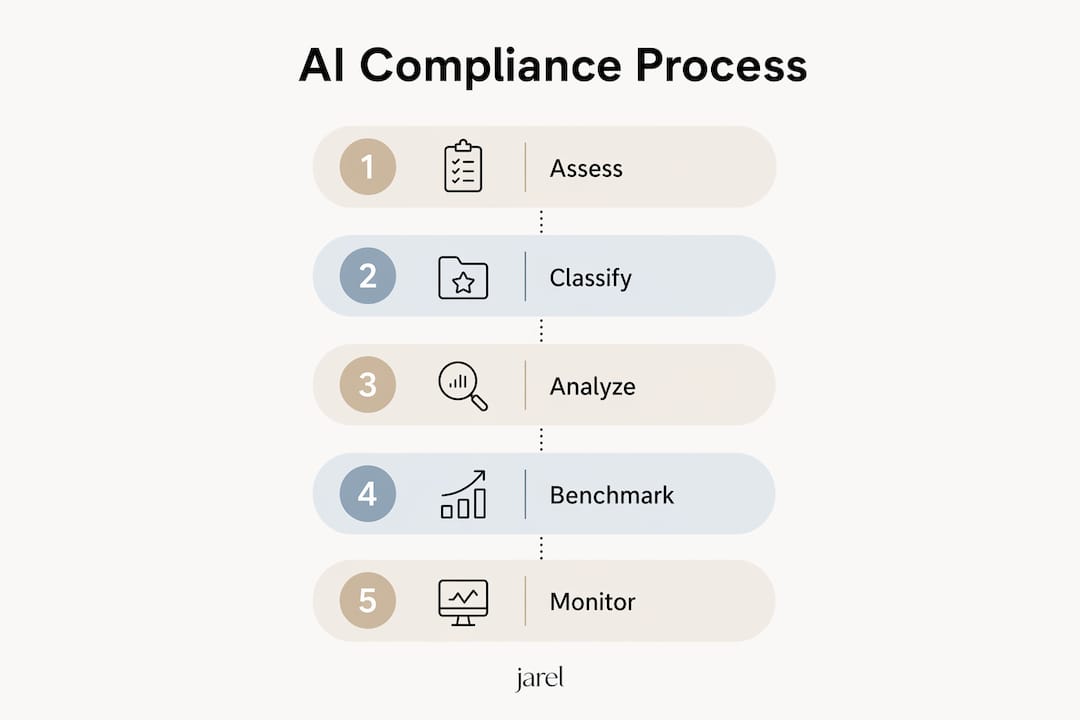
The AI compliance process combines governance policy-setting, risk identification, and continuous verification: AI tools scan documents and monitor systems, human reviewers validate findings, and audit logs capture every decision for regulatory examination.
What is an AI-assisted document review?
AI-assisted document review uses NLP models to read, classify, and extract key information from contracts and regulatory filings at scale, flagging provisions that require human attention rather than replacing the attorney's judgment on those provisions.
How do you pass an AI compliance assessment?
Passing an AI compliance assessment requires continuous evidence: audit logs showing active human review, documented override decisions, vendor attestations confirming data handling controls, and defined KPIs demonstrating ongoing monitoring rather than a one-time review.
What is the meaning of AI compliance?
AI compliance is the evidence-backed state of having the right policies, controls, records, and oversight in place so an AI deployment satisfies applicable legal, regulatory, and ethical obligations across its full operational lifecycle.