
What does AI model accountability mean for legal teams?
In short:
- AI model accountability requires shared responsibility across developers, implementers, and users, supported by concrete documentation. It includes transparency, traceability, explainability, and ongoing monitoring to prevent harms such as bias, hallucinations, and privacy breaches. Legal teams must demand verifiable artifacts such as model cards and audit logs to ensure accountability and due diligence.
AI model accountability means that someone can be identified, questioned, and held responsible for how an AI system behaves at every stage of its lifecycle – from design to implementation and beyond. Three things immediately follow from this definition:
- Who is responsible: Responsibility is shared among developers, implementers, and users and is not assigned to a single party. NIST's AI Risk Management Framework and NTIA's guidelines both regard this as a distributed obligation.
- What demonstrates accountability: Concrete artifacts, specifically model cards, Datasheets for Datasets, audit logs, and impact assessments, are the evidence that accountability exists. Marketing claims are not.
- What to do first: Ask any AI vendor or internal team for documentation before implementation. If they cannot produce a model card or a test report, that is your answer.
Table of contents
- What accountability actually covers in an AI system
- Why AI model accountability matters: the harms when it fails
- Who can be held accountable: stakeholders and shared responsibility
- Concrete mechanisms and practices that demonstrate accountability
- The US legal and policy landscape relevant to AI accountability
- How to evaluate a model, vendor, or internal team for accountability
- What AI model accountability specifically means for legal teams
- Key takeaways
- Accountability is an operational discipline, not a compliance checkbox
- Jarel gives legal teams a practical accountability foundation
- Authoritative sources and suggested further reading
- Frequently asked questions
What accountability actually covers in an AI system
The term “AI model accountability” is used loosely, so it is useful to break it down into the components that governance frameworks actually measure. Each component corresponds to a distinct governance obligation.
Transparency means that the system's purpose, training data, and known limitations are disclosed in clear language. For a contract review model, this means knowing which contract types it is trained on and which it is not trained on.
Traceability is the ability to follow a decision or output back to its source. In a legal workflow, each flagged clause should link to the specific provision or precedent that triggered the flag. Tools focused on model provenance and traceability address exactly this need.
Explainability goes a step further: not just where an output came from, but why the model produced it. A contract review model that flags a limitation of liability clause should be able to state the rationale – not just the flag.
Auditability means that an independent party can subsequently examine the system's behavior. Audit logs, version history, and access records are the raw material. Without them, post-incident review becomes guesswork.
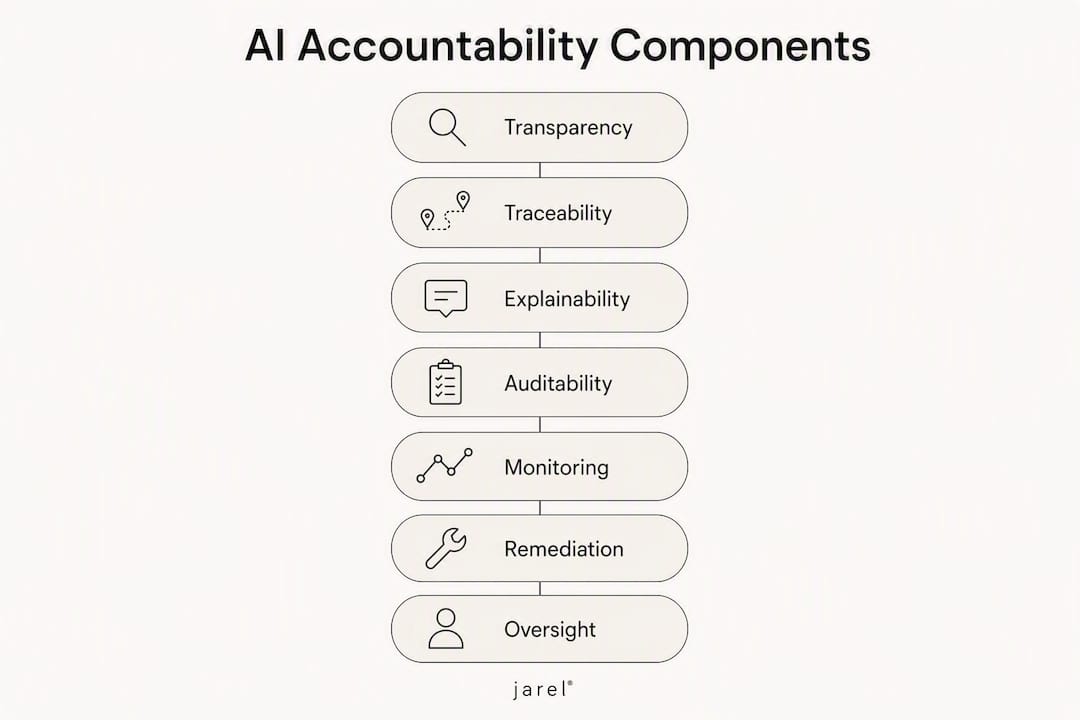
Monitoring is the ongoing practice of watching a deployed model for drift, degradation, or unexpected behavior. A model that performed well on last year's contracts may behave differently toward new regulatory language.
Remediation includes what happens when something goes wrong: a documented process to correct errors, notify affected parties, and update the model or its safeguards.
Human oversight is the governance layer that sits above it all. A person with the necessary authority must be able to intervene, override, or shut down a model. Automated pipelines without a human checkpoint are an accountability gap, not an efficiency gain.
An important distinction is that model-level accountability covers what the foundation model does, while application-level accountability covers what an implementer does with it. A foundation model may be well-documented and tested, but an implementer's prompt engineering, grounding data, or integration choices can introduce entirely new risks that the original model card never accounted for. Both layers need governance.
Why AI model accountability matters: the harms when it fails
Accountability failures are not theoretical. They appear in courtrooms, regulatory cases, and front-page stories.
- Discriminatory outputs: Models trained on historical data with bias can reproduce and amplify that bias in hiring, lending, and legal risk assessment. Without documentation of training data and bias testing, there is no way to detect or correct this.
- Hallucinations in legal advice: Generative models can produce confident, plausible, and completely fabricated citations. AI hallucinations in legal contexts have already led to sanctions against lawyers who submitted AI-generated pleadings without verification.
- Personal data exposure: Models trained on or processing sensitive client data can leak that data through outputs, fine-tuning artifacts, or inadequate access controls. More than 90% of organizational comments in NTIA's AI accountability process highlighted data protection as a central concern.
- Safety failures: In regulated industries, an AI system that provides incorrect guidance on a compliance deadline or misreads a contract clause can trigger real legal and financial consequences.
- Business continuity consequences: When a model is updated without notice and its outputs change, legal teams that rely on it face sudden workflow failures without a documented rollback option.
The Federal Trade Commission has clearly signaled that deceptive or unfair AI practices fall within its existing powers. Litigation risk follows from accountability gaps: If you cannot show what a model did, why it did it, and who approved it, your exposure under discovery is significant. The AI risk profile for legal practice is not abstract; it is already creating real cases.
Who can be held accountable: stakeholders and shared responsibility
Accountability in AI is not one person's job. Microsoft's shared responsibility guidance distributes obligations across platform, application, and usage layers, and the distribution changes depending on whether you use a SaaS product, a PaaS environment, or build on raw infrastructure.
This is how responsibility typically distributes through the lifecycle:
- Model developers are responsible for the quality of training data, architecture choices, bias testing, and the accuracy of the model card. Their obligations are greatest in the design and training phases.
- Implementers (product owners, legal ops teams, vendors) take over responsibility for how the model is integrated, which prompts or grounding data are added, which safeguards are in place, and how the system is monitored after launch. It is their job to manage application-level risks.
- Users have responsibility for how they apply outputs. A lawyer who submits an AI-generated pleading without review has not transferred responsibility to the model; professional responsibility rules still apply.
- Third-party auditors provide independent verification that the system behaves as documented. Their role is to close the gap between the vendor's own reports and actual performance.
- Regulators and governance bodies set the consequences that give accountability teeth: enforcement actions, fines, and liability exposure.
A RACI model breakdown helps clarify this in practice. In the design phase, developers are responsible for execution and overall accountability; implementers are consulted. At implementation, implementers become responsible for execution and overall accountability; users are informed. In monitoring and remediation, implementers and users share responsibility for execution, while governance bodies have overall accountability for enforcement.
Accountability diffusion is a recognized failure mode: When responsibility is spread across too many tools, teams, and vendors, no single actor feels fully accountable. The solution is explicit documentation of who owns what at each stage – not a general commitment to “responsible AI”.
Concrete mechanisms and practices that demonstrate accountability
Documentation is the difference between claimed accountability and documented accountability. NTIA recommends disclosure of model architecture, training data, performance limitations, and test results in forms that fit the intended audience. This is what it looks like in practice:
- Evaluation reports: — Structured results from benchmark tests, including performance in edge cases and among underrepresented populations.
- Red teaming results: Reports from adversarial testing, where testers actively try to break the model or elicit harmful output. Google's AI Responsibility Lifecycle regards red teaming as a core practice both before and after release.
The difference between proactive and reactive accountability should be clarified:
| Dimension | Proactive (ex ante) | Reactive (ex post) |
|---|---|---|
| Purpose | Prevent harm before implementation | Respond to harm after it has occurred |
| Typical artifacts | Model cards, impact assessments, red-team reports | Incident logs, remediation records, audit trails |
| Who owns it | Developers and implementers in the design/test phase | Implementers, legal teams, and governance bodies after incidents |
| Governance value | Reduces litigation and regulatory exposure | Enables credible remediation and continuous improvement |
Pro-tip: Third-party audits and reproducible test records weigh significantly heavier than vendors' own assessments. When evaluating a vendor, specifically ask for results from independent evaluations – not summaries of internal testing. Trust that is earned comes according to NTIA from verifiable evidence, not claims.
The US legal and policy landscape relevant to AI accountability
The US does not yet have one unified federal law on AI accountability, but the policy architecture is extensive and growing.
NIST's AI Risk Management Framework (AI RMF): NIST AI RMF is the foundational technical reference for trustworthy AI in the US. It organizes risk management into four functions (Govern, Map, Measure, Manage) and defines accountability as a core characteristic of trustworthy AI. Organizations that align with AI RMF can demonstrate a structured approach to risk, which is important in procurement, litigation, and regulatory review.

NTIA's AI Accountability Policy Report: NTIA's report presents accountability as an ecosystem built on three inputs: documentation and disclosures, independent evaluation (audits, red teaming), and consequences (liability, regulation). The report explicitly calls for disclosure of model architecture, training data, performance limitations, and test results. It is the clearest US government statement on how accountability documentation should look.
President Biden's AI Executive Order: The AI Executive Order, issued in October 2023, directed federal agencies to develop standards for AI safety and accountability, accelerated NIST's work, and required federal contractors to meet specific thresholds for documentation and testing. Its downstream effect on private-sector procurement standards is still evolving.
FTC's enforcement line: The FTC has established that existing consumer protection powers cover deceptive AI practices. Unfair or deceptive claims about AI capabilities, unexplained negative decisions affecting consumers, and privacy breaches through AI systems all fall within the agency's reach. This is not hypothetical; the FTC has already acted in adjacent areas.
State-level activity: Colorado, Illinois, and California have each advanced AI-specific legislation targeting high-risk automated decision-making with disclosure and impact assessment requirements that reflect NTIA's documentation recommendations. Transparency obligations under US frameworks are evolving rapidly at the state level.
For high-risk uses, including legal advice, healthcare, and financial services, the compliance picture is jurisdiction-specific. Consult qualified legal advice before implementing AI in these contexts.
How to evaluate a model, vendor, or internal team for accountability
Use this checklist in RFPs, procurement reviews, or internal implementation approvals. Adjust the required documentation depth according to the risk level of the use case.
- Ask for the model card — Request the current version, including description of training data, known limitations, and intended use cases. A vendor that cannot produce one is a warning sign.
For low-risk uses (internal writing assistance with human review) a model card and a basic incident log are a reasonable minimum. For medium-risk uses (contract review with some autonomous flagging) you should add red-team reports and a third-party audit. For high-risk uses (regulatory filings, legal advice, decisions affecting rights) you should require the full set: independent evaluation, reproducible tests, impact assessment, and contractual SLAs for remediation.
What AI model accountability specifically means for legal teams
Legal professionals encounter a sharper version of this question than most. Professional responsibility rules, specifically the competence duty in ABA Model Rule 1.1 and the supervisory duties in Rules 5.1 and 5.3, already require lawyers to understand the tools they use and supervise the work product the tools produce. AI accountability artifacts are not just governance documents; they are evidence of professional due diligence.
This is how accountability ties to specific legal workflows:
- Contract review: — A source-cited model that cites the specific clause or precedent behind each flag gives the reviewing lawyer a verifiable basis for their assessment. A model that flags without source citation requires the lawyer to independently verify every output, which undermines the efficiency argument.
- Legal research: Provenance documentation for a research model should show which databases it is trained on, how recently they are updated, and which jurisdictions are well represented versus sparsely covered. Hallucinated citations are a known risk; AI-generated legal summaries require the same verification discipline as any other secondary source.
Professional responsibility in AI-based legal research is an area where bar associations are actively issuing guidance. Several state bars have issued formal opinions requiring that clients be informed when AI is used in substantive work. Accountability artifacts, specifically model cards, change logs, and source citations, are the practical tools that support these disclosure obligations.
The evidence legal teams should prioritize: source-cited outputs (not just answers), access controls that record who reviewed what, checkpoints that document human approval, and a vendor's willingness to produce results from independent audits on request.
Key takeaways
AI model accountability is an evidence-based practice that covers the entire lifecycle: The organizations that can produce model cards, audit logs, and reports from independent evaluations are the ones that have actually built accountability.
| Point | Details |
|---|---|
| Basic definition | Accountability means that someone can be identified and questioned about AI behavior at every stage of the lifecycle. |
| Shared responsibility | Developers, implementers, and users each have their obligations; no single party owns it all. |
| Key artifacts that should be required | Model cards, Datasheets for Datasets, red-team reports, audit logs, and impact assessments are the minimum evidence set. |
| US policy anchors | NIST AI RMF and NTIA's AI Accountability Policy Report define the documentation and evaluation standards that matter most. |
| Jarel for legal teams | Jarel delivers source-cited outputs, audit logs, access controls, and checkpoints that directly correspond to the accountability artifacts legal teams should demand of any AI tool. |
Accountability is an operational discipline, not a compliance checkbox
The framing that frustrates me most in this area is treating accountability as something you achieve once and file away. A model card written at launch and never updated is not accountability; it is an outdated document. The organizations that actually manage AI risks well treat accountability the way a good law firm treats case management: continuously, documented, and audit-ready as needed.
The practical consequence is that accountability requires someone to own it operationally – not just approve it at procurement. That means a named person responsible for monitoring, a set review cadence, and a process for updating documentation when the model or its implementation context changes.
One thing you can do today: Add a request for a model card to your standard vendor questionnaire or RFP template. It takes five minutes to add the line, and the answer tells you more about a vendor's approach to accountability than any amount of marketing material. If the vendor sends you a polished one-pager without a limitations section, ask for the red teaming results. The willingness to share unflattering documentation is the real signal.
Proactive accountability, the kind built into design and testing instead of being added after an incident, actually reduces litigation and regulatory exposure. It is not a theoretical benefit; it is the direct consequence of NTIA's accountability ecosystem model, where documentation and independent evaluation lead to consequences. Build the documentation first, then the consequences become manageable.
Jarel gives legal teams a practical accountability foundation
Legal teams that have worked through the accountability checklist above often discover the same gap: The AI tool they are evaluating produces output, but not the verifiable trail that professional responsibility requires.

Jarel is built around this gap. Every output in Jarel is source-cited, meaning the contract clause, statutory provision, or case law behind each finding is cited and available for review. Audit logs record who reviewed what and when. Access controls create a documented chain of custody for sensitive matters. Checkpoints require human approval before output moves further in a workflow. For in-house legal teams reviewing contracts, these features are not add-ons; they are the architecture itself. If you want to see how Jarel's workflow and checkpoint features fit your team's accountability requirements, the product pages walk through each function in detail.
Authoritative sources and suggested further reading
- NIST AI Risk Management Framework: The US foundation for governance of trustworthy AI. Essential reading for product owners and compliance teams building accountability programs.
- NTIA AI Accountability Policy Report: The clearest US government statement on what accountability documentation should contain. Start here for policy context.
- NTIA AI Accountability Overview: A shorter introduction to the NTIA report covering documentation and disclosure expectations. Useful for legal teams briefing leadership.
- Shared Responsibility for AI (Microsoft): Explains how accountability is distributed across SaaS, PaaS, and IaaS deployments. Mandatory reading for procurement teams evaluating vendor contracts.
- Google AI Responsibility Update: Describes red teaming, adversarial testing, and the overall accountability lifecycle. Useful for auditors and product owners.
- Accountability in AI: What it is and how it works (Springer/AI & Society): Peer-reviewed conceptual framework that distinguishes between proactive and reactive accountability. Best for compliance officers and researchers who want the theoretical foundation.
- OECD AI Principles: Accountability: International best-practice principles for accountability, transparency, and oversight. Useful context for teams working across jurisdictions.
- Accountability diffusion in AI (The Decision Lab): Explains why distributed AI systems create accountability gaps and how they can be addressed organizationally.
- Answers to critical questions about AI accountability (Berkeley CMR): Accessible overview of the key accountability questions organizations face today. A good starting point for executives and legal leaders.
Frequently asked questions
What does model accountability mean in AI?
Model accountability means that a specific person or organization can be identified, questioned, and held responsible for an AI model's behavior and output at every stage of its lifecycle. It requires documented evidence such as model cards, audit logs, and test reports – not just a general commitment to responsible AI.
Why is accountability a problem in AI systems?
Accountability in AI is difficult because responsibility is often distributed among developers, implementers, and users, and no single actor controls the entire system. This diffusion means that when something goes wrong, it can actually be unclear who can be held accountable, which is why explicit documentation and role allocation according to the RACI model is necessary.
What is the principle of AI accountability?
The core principle, as formulated by NTIA and OECD, is that AI systems must be governable: someone must be able to explain what the system does, why it does it, and what happens when it fails. This principle requires proactive documentation and independent evaluation – not just reactive incident management.
How does AI accountability apply to legal professionals?
For lawyers, AI accountability is directly linked to professional responsibility duties: Competence requires understanding the tools you use, and supervisory duties require verification of AI-generated work product. Source-cited outputs, audit trails, and model documentation are the practical artifacts that support these obligations.