
Document Privilege Protection: A Legal Pro’s Guide
TL;DR:
- Document privilege protects parties from disclosing certain confidential communications during litigation, primarily through attorney-client privilege and the work-product doctrine. Both protect different types of legal materials and require strict adherence to criteria like confidentiality, purpose, and proper documentation to avoid waiver. Active, careful management and clear labeling are essential to maintain privilege throughout legal proceedings.
Document privilege protection is a legal right that lets a party resist compulsory disclosure of certain confidential communications and materials during litigation. Under U.S. law, privilege functions as an exception to the general rule that courts can demand any relevant evidence. The two main categories are attorney-client privilege and the work-product doctrine, and knowing exactly how each operates is what separates a practitioner who preserves privilege from one who inadvertently waives it.
A few foundational points before going deeper:
- Privilege protects only confidential communications, not merely sensitive ones. Sensitivity alone does not shield a document from disclosure.
- The party asserting privilege carries the burden of proving it applies.
- Attorney-client privilege protects communications made for the purpose of obtaining or providing legal advice.
- The work-product doctrine, governed by Federal Rule of Civil Procedure 26(b)(3)(A), protects documents prepared in anticipation of litigation.
- Privilege can be waived, often inadvertently, and courts are quick to find waiver when the requirements are not clearly met.
- Underlying facts remain discoverable even when the communication conveying them is privileged.
What is document privilege protection and what types exist?
Two doctrines do the heavy lifting in U.S. privilege law: attorney-client privilege and the work-product doctrine. They overlap in some situations but operate under distinct rules, and conflating them is a common mistake.
Attorney-client privilege
Attorney-client privilege protects confidential communications between a lawyer and client made for the purpose of seeking or providing legal advice. The privilege covers written, oral, and electronic communications alike, provided they are kept confidential. Both directions of communication are protected: what the client tells the lawyer and what the lawyer tells the client.
The privilege belongs to the client, not the attorney. That ownership matters procedurally because the client is the one who invokes it and the one who can waive it. An attorney cannot unilaterally surrender the privilege, though the attorney does have an independent duty to protect it. For a deeper look at how this plays out in practice, the attorney-client privilege page on Jarel’s blog covers the current landscape in detail.
Key documents typically covered:
- Legal advice memoranda from counsel to client
- Client communications describing facts for the purpose of obtaining legal guidance
- Attorney notes summarizing client instructions
- Confidential email threads where legal advice is sought or rendered
Work-product doctrine
The work-product doctrine is broader in one important way: it extends beyond attorney-client communications to cover documents prepared in anticipation of litigation, including materials prepared by non-attorneys working under counsel’s direction. A paralegal’s research memo, an investigator’s interview notes, or a litigation timeline assembled by a legal team all qualify, as long as they were created because litigation was on the horizon.
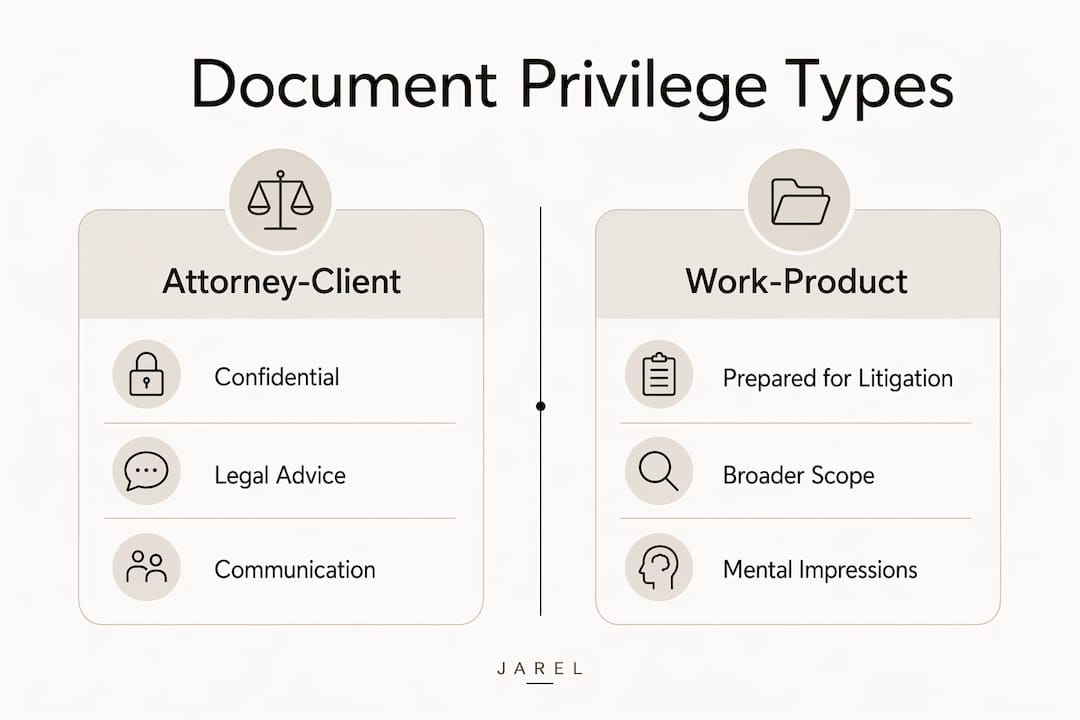
An attorney’s mental impressions, conclusions, opinions, and legal theories receive absolute protection under the doctrine. Other work product gets qualified protection, meaning an opposing party can overcome it by showing substantial need and an inability to obtain the equivalent by other means without undue hardship. That two-tier structure is one of the sharpest distinctions between the two doctrines.
Work-product protection is invoked and waived by the attorney, not the client. Ordinary business documents do not qualify, even if they later become relevant to litigation.
Key documents typically covered:
- Attorney strategy memoranda and litigation plans
- Draft pleadings and motions prepared for anticipated litigation
- Interview notes and investigation summaries created by counsel’s team
- Expert witness draft reports (protected under Rule 26(b)(4)(B))
Litigation privilege
A third, narrower doctrine worth knowing: litigation privilege protects communications made in the course of judicial proceedings from defamation or tort claims. It supports candid participation in the legal process beyond what attorney-client privilege covers, though it does not function as a discovery shield in the same way.
What criteria must a document meet to be privileged?
Courts apply a demanding checklist before recognizing privilege, and they interpret the doctrine narrowly because privilege restricts fact-finding. Meeting most of the criteria is not enough. All of them must be clearly satisfied.
For attorney-client privilege, the requirements are:
- Confidential communication. The communication must have been intended to remain private and must actually have been kept private. Sharing it with a third party outside the common-interest doctrine typically destroys this element.
- Attorney-client relationship. A formal representation relationship must exist between the parties to the communication.
- Primary purpose of legal advice. The dominant reason for the communication must be to seek or provide legal advice, not to discuss business operations or strategy. Courts apply the “primary purpose” test strictly: a communication that mixes legal and business content may lose protection for the entire document.
- Actual confidentiality maintained. Assertions that a communication was intended to be confidential are not enough. Courts look at the circumstances, including how the document was labeled, who received it, and how it was stored.
One nuance that trips up corporate clients: copying an attorney on an email does not automatically make that email privileged. If the attorney is not providing or being asked to provide legal advice, the communication is not protected. Courts analyze purpose over form.
For the work-product doctrine, the threshold question is whether the document was prepared because of the prospect of litigation. Ordinary business documents created in the normal course of operations do not qualify, even if they later become relevant to a lawsuit.
Pro Tip: When a document serves both a legal and a business purpose, the safest practice is to separate the legal advice into a distinct communication clearly labeled as privileged. Mixing the two in one document puts the entire communication at risk.
What privilege does not protect
Privilege protects the communication itself, not the underlying facts. A client cannot shield a fact from discovery simply by mentioning it to an attorney. The opposing party can still depose the client about those facts; they just cannot compel production of the privileged communication in which those facts appeared.
Privilege also does not apply to:
- Communications made to facilitate a crime or fraud (the crime-fraud exception)
- Documents that were never intended to be confidential
- Business advice provided by an attorney acting in a non-legal capacity
- Communications disclosed to unnecessary third parties
How do courts handle waiver and burden of proof?
Waiver is where privilege most often collapses in practice. Courts are eager to find that a party gave up its privilege, and the rules differ depending on which doctrine is at stake.
For attorney-client privilege, disclosure to third parties typically results in waiver. The exception is the common-interest doctrine, which preserves privilege when a communication is shared with a third party who holds a common legal interest, the communication is made in furtherance of that interest, and the privilege has not otherwise been waived. This doctrine applies to work-product protection as well.
Work-product protection has more resilient waiver rules. Disclosure to a third party does not automatically waive it unless the disclosure creates a likelihood that a potential adversary in the anticipated litigation will obtain the materials. That higher threshold reflects the doctrine’s purpose of protecting litigation strategy.
Burden of proof
The party asserting privilege carries the burden of establishing that it applies. In discovery, that means producing a privilege log that identifies each withheld document, the date, the author, the recipients, the general subject matter, and the basis for the privilege claim. A vague or incomplete log is itself grounds for a court to deny the privilege claim.
The procedural sequence under Rule 26(b)(3)(A) works as follows: once the asserting party shows the materials were prepared in anticipation of litigation, the burden shifts to the requesting party to demonstrate substantial need and inability to obtain the equivalent without undue hardship. For absolutely protected opinion work product, that showing is never sufficient.
For a structured overview of the types of privileged documents that typically appear in privilege logs, Jarel’s guide covers the categories practitioners encounter most often.
How to maintain document privilege in daily legal practice
Privilege is fragile. Courts will find waiver when the requirements are not clearly met, and the burden of proving privilege falls on the party asserting it. The practical implication is that maintaining privilege requires active, consistent effort, not just good intentions.
The American Bar Association’s guidance on maintaining privilege distills the core practices:
- Label privileged communications clearly. Written communications seeking or rendering legal advice should be marked “Attorney-Client Communication — Privileged and Confidential.” This is not a magic shield, but it signals intent and helps courts assess confidentiality.
- Limit distribution strictly. Share privileged materials only with personnel who have a genuine need to know for the purpose of conveying or acting on legal advice. Every additional recipient is a potential waiver risk.
- Separate legal advice from business matters. When an attorney is involved in both legal and operational discussions, keep those communications in separate documents. A single email that mixes legal guidance with business strategy invites a court to deny privilege for the whole thing.
- Educate clients proactively. Clients frequently assume that anything shared with their lawyer is automatically protected. Correcting that assumption early prevents the inadvertent disclosures that generate most privilege disputes.
- Treat draft documents carefully. Draft contracts, regulatory filings, and board reports that do not clearly provide legal advice have been held not privileged. When an attorney reviews a draft for legal purposes, that review should be documented separately from the business review.
- Maintain a privilege log from the start of litigation. Waiting until a discovery dispute arises to build the log is a recipe for incomplete documentation and lost privilege.
- Apply the common-interest doctrine deliberately. When sharing privileged materials with co-defendants, joint venture partners, or other parties with aligned legal interests, document the shared interest explicitly before the disclosure.
Pro Tip: Before sending any communication that involves an attorney, ask one question: is the primary purpose of this message to obtain or provide legal advice? If the honest answer is no, do not expect privilege to attach, regardless of who is copied.
Legal teams managing large document sets during discovery can use document security tools to enforce access controls and maintain audit trails, reducing the risk of inadvertent disclosure.

How Jarel supports privilege management
Privilege management at scale requires more than good habits. Jarel’s source-linked workspace gives legal teams the ability to classify documents, apply access controls, and maintain audit logs that track who viewed or edited a privileged file. When a privilege question arises during discovery, that audit trail is exactly what courts want to see. The Jarel Outlook Add-In brings those controls directly into email workflows, where inadvertent disclosure most often happens.

Key Takeaways
Attorney-client privilege and the work-product doctrine are the two primary shields against compulsory disclosure in U.S. litigation, and both require active maintenance to survive discovery.
| Point | Details |
|---|---|
| Privilege requires confidentiality | Sensitivity alone does not protect a document; it must have been kept genuinely confidential. |
| Primary purpose controls | A communication is only privileged if its dominant purpose is legal advice, not business strategy. |
| Waiver is easy to trigger | Disclosure to unnecessary third parties typically waives attorney-client privilege; work-product rules are more forgiving. |
| Burden falls on the asserting party | The party claiming privilege must prove it applies, usually through a detailed privilege log. |
| Underlying facts remain discoverable | Privilege protects the communication itself, not the facts it contains. |
FAQ
How do I know if a document is privileged?
A document is privileged if it is a confidential communication between an attorney and client made for the purpose of legal advice, or a document prepared in anticipation of litigation. Apply the primary purpose test: if the dominant reason for the communication was legal advice, privilege likely applies.
What documents are not privileged?
Documents created for ordinary business purposes, communications shared with unnecessary third parties, and materials where the attorney was not providing legal advice are not privileged. The crime-fraud exception also removes protection from communications made to further illegal activity.
What does it mean when a document is described as privileged?
A privileged document is one that the holder has a legal right to withhold from disclosure in court proceedings. It is exempt from discovery and cannot be introduced as evidence, provided the privilege has been properly asserted and maintained.
How do you make a document privileged?
Privilege is not created by labeling alone. The communication must genuinely meet the legal criteria: it must be confidential, made within an attorney-client relationship, and motivated primarily by the need for legal advice. Clear labeling, restricted distribution, and separation of legal from business content all help establish and preserve privilege, but they do not substitute for meeting the substantive requirements.
Can privilege be lost after it attaches?
Yes. Privilege is waived when the holder voluntarily discloses the protected communication to a third party outside the common-interest doctrine, or when a court finds that the confidentiality requirement was not maintained. Courts apply waiver broadly for attorney-client privilege and somewhat more narrowly for work-product protection.