AI Legal Research Citation Checking: 2026 Guide
TL;DR:
- AI legal citation checking verifies the existence and accuracy of cited sources, with tools like cite.review and CourtListener API supporting systematic review. However, high hallucination rates in AI tools necessitate layered workflows involving automated verification and attorney judgment to prevent fabricated citations. Implementing conservative, traceable, and procedural review practices is essential for maintaining citation integrity and professional responsibility.
AI legal research citation checking is the practice of verifying that every case, statute, and regulation cited in AI-generated legal work actually exists, says what the AI claims, and supports the proposition it is cited for. This is not a precaution for edge cases. Hallucination rates between 17% and 33% across Lexis+ AI, Westlaw AI, and Practical Law AI mean that roughly one in five AI-generated citations in your research memo may be fabricated or materially inaccurate. Tools like cite.review, the CourtListener API, and dave817’s case-verification pipeline now make systematic verification tractable. The industry term for this practice is automated citation verification, and it sits at the intersection of AI in law research and professional responsibility.
Which AI tools provide the best legal citation verification in 2026?
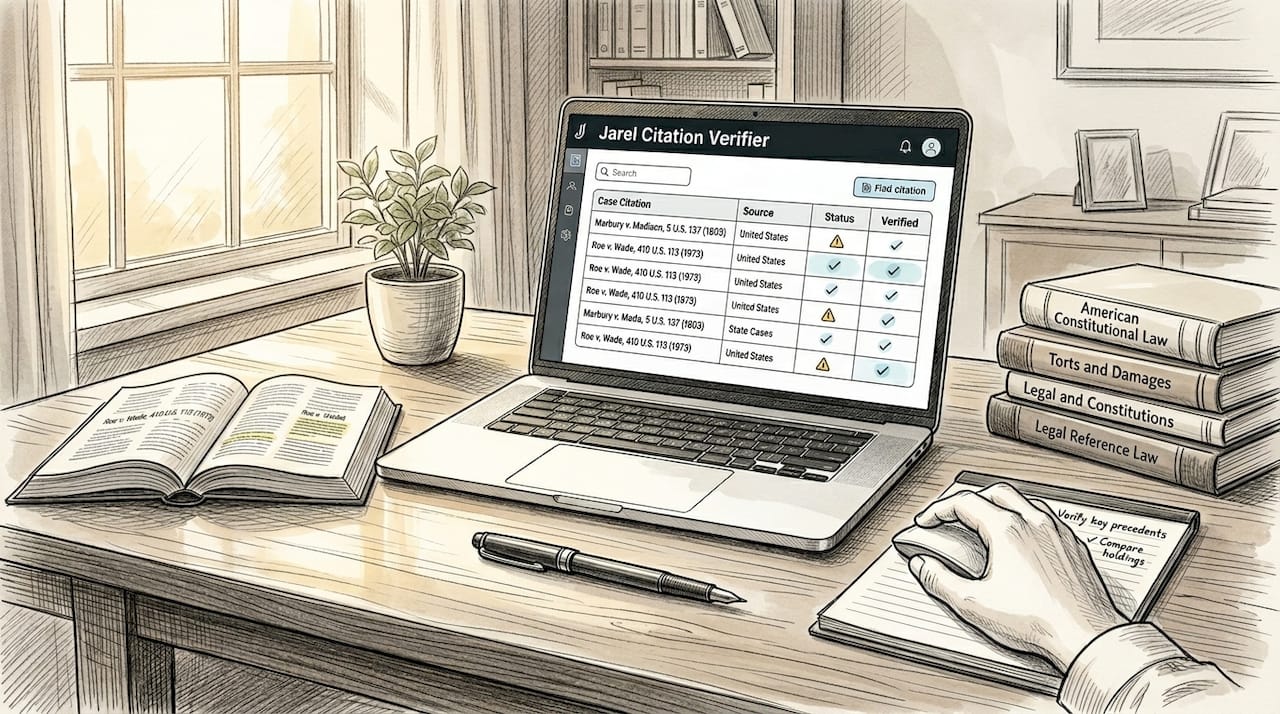
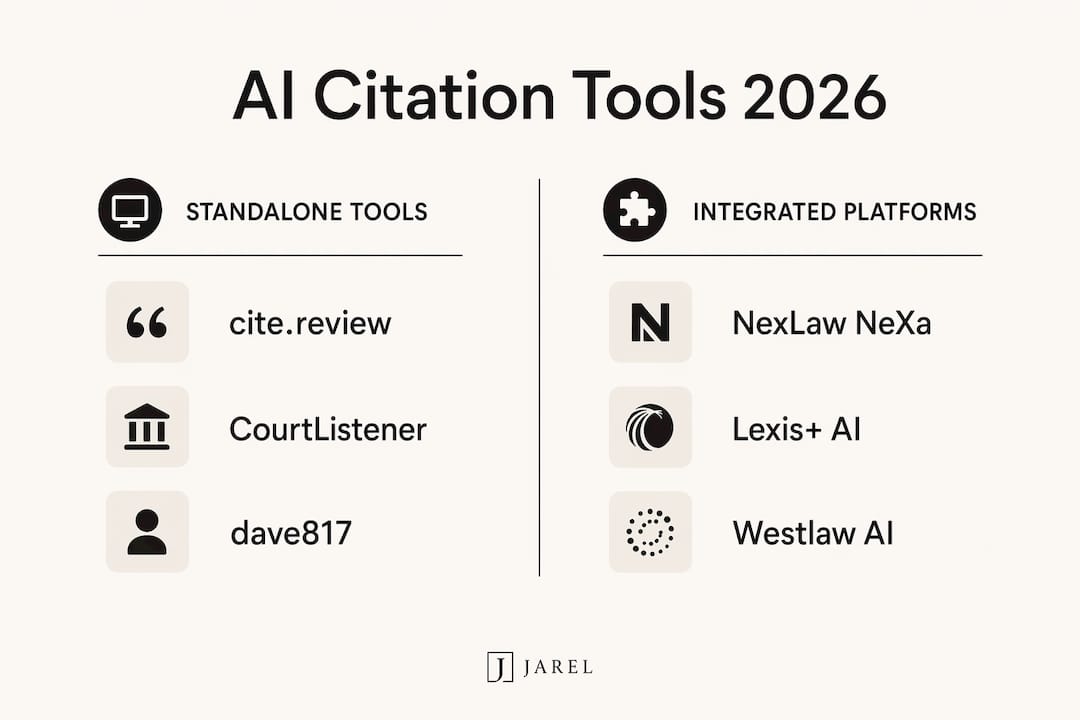
The verification tool market has split into two categories: standalone final-check tools and integrated research-and-verification workflows. Understanding which category a tool belongs to determines where it fits in your process.
cite.review is the most accessible standalone checker for legal professionals. It cross-references citations against multiple authoritative databases and returns one of three verdicts: Verified, Warning, or Not Found. For U.S. case law it queries CourtListener; for federal statutes and the Code of Federal Regulations it queries Cornell LII; for public laws and federal materials it queries GovInfo. The tool is designed to fail conservatively, meaning it returns “Not Found” rather than a false “Verified” when evidence is ambiguous. That design choice matters more than it might appear, and the reasoning is covered in detail in the challenges section below.
The CourtListener citation-lookup API, maintained by Free Law Project, parses citations using the Eyecite library and handles up to 250 citations per request. It returns structured status codes indicating whether a citation resolved to a known opinion. The API is throttled to 60 valid citations per minute, which is sufficient for most document-level checks but requires batching logic for large brief reviews. Its critical limitation: it covers U.S. case law only. Statutes, regulations, and law journal articles fall outside its scope entirely.
dave817’s case-verification is the most technically rigorous open-source option. It performs deterministic citation and quote verification against CourtListener, including star-pagination normalization to handle the formatting variations that cause false matches in simpler tools. It emits multilayer status codes and maintains an evidence ledger so you can trace exactly why a citation passed or failed. This is the right tool when you need to verify not just that a case exists, but that a specific quoted passage appears at the cited page.
Commercial platforms like NexLaw NeXa bundle citation checking inside broader AI research workflows, which reduces friction but limits your control over verification logic.
| Tool | Coverage | Strengths | Limitations |
|---|---|---|---|
| cite.review | Cases, U.S. Code, CFR, GovInfo | Multi-database, conservative design, clear status labels | Open-source, limited commercial support |
| CourtListener API | U.S. case law only | Fast, scalable, 250 citations per request | No statutes, regulations, or journals |
| dave817/case-verification | U.S. case law | Quote and pincite verification, evidence ledger | Requires technical setup |
| NexLaw NeXa | Cases and statutes (varies) | Integrated research workflow | Less transparent verification logic |
Pro Tip: Run CourtListener for bulk case citation checks first, then route any “Not Found” results through cite.review before concluding a citation is fabricated. A result that fails one database may still resolve in another.
How to use AI citation verification tools effectively in legal workflows
Effective AI legal citation analysis requires a structured workflow, not ad hoc spot-checking. The following sequence covers the full verification cycle from raw AI output to a verified citation list.
- Extract and parse all citations. Copy your AI-generated document into a citation parser. Eyecite, which powers CourtListener, handles most standard U.S. citation formats automatically. For non-standard or international citations, manual extraction is still necessary.
- Route by citation type. Different citation formats require different tools for effective verification. Send case citations to CourtListener or dave817’s pipeline. Send U.S. Code and CFR citations to Cornell LII via cite.review. Send public law citations to GovInfo.
- Run existence checks. Submit your parsed citations to the appropriate API or tool. Record every status code. Do not discard “Warning” results. They indicate partial matches that require manual review.
- Verify quotes and pincites. For every citation where you are relying on a specific quoted passage, use dave817’s case-verification to confirm the quote appears at the cited page. AI tools frequently transpose quotes from nearby pages or adjacent cases.
- Flag unresolved citations for manual lookup. Any citation returning “Not Found” after running through both CourtListener and cite.review needs direct lookup in Westlaw, LexisNexis, or the relevant court’s PACER docket before you can conclude it is fabricated.
- Document your verification trail. Record which tool verified each citation, the status returned, and the date of verification. This documentation supports professional responsibility compliance and protects you if a citation is later challenged.
The practical challenges by citation type break down as follows:
- Case law: Best covered by CourtListener and dave817. Older or unreported cases may not appear in CourtListener’s database even if they are real.
- Federal statutes and regulations: cite.review’s Cornell LII and GovInfo routing covers most current federal materials. State statutes require direct database lookup.
- Law journal articles: No free API covers these reliably. Manual verification against Google Scholar, HeinOnline, or JSTOR remains necessary.
- Secondary sources: Treat all AI-cited secondary sources as unverified until you locate the physical or digital source yourself.
Pro Tip: If you are verifying a document with more than 60 citations, batch your CourtListener API requests into groups of 50 to stay within the rate limit and avoid dropped requests that could be misread as failed citations.
Common challenges and errors in AI legal citation checking
AI hallucinations in legal citations are defined as citations to cases, statutes, or passages that do not exist in any authoritative database. They are not typos or formatting errors. They are plausible-sounding fabrications generated by a language model that has no mechanism for confirming a case exists before citing it. Attorneys continue to receive court sanctions for filing documents with AI-hallucinated citations, with documented cases as recently as 2026. The sanctions are not hypothetical. They are career-altering.
The most common errors you will encounter in AI legal citation analysis fall into four categories:
- Fabricated citations: Cases with plausible names, realistic reporters, and believable docket numbers that do not exist. These are the most dangerous because they pass a casual read.
- Misquoted passages: Real cases where the AI has altered the quoted language, sometimes subtly. A single changed word can invert the legal meaning of a holding.
- Wrong pincites: Real cases where the cited page does not contain the proposition the AI attributes to it. The case exists; the support does not.
- Coverage gaps misread as fabrications: CourtListener does not contain every real U.S. case. Older state court opinions, unreported federal decisions, and many administrative rulings are absent. A “Not Found” result is not proof of fabrication.
That last point is where conservative tool design becomes critical. cite.review’s author guidance explicitly recommends that verification tools fail closed rather than return a false positive. A tool that marks an unverifiable citation as “Verified” because it cannot confirm it is fake creates a worse outcome than one that flags it for manual review.
“False citation accusations are the worst failure mode. A verification tool must be conservative: it should never accuse a citation of being fabricated unless it has strong evidence. The right response to uncertainty is ‘Not Found’ or ‘Warning,’ not a verdict either way.” — cite.review author guidance
The distinction between a coverage gap and a fabricated citation requires legal judgment, not just software. If a citation returns “Not Found” in CourtListener but the case name, jurisdiction, and date are internally consistent, check PACER or a commercial database before concluding it is hallucinated.
Best practices for ensuring citation integrity and substantive support
Citation verification covers two distinct tasks: confirming that a cited source exists and is accurately quoted, and confirming that the source actually supports the legal proposition for which it is cited. Automated tools handle the first task well. The second task requires a lawyer.
This distinction matters because an AI tool can verify that Ashcroft v. Iqbal, 556 U.S. 662 (2009) exists and that a quoted passage appears on page 678. It cannot determine whether that passage supports your specific pleading standard argument in the jurisdiction and procedural posture you are working in. That judgment belongs to the attorney of record.
Thomson Reuters’ 2026 Fiduciary-Grade AI standards require that high-stakes professional AI systems provide traceable, authoritative sourcing and support independent review. This standard maps directly onto citation workflows: every AI-generated citation should be traceable to a source document, and that traceability should be documented in a review trail.
The following practices form a defensible citation integrity program:
- Separate your verification workflow into two explicit phases: automated integrity checks first, attorney substantive review second. Never collapse these into a single step.
- Maintain a citation log for every document that records the verification tool used, the status returned, and the reviewing attorney’s sign-off.
- Apply the same verification standard to AI-assisted research as you would to a first-year associate’s work product. The professional responsibility standards have not changed because the tool generating the citations has.
- Train every team member who uses AI research tools on the difference between a “Verified” status from an automated tool and a confirmed, substantively supported citation.
- Review your verification process after every court filing. If a citation was challenged or returned a late-stage warning, trace back to where the workflow failed.
The continued pattern of mis-citations despite widespread awareness of AI hallucination risks points to a process failure, not just a technology failure. Better tools help, but they do not substitute for institutional process controls and clear accountability.
Key takeaways
Reliable AI legal research citation checking requires routing citations by type, using conservative verification tools, and pairing automated integrity checks with attorney review for substantive support.
| Point | Details |
|---|---|
| Hallucination rates are high | Lexis+ AI, Westlaw AI, and Practical Law AI hallucinate between 17% and 33% of citations. |
| Route citations by type | Use CourtListener for cases, Cornell LII for statutes, and GovInfo for federal materials. |
| Conservative tools prevent false positives | cite.review and dave817’s pipeline fail closed, returning “Not Found” rather than a false “Verified.” |
| Automated tools cover integrity, not substance | Attorneys must separately assess whether a verified citation actually supports the cited proposition. |
| Documentation is a professional obligation | Every citation verification should produce a traceable log that supports independent review. |
Why I think most legal teams are solving this problem backwards
Most of the conversation about AI citation errors focuses on the tools, specifically on finding a better checker. That framing misses the actual failure point. The attorneys sanctioned for filing hallucinated citations in 2026 were not using bad verification tools. Most were not using any systematic verification process at all. They trusted the AI output because it looked authoritative, and they filed.
The tools are now good enough. cite.review, CourtListener, and dave817’s pipeline collectively cover the vast majority of U.S. case law verification needs at no cost. The gap is not technological. It is procedural and cultural.
What I have observed working with legal teams integrating AI research tools is that the teams with the fewest citation errors are not the ones with the most sophisticated software. They are the ones that treat AI output the same way they treat a junior associate’s draft: as a starting point that requires review, not a finished product that requires only formatting. That mindset shift is harder to implement than installing a new tool, but it is the change that actually prevents sanctions.
The other thing worth saying plainly: the distinction between citation integrity and substantive support is not a technicality. A citation can be perfectly verified, the case real, the quote accurate, the pincite correct, and still be wrong for your argument. No automated tool catches that. The attorney who signs the brief is the last line of defense, and that responsibility does not transfer to the software.
— Albin
How Jarel supports verifiable legal research workflows
Jarel is built around the principle that every AI-generated output in a legal workflow should be traceable to its source. For legal professionals who need citation checking integrated directly into their drafting environment, the Jarel Word Add-in connects AI-assisted drafting to source-linked citations without requiring a separate verification step outside your document. For teams managing research and correspondence inside Microsoft Outlook, the Jarel Outlook Add-in brings the same source-linked AI workspace into your inbox. Law students building citation verification habits early can access Jarel’s tools at jarel.se/solutions/law-students. Every output includes audit trails and access controls designed to meet the traceability standards that professional responsibility frameworks now require.
FAQ
What is AI legal research citation checking?
AI legal research citation checking is the process of verifying that citations generated by AI legal research tools exist in authoritative databases, are accurately quoted, and support the propositions attributed to them. It combines automated tools like cite.review and the CourtListener API with attorney review for substantive accuracy.
How often do AI legal tools produce hallucinated citations?
Stanford University’s 2024 evaluation found hallucination rates between 17% and 33% across Lexis+ AI, Westlaw AI, and Practical Law AI. This means a document with 20 AI-generated citations may contain three to six fabricated or materially inaccurate references.
Can automated tools verify all citation types?
No. CourtListener covers U.S. case law; Cornell LII and GovInfo cover federal statutes and regulations. Law journal articles and most state secondary sources require manual verification against HeinOnline, Westlaw, or LexisNexis.
What is the difference between citation integrity and substantive support?
Citation integrity means the source exists and is accurately quoted. Substantive support means the source actually backs the legal proposition for which it is cited. Automated tools verify integrity; only an attorney can assess substantive fit.
What happens if a citation returns “Not Found” in CourtListener?
A “Not Found” result means CourtListener does not have a record of that citation. It does not confirm fabrication. Older opinions, unreported decisions, and many state court rulings are absent from CourtListener’s database. Always cross-check against a commercial database or PACER before concluding a citation is hallucinated.