
Researching Jurisdiction-Specific Case Law in 2026
TL;DR:
- Effective jurisdiction-specific case law research involves using jurisdiction-filtered databases, secondary sources, and citator validation to identify controlling authority within a defined legal forum. Following a structured workflow that begins with framing the legal issue and mapping the court hierarchy prevents relying on persuasive rather than binding cases. Employing advanced search techniques and verifying case authority through citators ensures accurate and efficient legal research tailored to specific jurisdictions.
Researching jurisdiction-specific case law is the targeted process of isolating binding judicial decisions within a defined legal forum to confirm controlling authority for your case or analysis. Jurisdiction determines which court decisions actually bind a tribunal, making broad multi-jurisdiction searches a reliable path to wasted time and misleading results. Platforms like Westlaw, Lexis, CanLII, and BAILII each offer jurisdiction-scoped filters that transform this discovery problem into a manageable workflow. This guide covers the right database selection, structured search execution, and citator validation to give you a repeatable system for accurate case law research methods in 2026.
What tools are essential for researching jurisdiction-specific case law?
The right database is not the one with the most cases. It is the one with the most precise jurisdiction coverage for your forum. Jurisdiction-scoped databases solve the discovery problem directly by organizing case law around court hierarchy and geographic boundaries rather than forcing you to filter a global index.

Westlaw and Lexis remain the dominant subscription platforms for U.S. federal and state case law. Both offer jurisdiction-specific filters at the search level, allowing you to restrict results to a single state, circuit, or court tier. For Canadian practitioners, CanLII provides free access to federal and provincial decisions organized by jurisdiction, making it the first stop for Canadian case law analysis techniques. AustLII and BAILII serve equivalent roles for Australian and British Commonwealth jurisdictions respectively.
Secondary sources deserve more credit than most practitioners give them. A well-targeted law review article or a treatise section on your specific legal issue will surface the leading cases in the relevant jurisdiction before you run a single primary search. Secondary sources generate citations to primary authority, saving you from building a case list from scratch.
| Tool | Jurisdiction coverage | Key feature |
|---|---|---|
| Westlaw | U.S. federal and all 50 states | KeyCite citator, headnote classification |
| Lexis | U.S. federal, state, and international | Shepard’s citator, topic browsing |
| CanLII | Canadian federal and provincial | Free access, jurisdiction browsing |
| AustLII | Australian federal and state | Free access, full-text search |
| BAILII | UK and Irish courts | Free access, court-level filtering |
Pro Tip: Always scope your search to the target jurisdiction’s database before running a broad all-jurisdiction query. A jurisdiction-filtered search on Westlaw or Lexis returns fewer but far more relevant results, cutting review time significantly.
How to plan and structure your research effectively
Effective case law research methods start with a clearly framed legal issue, not a keyword list. Before you open a database, write out the legal question in one sentence and identify the controlling jurisdiction. That single step eliminates the most common source of research drift: searching for interesting cases rather than binding ones.
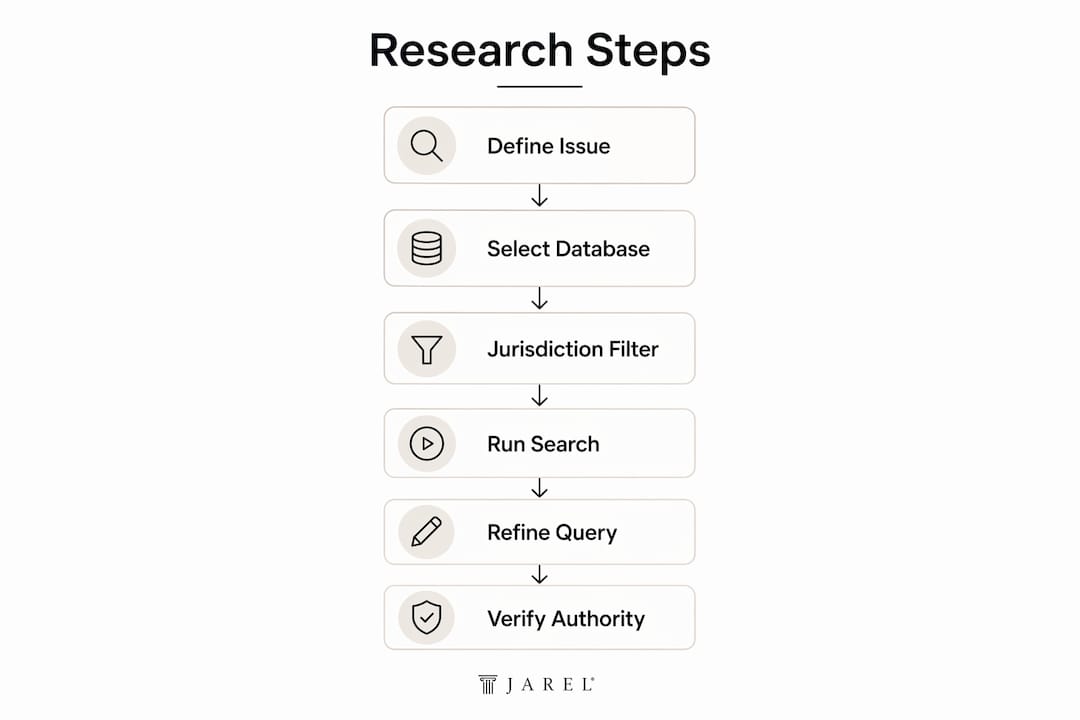
The University of Michigan Law Library outlines a five-stage workflow that legal professionals consistently apply to jurisdiction-specific research. This sequence prevents the common mistake of jumping straight into primary sources before understanding the legal terrain.
Follow this sequence for every jurisdiction-specific research project:
- Define the legal issue and controlling jurisdiction. Identify the court that will hear the matter and map the binding authority hierarchy for that forum.
- Generate search terms. List the legal concepts, statutory terms, and factual descriptors relevant to your issue. Include synonyms courts actually use in opinions.
- Consult secondary sources first. Use treatises, law review articles, and practice guides to locate leading cases and confirm your issue framing before touching primary databases.
- Search primary jurisdiction databases. Run targeted searches in Westlaw, Lexis, or the relevant free database using your refined terms and jurisdiction filters.
- Update and validate with citators. Run every case through Shepard’s or KeyCite before relying on it. A case that has been overruled in your jurisdiction is worse than no case at all.
- Analyze and organize results. Group cases by sub-issue, note the court level, and flag any circuit splits or conflicting state authority.
This sequence reflects how to find case law efficiently rather than exhaustively. Researchers who skip step three routinely miss the controlling case because it was cited in a treatise but never surfaced in their keyword search.
What advanced search strategies improve case law retrieval?
Starting broad is a deliberate tactic, not a sign of poor preparation. UCLA Law Library advises beginning with a wide keyword or topic search to map the case landscape, then tightening the query using Boolean connectors and jurisdiction filters to isolate the most relevant decisions. This two-pass approach prevents the tunnel vision that comes from starting with an overly specific query.
Boolean connectors give you precise control over how search terms relate to each other. The connector “AND” requires both terms to appear; “OR” broadens to either; “W/n” (within n words) captures terms used in close proximity, which is how courts actually write about legal standards. Phrase searching with quotation marks locks in exact statutory language or legal tests that courts repeat verbatim.
Jurisdiction and court-level filters are the most underused features in Westlaw and Lexis. Setting a filter to a specific circuit or state court before running a search removes the need to manually exclude irrelevant results afterward. Advanced database fields like party name, headnote classification, and jurisdiction field searching allow precision that full-text search alone cannot match. A headnote search in Westlaw’s Key Number System, for example, retrieves cases classified under a specific legal point regardless of the exact words used in the opinion.
After reviewing your first set of results, adjust. If the results are too narrow, broaden the connector or add synonyms. If they are too broad, add a limiting term or tighten the jurisdiction filter to a specific court level.
Pro Tip: Run a full-text search in addition to headnote or topic searches. Some jurisdiction-specific cases are not well-indexed under standard headnotes but contain the exact statutory phrase or legal standard you need buried in the opinion text.
How to verify jurisdiction-specific case law authority using citators
A case that has been overruled, distinguished, or limited by a court in your jurisdiction is not good law, regardless of how well it supports your argument. Citators are the mechanism for confirming that a case still carries the authority you are relying on.
Shepard’s on Lexis and KeyCite on Westlaw both assign status signals to cases. A red flag in KeyCite or a red stop sign in Shepard’s signals that the case has been overruled or has significant negative treatment. Yellow signals indicate caution: the case may have been distinguished or criticized. These signals are a starting point, not a conclusion.
Negative citing references from courts that bind your forum carry the most weight. A criticism from a court in a different circuit is relevant but not controlling. A partial overruling from the same state supreme court may affect only one holding while leaving others intact. Reading the actual citing opinion is the only way to determine whether the negative treatment affects the specific point you are relying on.
| Citator signal | Meaning | Required action |
|---|---|---|
| Red flag / Red stop | Overruled or reversed | Do not cite; find replacement authority |
| Yellow flag / Yellow triangle | Distinguished or criticized | Read citing opinion; assess impact on your point |
| Blue “H” (KeyCite) | History only | Review procedural history for relevance |
| Green “C” (KeyCite) | Cited without negative treatment | Confirm citing courts are within your jurisdiction |
| Shepard’s “Followed” signal | Positively adopted by another court | Use to strengthen persuasive authority |
Manual interpretation of citator signals combined with an understanding of court hierarchy is what separates accurate case authority assessment from mechanical checking. Citators model citation relationships, not binding authority relationships. You must apply the court hierarchy yourself.
What pitfalls and best practices matter most in jurisdiction-specific research?
The most expensive mistake in jurisdiction-specific case law research is treating a persuasive authority as binding. A well-reasoned Ninth Circuit opinion does not bind a Texas state court. Researchers who skip jurisdiction mapping at the outset routinely build arguments on authority that opposing counsel can dismiss in a single sentence.
Statute-first research is the most effective entry point when your issue involves a statutory scheme. Identify the controlling statute, then use citator tools and database searches to find cases interpreting that specific provision within your jurisdiction. This pathway produces more targeted results than starting with a general case search because courts organize their analysis around statutory text.
Key practices to follow and mistakes to avoid:
- Do scope every search to the controlling jurisdiction before expanding to persuasive authority.
- Do run citator checks on every case before including it in a brief or memo.
- Do update your research within 48 hours of filing to catch recent decisions.
- Do use secondary sources to frame the issue before searching primary databases.
- Don’t rely on a single database for comprehensive jurisdiction coverage. CanLII, for example, may lack full-text API access for large-scale research, requiring workflow adaptations.
- Don’t treat a yellow citator flag as a green light without reading the citing opinion.
- Don’t ignore court-level distinctions within a jurisdiction. A trial court decision in the same state is not binding on an appellate court.
Pro Tip: When researching a statutory issue, search the statute’s citation directly in Westlaw or Lexis to retrieve all cases that have cited that provision within your jurisdiction. This is faster and more precise than building a keyword search from scratch.
Understanding case law effectively also means recognizing when you have reached saturation: the point where new searches return the same cases you have already reviewed. That is the signal to move to citator analysis and synthesis rather than continuing to search.
Key takeaways
Jurisdiction-specific case law research requires a structured sequence of database selection, jurisdiction-filtered searching, and citator validation to produce reliable, binding authority.
| Point | Details |
|---|---|
| Start with jurisdiction-scoped databases | Use Westlaw, Lexis, CanLII, or AustLII filtered to your forum before running broad searches. |
| Use secondary sources to locate primary authority | Treatises and law reviews surface leading jurisdiction-specific cases faster than keyword searches alone. |
| Apply Boolean and field-level search techniques | Connectors, phrase controls, and headnote fields improve precision beyond basic full-text queries. |
| Validate every case with Shepard’s or KeyCite | Read the actual citing opinion for any negative signal from a court binding in your jurisdiction. |
| Follow a statute-first pathway for statutory issues | Searching by statute citation retrieves jurisdiction-specific interpretive cases more efficiently than topic searches. |
Why jurisdiction deserves more than a dropdown filter
Practitioners often treat jurisdiction as a checkbox: select the state, run the search, move on. That approach misses the structural complexity that makes jurisdiction-specific research genuinely difficult. Jurisdiction is not just geography. It is court hierarchy, issue type, and the distinction between binding and persuasive authority operating simultaneously.
I have seen experienced researchers cite a well-reasoned federal district court opinion in a state court brief without checking whether the state appellate courts had addressed the same issue. The district court opinion was persuasive at best. The state court had actually ruled the opposite way three years earlier. A citator check and a jurisdiction-aware search would have caught it in ten minutes.
Free resources like CanLII are gaining real traction in professional workflows, not just academic ones. Their jurisdiction-browsing architecture is often more intuitive than the filter interfaces on subscription platforms. The limitation is depth: full-text API access and advanced connector searching remain stronger on Westlaw and Lexis for complex queries.
The trend toward legal research automation is real, but automation does not replace the judgment required to assess binding authority. Tools that surface cases faster are only valuable if the researcher can evaluate what those cases actually mean for the specific forum. The workflow I trust combines database precision, citator discipline, and manual reading of any case with negative treatment. That combination has not been automated yet.
— Albin
Strengthen your case law research with Jarel
Legal professionals who need source-linked, jurisdiction-aware research support can use Jarel’s legal research platform to connect AI-generated outputs directly to the underlying cases, statutes, and secondary sources that support them. Every result in Jarel carries a traceable citation, so you can verify authority without rebuilding the research chain from scratch.

Jarel also supports contract review workflows through its Playbooks feature, which applies jurisdiction-aware review rules to contracts and flags provisions that require case law validation. For legal teams managing high-volume research and document review, Jarel’s audit logs and access controls keep every research output accountable and privilege-protected. It is built for the precision that jurisdiction-specific legal work demands.
FAQ
What is jurisdiction-specific case law research?
Jurisdiction-specific case law research is the process of locating judicial decisions that are binding or persuasive within a defined legal forum, such as a specific state, circuit, or country. The goal is to identify controlling authority rather than simply finding cases that discuss a relevant legal issue.
How do I find case law for a specific jurisdiction?
Start with a database that organizes case law by jurisdiction, such as Westlaw or Lexis for U.S. courts, CanLII for Canadian courts, or AustLII for Australian courts. Apply jurisdiction and court-level filters before running your search to limit results to binding authority.
What is the role of citators in jurisdiction-specific research?
Citators like Shepard’s and KeyCite confirm whether a case is still good law by showing how subsequent courts have treated it. Negative signals from courts binding in your jurisdiction require you to read the citing opinion before relying on the original case.
When should I use secondary sources in case law research?
Secondary sources should be consulted before primary database searches. Treatises, law review articles, and practice guides identify the leading cases in a jurisdiction and frame the legal issue accurately, reducing the time spent on unfocused keyword searches.
What is the most common mistake in jurisdiction-specific case law research?
The most common mistake is relying on persuasive authority from another jurisdiction without confirming that the controlling jurisdiction has not already addressed the issue differently. Always map the court hierarchy and run a jurisdiction-filtered search before treating any case as binding.